Touch and changeToca y cambia
Move, type, tap, or drag in the model. Watch what changes.Mueve, escribe, toca o arrastra en el modelo. Observa qué cambia.
Unit 10 · MPP.4
Math is Ingenuity · Lesson 10-4
English: Use the pictures and short steps. Ask questions; let your student do the thinking. Español: Usen los dibujos y los pasos cortos. Hagan preguntas; dejen que su estudiante piense.
Tonight we use ratios to explain how bicycle gears work — why one turn of the pedals can spin the wheel more than once.
Esta noche usamos razones para explicar cómo funcionan los engranajes de una bicicleta: por qué una vuelta de los pedales puede girar la rueda más de una vez.
Follow the picture pathSigan la ruta visual
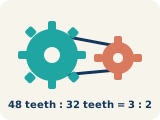
Real example: the pedal gear has 48 teeth and the rear wheel gear has 32 teeth.
Ejemplo real: el engranaje del pedal tiene 48 dientes y el de la rueda trasera tiene 32.
One full turn of the pedals pulls 48 teeth of chain.
Una vuelta completa de los pedales jala 48 dientes de cadena.
The rear gear needs 32 teeth for one full turn, so divide: 48 ÷ 32 = 1.5.
El engranaje trasero necesita 32 dientes para una vuelta completa, así que divide: 48 ÷ 32 = 1.5.
The rear wheel turns 1.5 times for every 1 pedal turn — the ratio 48 : 32 is the same as 3 : 2.
La rueda trasera gira 1.5 veces por cada vuelta del pedal: la razón 48 : 32 equivale a 3 : 2.
Listen for "ratio" (razón) and "equivalent ratios" (razones equivalentes) — 48 : 32 and 3 : 2 mean the same thing.
Escucha "razón" y "razones equivalentes": 48 : 32 y 3 : 2 significan lo mismo.
The old Penny Farthing solved the same problem with one giant wheel instead of gears.
La antigua bicicleta Penny Farthing resolvía el mismo problema con una rueda gigante en vez de engranajes.
Simplify a ratio by dividing both numbers by the same amount: 48 ÷ 16 = 3, 32 ÷ 16 = 2.
Simplifiquen una razón dividiendo ambos números entre la misma cantidad: 48 ÷ 16 = 3, 32 ÷ 16 = 2.
Use the same interactive model from the lesson. Change it, notice the pattern, and explain what the model shows.Usa el mismo modelo interactivo de la lección. Cámbialo, observa el patrón y explica lo que muestra.
Move, type, tap, or drag in the model. Watch what changes.Mueve, escribe, toca o arrastra en el modelo. Observa qué cambia.
Record one equation, value, or relationship you can see.Escribe una ecuación, un valor o una relación que puedas ver.
I notice ___ changes when ___ changes. This shows ___.Noto que ___ cambia cuando ___ cambia. Esto muestra ___.
Gear Ratios, Circumference & Mechanical Advantage. Formula: Distance = Rotations × Circumference | Gear Ratio = Teeth_Driver / Teeth_Driven. 1. Circumference is the distance traveled in one full wheel rotation. 2. Gear ratios determine speed and rotational force (torque). 3. Apply proportional reasoning to calculate travel distance and mechanical advantage
A quick, no-timer review game for tonight's lesson — sort, match, and choose. A wrong answer just gives a hint and lets your student try again. Un juego de repaso sin reloj para la lección de hoy — clasificar, emparejar y elegir. Si se equivocan, reciben una pista y pueden intentar de nuevo.
↗ Play full screen ↗ Jugar en pantalla completa
Tap a card to flip. Use these words when you talk about the math together. Toquen una tarjeta para voltearla. Usen estas palabras cuando hablen de la matemática juntos.

ingenio
Coming up with different, and sometimes unique, solutions to problems.
Idear soluciones diferentes, y a veces únicas, a los problemas.
📌 The Penny Farthing's huge wheel, then chains and gears — two clever fixes.
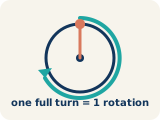
rotación
One full turn of a wheel, gear, or pedal all the way around.
Una vuelta completa de una rueda, un engranaje o un pedal.
📌 One full turn of the pedal — 360° all the way around.
engranaje
A toothed wheel that passes motion to another toothed wheel through a chain.
Una rueda con dientes que transmite el movimiento a otra rueda con dientes por medio de una cadena.
📌 A 48-tooth pedal gear pulling a 12-tooth wheel gear through the chain.
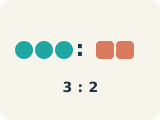
razón
A comparison of two quantities, like pedal rotations to wheel rotations.
Una comparación de dos cantidades, como rotaciones del pedal y rotaciones de la rueda.
📌 48 pedal teeth to 12 wheel teeth — 4 wheel turns for every pedal turn.
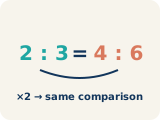
razones equivalentes
Ratios that make the same comparison using different numbers.
Razones que hacen la misma comparación con números diferentes.
📌 1 : 4 and 3 : 12 describe the same gear, at different sizes.
A bike has a 44-tooth pedal gear and a 22-tooth rear gear.
Una bicicleta tiene un engranaje de pedal de 44 dientes y uno trasero de 22.
Work side by side. You ask questions; your student does the thinking. Trabajen juntos. Tú haces preguntas; tu estudiante piensa.
Write the gear ratio.
Escriban la razón de engranajes.
Simplify it.
Simplifíquenla.
Say what it means for riding.
Digan qué significa al andar en bicicleta.
Do these together. Start at ★ and climb to ★★★ when ready. Háganlos juntos. Empiecen en ★ y suban a ★★★ cuando estén listos.
On the Penny Farthing, what is the ratio of pedal rotations to front-wheel rotations?
A. 1 to 1
How far does the Penny Farthing travel with each pedal rotation?
A. The length of the perimeter of the front wheel
The pedal gear turns 48 teeth per rotation. The largest rear gear needs 32 teeth for one full rotation. How many rotations does the rear wheel make for each pedal rotation?
A. 1.5 rotations
The smallest rear gear has 12 teeth. How many rotations will the rear wheel make for each rotation of the 48-tooth pedal gear?
A. 4 rotations
The rider makes 3 full pedal rotations with the chain on the 32-tooth gear. How many rotations does the rear wheel make?
A. 4.5 rotations
⏱️ Plan on about 15–20 minutes for the 6 problems below. The extra practice at the bottom is optional. ⏱️ Calculen unos 15–20 minutos para los 6 problemas de abajo. La práctica extra al final es opcional.
A few problems to practice together. Each one has a step-by-step guide, a picture to draw on, and a space to show your work. Use Check This Problem for instant feedback — no need to finish everything at once. Unos problemas para practicar juntos. Cada uno tiene una guía paso a paso, un dibujo para trabajar y un espacio para mostrar el trabajo. Usen Revisar esta pregunta para retroalimentación al instante — no tienen que terminar todo de una vez.
Easier problems to practice the idea. Do these first together. Problemas más fáciles para practicar la idea. Hagan estos primero juntos.
The pedal gear turns 48 teeth per rotation. The largest rear gear needs 32 teeth for one full rotation. How many rotations does the rear wheel make for each pedal rotation?El engranaje del pedal mueve 48 dientes por rotación. El engranaje trasero más grande necesita 32 dientes para una rotación completa. ¿Cuántas rotaciones da la rueda trasera por cada rotación del pedal?
👪 Read the question together, then let your student pick an answer before you discuss why.👪 Lean la pregunta juntos; dejen que su estudiante elija antes de hablar del porqué.
Cuando la cadena está en el engranaje más grande, la rueda trasera da 1.5 rotaciones por rotación del pedal; en el más pequeño da 4. ¿Qué notas sobre el tamaño de los engranajes y la distancia que recorre la bicicleta?
👪 A complete sentence with math vocabulary is the goal — not a perfect paragraph.👪 Una oración completa con vocabulario matemático es la meta — no un párrafo perfecto.
The smallest rear gear has 12 teeth. How many rotations will the rear wheel make for each rotation of the 48-tooth pedal gear?El engranaje trasero más pequeño tiene 12 dientes. ¿Cuántas rotaciones dará la rueda trasera por cada rotación del engranaje de pedal de 48 dientes?
👪 Read the question together, then let your student pick an answer before you discuss why.👪 Lean la pregunta juntos; dejen que su estudiante elija antes de hablar del porqué.
Try these once the warm-up feels easy. It's okay to use the steps and pictures. Intenten estos cuando el calentamiento sea fácil. Está bien usar los pasos y los dibujos.
¿Cómo sería distinta la distancia recorrida con una rueda delantera más pequeña en la Penny Farthing? Usa la razón de 1 a 1 del pedal en tu respuesta.
👪 A complete sentence with math vocabulary is the goal — not a perfect paragraph.👪 Una oración completa con vocabulario matemático es la meta — no un párrafo perfecto.
The rider makes 3 full pedal rotations with the chain on the 32-tooth gear. How many rotations does the rear wheel make?El ciclista da 3 rotaciones completas del pedal con la cadena en el engranaje de 32 dientes. ¿Cuántas rotaciones da la rueda trasera?
👪 Read the question together, then let your student pick an answer before you discuss why.👪 Lean la pregunta juntos; dejen que su estudiante elija antes de hablar del porqué.
A designer adds a middle gear so the rear wheel makes exactly 2 rotations per rotation of the 48-tooth pedal gear. How many teeth must the new gear have?Un diseñador agrega un engranaje intermedio para que la rueda trasera dé exactamente 2 rotaciones por cada rotación del engranaje de pedal de 48 dientes. ¿Cuántos dientes debe tener el engranaje nuevo?
👪 Read the question together, then let your student pick an answer before you discuss why.👪 Lean la pregunta juntos; dejen que su estudiante elija antes de hablar del porqué.
Optional. Only if your student wants more — these are bonus problems. Opcional. Solo si tu estudiante quiere más — son problemas adicionales.
How far does the Penny Farthing travel with each pedal rotation?¿Qué distancia recorre la bicicleta Penny Farthing con cada rotación del pedal?
👪 Read the question together, then let your student pick an answer before you discuss why.👪 Lean la pregunta juntos; dejen que su estudiante elija antes de hablar del porqué.
Why was the front wheel of the Penny Farthing so large?¿Por qué la rueda delantera de la Penny Farthing era tan grande?
👪 Read the question together, then let your student pick an answer before you discuss why.👪 Lean la pregunta juntos; dejen que su estudiante elija antes de hablar del porqué.
Sort each rear gear by how the wheel responds to one pedal turn.Clasifica cada engranaje trasero según cómo responde la rueda a un pedaleo.
👪 On a phone, use Move to. On a computer, drag cards or tap a card then tap a column.👪 En el teléfono usen Mover a. En la computadora arrastren o toquen tarjeta y columna.
💡 Gear ratio = driver teeth ÷ driven teeth = 48 ÷ rear teeth.Razón de engranajes = dientes del conductor ÷ dientes del conducido = 48 ÷ dientes traseros.
💡 A rear gear SMALLER than 48 teeth spins the wheel faster than the pedals.Un engranaje trasero MENOR de 48 dientes hace girar la rueda más rápido que los pedales.
You are about to ride up a steep hill. Which rear gear should the chain be on, and why?Estás a punto de subir una cuesta empinada. ¿En cuál engranaje trasero debe estar la cadena, y por qué?
👪 Read the question together, then let your student pick an answer before you discuss why.👪 Lean la pregunta juntos; dejen que su estudiante elija antes de hablar del porqué.
With the chain on the 12-tooth gear, the rider makes 10 pedal rotations. How many rotations does the rear wheel make?Con la cadena en el engranaje de 12 dientes, el ciclista da 10 rotaciones del pedal. ¿Cuántas rotaciones da la rueda trasera?
👪 Read the question together, then let your student pick an answer before you discuss why.👪 Lean la pregunta juntos; dejen que su estudiante elija antes de hablar del porqué.
¿Cómo ayudaron las matemáticas a los diseñadores de la bicicleta a encontrar soluciones ingeniosas — primero con la Penny Farthing y luego con cadenas y engranajes?
👪 A complete sentence with math vocabulary is the goal — not a perfect paragraph.👪 Una oración completa con vocabulario matemático es la meta — no un párrafo perfecto.
Distance = rotations × circumference. Match each ride to its distance.Distancia = rotaciones × circunferencia. Empareja cada recorrido con su distancia.
👪 Say each term out loud, then talk through which match makes sense before choosing.👪 Digan cada término en voz alta y hablen de cuál pareja tiene sentido antes de elegir.
On the Penny Farthing, what is the ratio of pedal rotations to front-wheel rotations?En la Penny Farthing, ¿cuál es la razón de rotaciones del pedal a rotaciones de la rueda delantera?
👪 Read the question together, then let your student pick an answer before you discuss why.👪 Lean la pregunta juntos; dejen que su estudiante elija antes de hablar del porqué.
A digital scratch pad to draw models, line up decimals, and show your work. It opens in a new tab so you keep your place on this homework. Una pizarra digital para dibujar modelos, alinear decimales y mostrar el trabajo. Se abre en una pestaña nueva para no perder tu lugar en esta tarea.
🧮 Open the Math Workbench ↗ 🧮 Abrir la Pizarra de matemáticas ↗
How many teeth does each gear have?
¿Cuántos dientes tiene cada engranaje?
What happens with one full turn of the pedals?
¿Qué pasa con una vuelta completa de los pedales?
Can you write that comparison as a ratio?
¿Puedes escribir esa comparación como una razón?
Just add the teeth together.
Solo suma los dientes.
Bigger gear always means faster.
Un engranaje más grande siempre significa más rápido.
Ratios are only for recipes.
Las razones solo sirven para recetas.
These links go to specific videos and lessons about tonight's topic — not general math pages. Estos enlaces van a videos y lecciones específicas sobre el tema de hoy — no páginas generales.
Reinforce tonight's topic with a quick family game. You ask; your student decides! Refuercen el tema de hoy con un juego rápido en familia. ¡Ustedes preguntan; su estudiante decide!
🎮 Play together! Use tonight's vocabulary words as you play! 🎮 ¡Jueguen juntos! ¡Usen las palabras del vocabulario de hoy mientras juegan!
High five! Whether every answer was perfect or not, you showed up for your student tonight. That matters.
¡Chócalas! No importa si cada respuesta fue perfecta — estuviste con tu estudiante esta noche. Eso importa.
Answers save automatically on this device. Tap Check This Problem anytime. Las respuestas se guardan solas en este dispositivo. Toquen Revisar esta pregunta cuando quieran.
Signed on:Firmado el:
Note to teacher / Nota para el maestro:
This certifies that the homework for was completed and reviewed collaboratively.
Parent/Guardian Signature
Date