- Basic practice 1Práctica básica 1
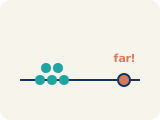
For symmetric data with no outlier, use the mean for center and the MAD for spread: Mean and MAD.Para datos simétricos sin valor atípico, usa la media para el centro y la DMA para la dispersión: Media y DMA.
- Basic practice 2Práctica básica 2
No value is far from the others, so report the mean and the MAD. So the answer is: Mean and MAD.Ningún valor está lejos de los demás, así que reporta la media y la DMA. Entonces la respuesta es: Media y DMA.
- Basic practice 3Práctica básica 3
- The median, $13, with the IQRLa mediana, $13, con el RIC
The $95 is an outlier. It pulls the mean to 145 ÷ 5 = $29, higher than four of five bills. Use the median, $13, with the IQR.Los $95 son un valor atípico. Jalan la media a 145 ÷ 5 = $29, mayor que cuatro de las cinco cuentas. Usen la mediana, $13, con el RIC.
- Basic practice 4Práctica básica 4
The median goes with the IQR, because both depend on the order of the values, not on an outlier. So the answer is: The IQR.La mediana va con el RIC, porque los dos dependen del orden de los valores, no de un valor atípico. Entonces la respuesta es: El RIC.
- Basic practice 5Práctica básica 5
The 60 is an outlier, so use the median and IQR for 3, 4, 4, 5, 60.El 60 es un valor atípico, así que usa la mediana y el RIC para 3, 4, 4, 5, 60.
- Basic practice 6Práctica básica 6
- Median and IQRMediana y RIC
The 90 is an outlier, so report the median and the IQR. So the answer is: Median and IQR.El 90 es un valor atípico, así que reporta la mediana y el RIC. Entonces la respuesta es: Mediana y RIC.
- Basic practice 7Práctica básica 7
- An outlier does not pull them very far, so they still show the typical groupUn valor atípico no los jala mucho, así que siguen mostrando al grupo típico
An outlier does not pull the median or IQR very far, so they still show the typical group. So the answer is: An outlier does not pull them very far, so they still show the typical group.Un valor atípico no jala mucho la mediana ni el RIC, así que siguen mostrando al grupo típico. Entonces la respuesta es: Un valor atípico no los jala mucho, así que siguen mostrando al grupo típico.
- Warm-up 1Calentamiento 1
- Kim's — the outlier 210 drags the mean far above the tight group of four, while the median sits inside it.El de Kim — el valor atípico 210 arrastra la media muy por encima del grupo apretado de cuatro, mientras que la mediana queda dentro de él.
The values 60–66 sit within 6 of each other; 210 is an outlier. It drags the mean to 92.4 — (60 + 62 + 64 + 66 + 210) ÷ 5 — a number that is nothing like any value in the set. The median, 64, sits inside the group and describes a typical value honestly; its partner for spread is the IQR. Using every value is not a virtue when one value is unlike all the others, and the greatest value is not a center.Los valores 60–66 están a 6 o menos entre sí; 210 es un valor atípico. Arrastra la media a 92.4 — (60 + 62 + 64 + 66 + 210) ÷ 5 — un número que no se parece a ningún valor del conjunto. La mediana, 64, queda dentro del grupo y describe un valor típico con honestidad; su pareja para la dispersión es el RIC. Usar todos los valores no es una virtud cuando uno es distinto a todos los demás, y el valor mayor no es un centro.
- Warm-up 2Calentamiento 2
- median and IQRmediana y RIC
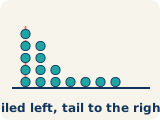
An outlier pulls the mean (and the MAD, which is built from the mean) toward itself, so a skewed set is described honestly by the median and the IQR — the pair that ignores the extreme. Mean-based measures overstate the spread, and mixing pairs breaks the match.Un valor atípico arrastra la media (y la MAD, que se construye a partir de la media) hacia sí, así que un conjunto sesgado se describe honestamente con la mediana y el RIC — el par que ignora el extremo. Las medidas basadas en la media exageran la dispersión, y mezclar pares rompe la pareja.
- Warm-up 3Calentamiento 3
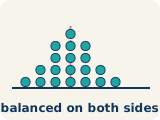
A symmetric set with no outlier is described by the mean (center) and the MAD (spread). Median and IQR are the pair for skewed data; the mode and range are not a matched center-and-spread pair; mean with IQR mixes the two families.Un conjunto simétrico sin valor atípico se describe con la media (centro) y la MAD (dispersión). Mediana y RIC son el par para datos sesgados; la moda y el rango no son una pareja de centro y dispersión; la media con el RIC mezcla las dos familias.
- Level up 1Sube de nivel 1
- The median (18), because the outlier 175 drags the mean up to 48.6 — a number bigger than four of the five values.La mediana (18), porque el valor atípico 175 arrastra la media hasta 48.6 — un número mayor que cuatro de los cinco valores.
The mean is 243 ÷ 5 = 48.6, which is larger than four of the five values — the outlier 175 dragged it there. The median, the 3rd of the five ordered values, is 18 and describes a typical value honestly. The median is of ALL five values, not just the small ones, and 175 does not repeat.La media es 243 ÷ 5 = 48.6, mayor que cuatro de los cinco valores — el valor atípico 175 la arrastró hasta ahí. La mediana, el 3.º de los cinco valores ordenados, es 18 y describe un valor típico con honestidad. La mediana es de los CINCO valores, no solo de los pequeños, y 175 no se repite.
- Level up 2Sube de nivel 2
- P: mean and MAD; Q: median and IQR
Set P is evenly spread with no outlier, so report the mean (56) and the MAD. Set Q has an outlier, 160, far above the tight group of four. It drags the mean up to 76, so report the median (56) and the IQR for Q.El conjunto P está repartido parejo y no tiene valor atípico, así que se reporta la media (56) y la MAD. El conjunto Q tiene un valor atípico, 160, muy por encima del grupo de cuatro. Sube la media a 76, así que para Q se reporta la mediana (56) y el IQR.
- Level up 3Sube de nivel 3
Set A is symmetric with no outlier (each value is 2 apart), so report the mean (18) and the MAD (2.4). Set B has an outlier, 175, far above a tight group, so report the median (18) and the IQR. For Set B the outlier would drag the mean up to 48.6, a number bigger than four of the five values, so the median describes the typical value honestly and the IQR describes the spread of the middle without the outlier.El Conjunto A es simétrico y sin valor atípico (cada valor está a 2 del siguiente), así que informa la media (18) y la MAD (2.4). El Conjunto B tiene un valor atípico, 175, muy por encima de un grupo apretado, así que informa la mediana (18) y el RIC. Para el Conjunto B el valor atípico arrastraría la media hasta 48.6, un número mayor que cuatro de los cinco valores, así que la mediana describe el valor típico con honestidad y el RIC describe la dispersión del medio sin el valor atípico.