Learn It
How do you add and subtract decimals?
A decimal is a number with a point that shows parts smaller than one whole. To add or subtract decimals, you line up the decimal points so the same place values match.
Picture itSee what the math looks like before you read about it
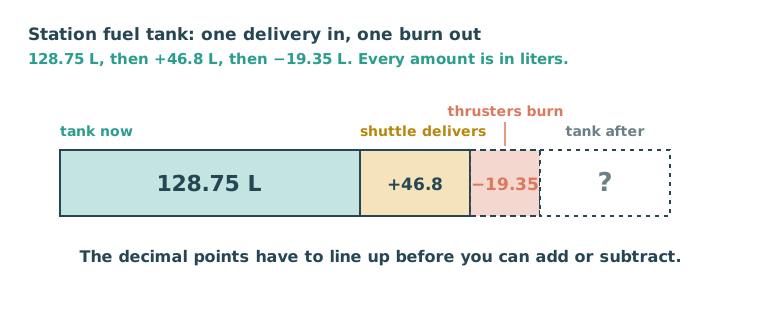
Watch me solve itI do — read one step at a time
- The tank has 128.75 liters. A shuttle adds 46.8 liters. I line up the points and annex a zero: 46.80.
- I add:128.75 + 46.80 = 175.55 liters
- Now the thrusters use 19.35 liters, so I subtract: 175.55 − 19.35 = 156.20.
- The final fuel level is 156.20 liters. I check with estimation: about 130 + 47 − 19 = 158, which is close, so my answer is reasonable.130 + 47
Watch out — mistakes students make here
- Recheck your borrowing across the tenths and hundredths.
- Rewrite 32.6 as 32.60, then subtract the hundredths carefully.
- Line up the decimal points and borrow carefully in the tenths.
Try it with meWe do — you answer first, then check
Same steps, new numbers.
- Let's add 12.45 and 7.8. First, how do we write 7.8 with two places?
Check this step
(7.80.) - Line up the points and add the , then , then ones. What do we get?
Check this step
(12.45 + 7.80 = 20.25.)(12.45 + 7.80 - So the sum is 20.25. The points stay lined up in the answer.
On your ownYou do — solve this one by yourself
Before you start, remember:
- Remember: line up the points and add zeros so every place matches.
Solve: A student buys items costing $4.59, $12.75, and $3.80. What is the total cost?
My answer
Stuck? Open one hint at a time.
Hint 1
Three prices, all in dollars and cents — every number already has two decimal places, so the columns line up cleanly.
Hint 2
Stack all three amounts with the decimal points in one column, then add the cents first, carrying as you go.
Hint 3
Start at the hundredths: 9 + 5 + 0 = 14 — write 4 and carry 1 into the tenths column. Keep moving left one column at a time.
Check my answer
4.59 + 12.75 + 3.80 = 21.14. Line up decimal points and add column by column.
Turn & TalkSay it out loud with a partner
A fuel tank holds 128.75 liters. A shuttle adds 46.8 liters, and the docking thrusters use 19.35 liters. Why must you line up the points — not the last digits — before you add and subtract these amounts?
Try starting with:
- I line up the ___ so each digit stays in its matching place value (tenths with tenths, hundredths with hundredths).Alineo los ___ para que cada dígito quede en su valor posicional correspondiente (décimos con décimos, centésimos con centésimos).
- If the points are not aligned, then ___.Si los puntos no están alineados, entonces ___.