Learn It
What is a unit rate, and how does it help me find the better buy?
A rate compares two amounts with different units. A unit rate tells you the amount for just 1 of something, like the cost for 1 game.
Picture itSee what the math looks like before you read about it
Watch me solve itI do — read one step at a time
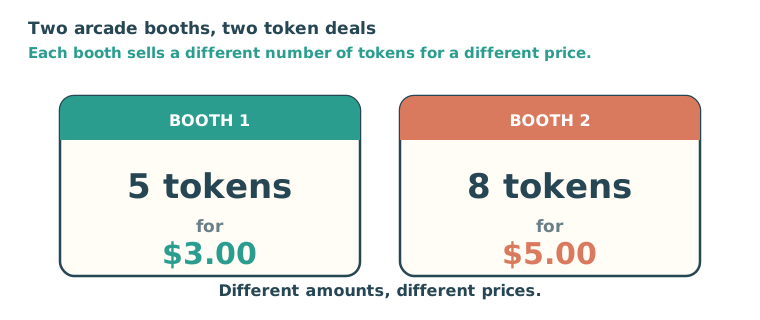
- Booth A charges $3 for 5 games. I want the cost for just 1 game.
- I the cost by the games:$3 ÷ 5 = $0.60
- So Booth A costs $0.60 game. That is the .
- Because this is money for one item, it has its own name: it is the .
- Now I can compare this booth's fairly with any other booth's.
Watch out — mistakes students make here
- Divide the cost by the number for each pack. You should get $0.25 and $0.28.
- Compare the cost per token, not the total price or the total number of tokens. Divide each pack's price by its tokens and compare those results.
- A bigger pack is not automatically cheaper for each token. Work out price ÷ tokens for every pack before deciding.
Try it with meWe do — you answer first, then check
Same steps, new numbers.
- A booth charges $4 for 8 games. What do we ?
- We cost by games: $4 ÷ 8 = ?$4 ÷ 8
- What is the , the cost for just 1 game?
Check this step
($0.50 game.)
On your ownYou do — solve this one by yourself
Before you start, remember:
- In the table, find the cost game for each booth by dividing.
- Then decide which booth has the lowest — that is the .
Solve: Complete the table to find and determine the best deal.
| Deal | Quantity | Cost | Unit Rate |
|---|---|---|---|
| Tokens Pack A | 20 tokens | $5.00 | |
| Tokens Pack B | 35 tokens | $7.00 | |
| Tokens Pack C | 50 tokens | $12.50 |
Stuck? Open one hint at a time.
Hint 1
Each pack lists tokens and a total cost. The unit rate column wants the cost of ONE token, like '$0.25 per token'.
Hint 2
Divide the cost by the number of tokens for each pack — dollars ÷ tokens = dollars per token.
Hint 3
For Pack A, divide $5.00 by 20 tokens. Then repeat: $7.00 ÷ 35 for Pack B and $12.50 ÷ 50 for Pack C.
Check my answer
- Tokens Pack A → Unit Rate: $0.25 per token
- Tokens Pack B → Unit Rate: $0.20 per token
- Tokens Pack C → Unit Rate: $0.25 per token
Turn & TalkSay it out loud with a partner
Booth A charges $3 for 5 games and Booth B charges $5 for 8 games. Just by looking, which booth seems like the better deal, and what makes it hard to be sure?
Try starting with:
- Booth ___ looks better because ___.El puesto ___ se ve mejor porque ___.
- It is hard to compare because the ___ are different.Es difícil comparar porque los/las ___ son diferentes.