Learn It
How do we graph a ratio table?
An ordered pair (x, y) tells where to plot a point: go right x, then up y. When you graph equal ratios, the points make a straight line through the origin (0, 0).
Picture itSee what the math looks like before you read about it
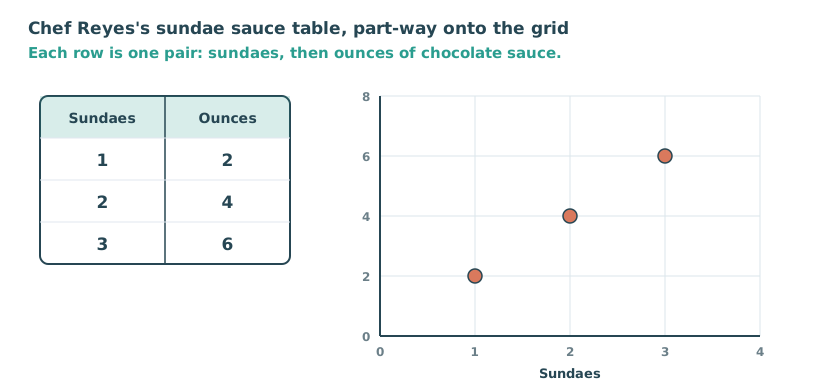
Watch me solve itI do — read one step at a time
- The recipe uses 2 ounces of sauce for every 1 sundae.
- I put sundaes on the x-axis and ounces of sauce on the y-axis.
- For 1 sundae I need 2 ounces, so I plot the (1, 2): right 1, up 2.
- For 2 sundaes I need 4 ounces, so I plot (2, 4): right 2, up 4.
- When I connect (1, 2), (2, 4), (3, 6), they form a straight line through the (0, 0).
Watch out — mistakes students make here
- Does 6 = 2 × 4? Each y must be double its x.
- Is 10 = 2 × 6? Keep y exactly double the x-value.
- Those numbers do come from the table, but they are written x to y and left unsimplified. Divide y by x and reduce.
Try it with meWe do — you answer first, then check
Same steps, new numbers.
- A recipe uses 1 cup of sugar for every 3 cups of flour.
- For 1 cup of sugar, the is (1, 3): right 1, up 3.
- For 2 cups of sugar, what is the pair?
Check this step
It is (2, 6): right 2, up 6.
On your ownYou do — solve this one by yourself
Before you start, remember:
- Check that your points line up straight through the .
Solve: Points from a are plotted at (1, 4), (2, 8), and (3, 12). What is the ratio of y to x for each point?
My answer
Stuck? Open one hint at a time.
Hint 1
The question asks y to x — the up-value compared to the across-value, in that order.
Hint 2
Divide y by x for each point. Equivalent ratios should give the same result all three times.
Hint 3
Take (2, 8): divide 8 ÷ 2. Check that (1, 4) and (3, 12) give the same value, then write it as y first, x second.
Check my answer
For each point: 4÷1 = 4, 8÷2 = 4, 12÷3 = 4. The ratio of y to x is always 4:1.
Turn & TalkSay it out loud with a partner
Each bag holds the same number of soccer balls, and the picture shows one bag with 6 balls. How can you use that one bag to find what 6 bags hold?
Try starting with:
- I think ___ because ___.Pienso que ___ porque ___.
- I agree / disagree with you because ___.Estoy / no estoy de acuerdo contigo porque ___.