Learn It
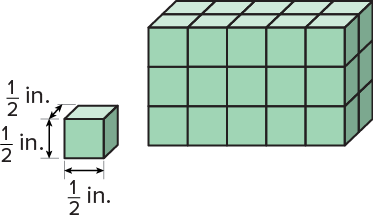
How do we find volume when an edge is a fraction?
Volume is the space inside a rectangular prism. There are two ways to write the same rule. You can multiply all three edges, V = length × width × height. Or you can find the base area first, B = length × width, and then stack that base up the height: V = B × h. Both give the same number, and both work when an edge is a fraction or a decimal.
Picture itSee what the math looks like before you read about it
Watch me solve itI do — read one step at a time
- My capsule is 2 ft long, 1.5 ft wide, and 1 ft tall. I write V = length × width × height.
- I put in the numbers:V = 2 × 1.5 × 1
- First I multiply 2 × 1.5 = 3.2 × 1.5 = 3
- Then 3 × 1 = 3.3 × 1 = 3
- So the is 3 ft³. A fractional edge like 1.5 did not change my steps at all.
Watch out — mistakes students make here
- Are you adding the dimensions? Volume multiplies all edges: length × width × height.
- Check the units. Area is square units (²), volume is cubic units (³).
- Recheck which box's volume is larger — recalculate both totals before comparing.
Try it with meWe do — you answer first, then check
Same steps, new numbers.
- Now try a box that is 4 long, 2 wide, and 0.5 tall. Let's do it the base-area way. What is the base, 4 × 2?base, 4 × 2
- The is B = 8. Picture that base sitting on the table — that is one layer.
- Now stack the base up the height: V = B × h = 8 × 0.5 (that means half of 8). What is the ?V = B × h = 8 × 0.5
- Yes, V = 4 . Check it the other way: 4 × 2 × 0.5 = 4. Same answer, because B × h already used the length and width.4 × 2 × 0.5 = 4
On your ownYou do — solve this one by yourself
Before you start, remember:
- In the table below, find the of each capsule design. Use whichever form you like: V = l × w × h, or find the first and multiply by the height.
- Some edges are fractions or decimals — use the same steps and write your answer in ft³.
Solve: Find the missing dimension or for each container.
| Container | Length | Width | Height | Volume |
|---|---|---|---|---|
| Box A | 12 in | 5 in | 3 in | |
| Box B | 7 cm | 4 cm | 168 cm³ | |
| Box C | 8 ft | 5 ft | 240 ft³ |
Stuck? Open one hint at a time.
Hint 1
Check each row: Box A is missing its volume, but Boxes B and C are each missing one dimension.
Hint 2
Missing volume? Multiply all three edges. Missing edge? Divide the volume by the product of the two known edges.
Hint 3
Box B: multiply the known edges 7 × 4 = 28, then ask what number times 28 makes 168.
Check my answer
- Box A → Volume: 180 in³
- Box B → Width: 6 cm
- Box C → Length: 6 ft
Turn & TalkSay it out loud with a partner
Your time capsule is 2 ft long, 1.5 ft wide, and 1 ft tall — one edge is a fraction. Does having a fractional edge change how you find the ? Why or why not?
Try starting with:
- A fractional edge ___ change the method because I still multiply ___ × ___ × ___.Una arista fraccionaria ___ cambia el método porque sigo multiplicando ___ × ___ × ___.
- The volume of the capsule is ___ ft³.El volumen de la cápsula es ___ ft³.