Learn It
How do we find the area of a trapezoid?
A trapezoid is a four-sided shape with one pair of parallel sides. The two parallel sides are called the bases, and they have different lengths.
Picture itSee what the math looks like before you read about it
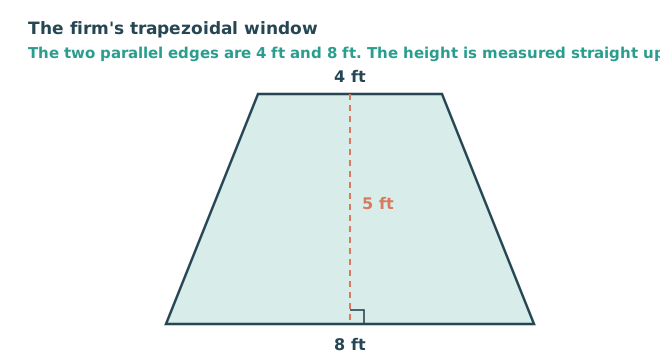
Watch me solve itI do — read one step at a time
- My window has a top base of 4 feet, a bottom base of 8 feet, and a of 5 feet.
- I write the formula: A = ½ × (b1 + b2) × h.
- I add the bases first:4 + 8 = 12
- I multiply by the :12 × 5 = 60
- I take half: ½ × 60 = 30. So the is 30 square feet.
Watch out — mistakes students make here
- Add both bases (9 + 5) before multiplying by height and ½.
- Don't forget the ½ — add the bases, times height, then halve.
- 24 is 6 × 4 — only one base was used. Add both bases first: 6 + 10 = 16.
Try it with meWe do — you answer first, then check
Same steps, new numbers.
- Now a smaller : bases 3 cm and 5 cm, 2 cm.
- First, what is 3 + 5?3 + 5
Check this step
Yes, 8. - Next, what is 8 × 2?8 × 2
Check this step
Yes, 16. - Now take half: ½ × 16 = 8, so the is 8 square centimeters.
On your ownYou do — solve this one by yourself
Before you start, remember:
- Remember the order: add the bases, multiply by the , then take half.
Solve: What is the of a with bases 6 cm and 10 cm, and 4 cm?
My answer
Stuck? Open one hint at a time.
Hint 1
A trapezoid has two bases (6 cm and 10 cm) plus a height (4 cm) — all three belong in the formula.
Hint 2
Use A = ½ × (b₁ + b₂) × h: add the bases first, then multiply by the height, then take half.
Hint 3
Add 6 + 10 to get the base sum, multiply that by 4, then cut the result in half.
Check my answer
A = ½ × (b₁ + b₂) × h = ½ × (6 + 10) × 4 = ½ × 16 × 4 = 32 sq cm.
Turn & TalkSay it out loud with a partner
The trapezoidal window has a top edge of 4 feet and a bottom edge of 8 feet. Why does the formula use BOTH bases instead of just one?
Try starting with:
- We use both bases because the top and bottom are ___.Usamos las dos bases porque la parte de arriba y la de abajo son ___.
- If I used only one base, the area would be ___.Si usara solo una base, el área sería ___.