Learn It
How do I solve a fraction division word problem?
In a word problem, first decide what the question asks: how many groups fit (total ÷ size of each group) or how much is in one group (total ÷ number of groups). The total amount is the dividend and the other number is the divisor. Write the equation, solve it with a model, common denominators, or by multiplying by the reciprocal, then check by multiplying the quotient by the divisor.
Picture itSee what the math looks like before you read about it
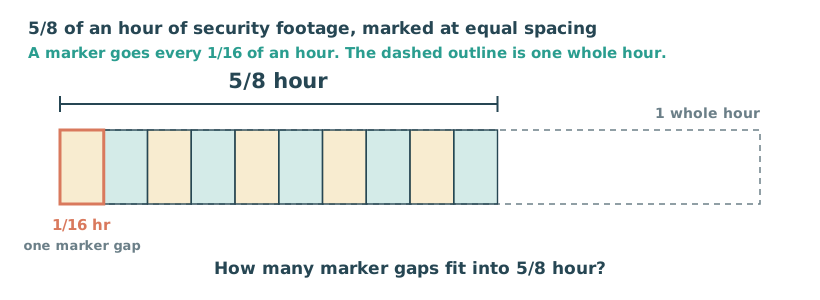
Watch me solve itI do — read one step at a time
- Agent Torres has 2/3 gallon of dust and each test uses 1/6 gallon. I ask: how many tests fit?
- The total 2/3 is the dividend. The size of each test 1/6 is the divisor. My is 2/3 ÷ 1/6.2/3 ÷ 1/6
- In sixths, 2/3 = 4/6, and 4 sixths ÷ 1 sixth = 4. Multiplying by the reciprocal gives the same answer:2/3 × 6/1 = 12/3 = 4
- So she can run 4 tests. I check by multiplying back: 4 × 1/6 = 4/6 = 2/3. It matches the total, so the answer is reasonable.4 × 1/6 = 4/6 = 2/3
Watch out — mistakes students make here
- 3/2 is less than 2. In eighths, 3/4 = 6/8, and 6 eighths hold 2 groups of 3 eighths.
- 6 counts eighths, not 3/8-meter connectors. 3/4 = 6/8, and 6 eighths make 2 groups of 3 eighths.
- 9/32 is 3/4 × 3/8 — the divisor was never flipped. Divide: 3/4 × 8/3 = 24/12 = 2.
Try it with meWe do — you answer first, then check
Same steps, new numbers.
- A ribbon is 3/4 yard and each bow uses 1/4 yard. The total 3/4 is the dividend; 1/4 is the divisor.
- : 3/4 ÷ 1/4. Three fourths hold 3 fourths, so the quotient is 3 — the same as 3/4 × 4/1 = 12/4 = 3.3/4 × 4/1 = 12/4 = 3
- So we can make 3 bows. Check: 3 × 1/4 = 3/4. It matches, so it is reasonable.3 × 1/4 = 3/4
On your ownYou do — solve this one by yourself
Before you start, remember:
- Now read each word problem and decide: does it ask how many groups fit (total ÷ group size) or how much is in one group (total ÷ number of groups)? Write the , solve it, and check by multiplying.
Solve: Marcus solved 2/3 ÷ 1/4 and got 8/3 = 2 2/3. He says 'That can't be right because I started with less than 1.' Is Marcus's math correct? Is his reasoning correct?
My answer
Stuck? Open one hint at a time.
Hint 1
Two separate questions: is Marcus's MATH right, and is his REASONING right? Check each on its own.
Hint 2
Redo 2/3 ÷ 1/4 with the reciprocal shortcut, then recall what dividing by a number less than 1 does to a quotient.
Hint 3
Compute 2/3 × 4/1 and compare with Marcus's 8/3. Then ask: is an answer bigger than the start actually a mistake here?
Check my answer
2/3 ÷ 1/4 = 2/3 × 4/1 = 8/3 = 2 2/3. This IS correct. When you divide by a number less than 1, the quotient is greater than the dividend.
Turn & TalkSay it out loud with a partner
Agent Torres has 2/3 gallon of fingerprint dust and each test uses 1/6 gallon. How do you decide which number is the dividend and which is the divisor?
Try starting with:
- The total, ___, is the dividend because ___.El total, ___, es el dividendo porque ___.
- The size of each test, ___, is the divisor because ___.El tamaño de cada prueba, ___, es el divisor porque ___.