Learn It
What is the distributive property?
The distributive property means you can multiply a number by everything inside the parentheses, one piece at a time: a(b + c) = ab + ac.
Picture itSee what the math looks like before you read about it
Watch me solve itI do — read one step at a time
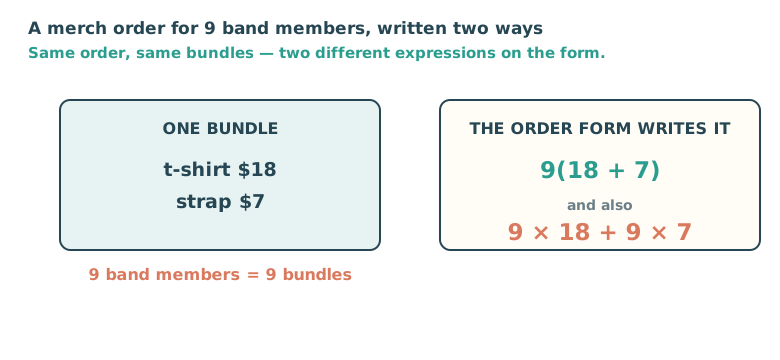
- Each bundle has a ticket ($15) and a snack ($5). For 3 bundles I can write 3(15 + 5).
- Way 1: add inside first. 15 + 5 = 20, then 3 × 20 = 60.15 + 5 = 20
- Way 2: distribute the 3 to each part. 3 × 15 + 3 × 5.part. 3 × 15 + 3 × 5
- That is 45 + 15 = 60.45 + 15 = 60
- Both ways give $60, so 3(15 + 5) = 3 × 15 + 3 × 5.
Watch out — mistakes students make here
- The 7 reached the x but skipped the 3. Distributing multiplies EVERY term inside — what is 7 × 3?
- The 10 comes from ADDING 7 + 3. Distributing multiplies across, so the constant term should be 7 × 3.
- The 7 reached the 3 but skipped the x. Both terms inside the parentheses get multiplied by 7.
Try it with meWe do — you answer first, then check
Same steps, new numbers.
- Let's 2(8 + 3). Where does the 2 go?
- We multiply the 2 by each term:2 × 8 + 2 × 3
- That is 16 + 6 = 22. So 2(8 + 3) = 22.16 + 6 = 22
On your ownYou do — solve this one by yourself
Before you start, remember:
- In the table, each expression using , then simplify.
- Start with 2(8 + 3) = 2 × 8 + 2 × 3.
Solve: Use to each expression.
| Factored Form | Expanded Form |
|---|---|
| 3(2x + 5) | |
| 7(a − 4) | |
| 2(3m + 8) | |
| 5(6 − y) |
Stuck? Open one hint at a time.
Hint 1
Some inside terms have coefficients, like 2x. Multiply the outside number by the WHOLE term: 3 × 2x.
Hint 2
Two products per row: outside × first term, outside × second term. Keep the − sign if the inside subtracts.
Hint 3
Row 1: 3(2x + 5) → 3 × 2x = 6x. Now multiply 3 × 5 and join the products with +. Repeat for each row.
Check my answer
- 3(2x + 5) → Expanded Form: 6x + 15
- 7(a − 4) → Expanded Form: 7a − 28
- 2(3m + 8) → Expanded Form: 6m + 16
- 5(6 − y) → Expanded Form: 30 − 5y
Turn & TalkSay it out loud with a partner
Each bundle is a ticket ($15) and a snack ($5). For 3 people, why does 3(15 + 5) give the same $60 as 3 × 15 + 3 × 5?
Try starting with:
- Both give $60 because I distribute the 3 to ___ and ___.Las dos dan $60 porque distribuyo el 3 a ___ y ___.
- So 3(15 + 5) equals ___ because ___.Entonces 3(15 + 5) es igual a ___ porque ___.