Learn It
What does an exponent mean?
An exponent is a small raised number that tells you how many times to multiply a number by itself. We say 2³ as "two to the third power."
Picture itSee what the math looks like before you read about it
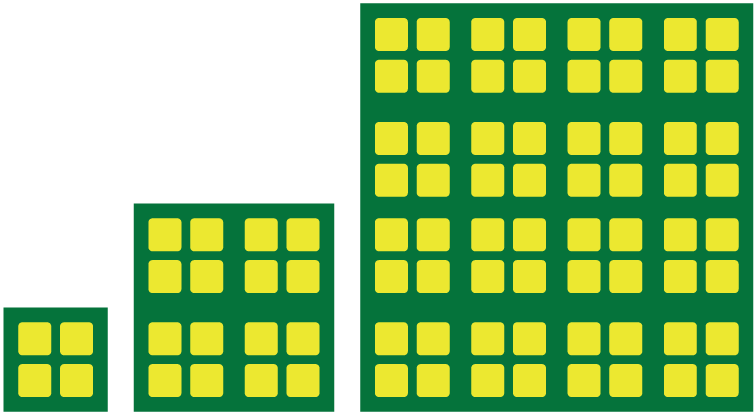
Watch me solve itI do — read one step at a time
- I want to find the value of 2³.
- The small 3 tells me to multiply 2 by itself 3 times.
- So I write 2 × 2 × 2.2 × 2 × 2
- First 2 × 2 = 4. Then 4 × 2 = 8.2 × 2 = 4
- So 2³ = 8.
Watch out — mistakes students make here
- Did you multiply base by exponent (3 × 4)? The exponent counts factors.
- The power is 3⁴, not 34. Write 3 × 3 × 3 × 3.
- Did you add 4 + 3 = 7? The exponent tells you to multiply 4 by itself 3 times: 4 × 4 × 4.
Try it with meWe do — you answer first, then check
Same steps, new numbers.
- Now let's find 5². How many times do we multiply 5 by itself?
- The is 2, so we write 5 × 5.5 × 5
- What is 5 × 5?5 × 5
Check this step
Yes, 25. So 5² = 25.
On your ownYou do — solve this one by yourself
Before you start, remember:
- In the table, write each as and find its value.
- Start with 2⁴ = 2 × 2 × 2 × 2.
Solve: each exponential expression. Show the and the final value.
| Power | Repeated Multiplication | Value |
|---|---|---|
| 4³ | 4 × 4 × 4 | |
| 2⁶ | 2 × 2 × 2 × 2 × 2 × 2 | |
| 5³ | 5 × 5 × 5 | |
| 10⁴ | 10 × 10 × 10 × 10 |
Stuck? Open one hint at a time.
Hint 1
Each row shows the repeated multiplication for you. Your job is to multiply the factors carefully.
Hint 2
Multiply left to right, keeping a running total. For 10⁴, watch the zeros pile up.
Hint 3
Row 1: 4 × 4 = 16, then 16 × 4 gives the value. Use the same running-total idea for the other rows.
Check my answer
- 4³ → Value: 64
- 2⁶ → Value: 64
- 5³ → Value: 125
- 10⁴ → Value: 10000
Turn & TalkSay it out loud with a partner
In the sound studio, the volume doubles each time you flip the switch. Why is the volume after 3 flips 2³ = 8 and not 2 × 3 = 6?
Try starting with:
- After 3 flips the volume is ___ because we multiply 2 three times.Después de 3 cambios el volumen es ___ porque multiplicamos 2 tres veces.
- It is not 6 because doubling means we ___, not add.No es 6 porque duplicar significa que ___, no sumar.