Explore Numerical Expressions with Exponents
I can write and evaluate numbers in exponent form using a base and a power.
How to Use This Deck
Click Present or press F11 for fullscreen. Use arrow keys to advance.
Blue boxes show exactly what to say, ask, and how long to spend.
Text boxes, polls, and drag-sort save automatically in the browser.
Press N or click 📝 in the toolbar for pacing tips and answers.
Launch the full HTML activity for independent practice.
File → Print or the print button for handout copies.
🎯 Content Objective / Objetivo de contenido
I can write and evaluate numbers in exponent form using a base and a power.
Today's Flow
Total pacing: ~45 min · Progress bar at top tracks your place
LAUNCH
⏱ ~10 min
⏱️ 3 MIN · THINK-PAIR-SHARE
In the sound studio, the volume doubles each time you flip the switch. Why is the volume after 3 flips 2³ = 8 and not 2 × 3 = 6?
Check for Understanding #1
Teacher: If >30% thumbs down, re-teach with a fresh example before moving on.
Sound Check
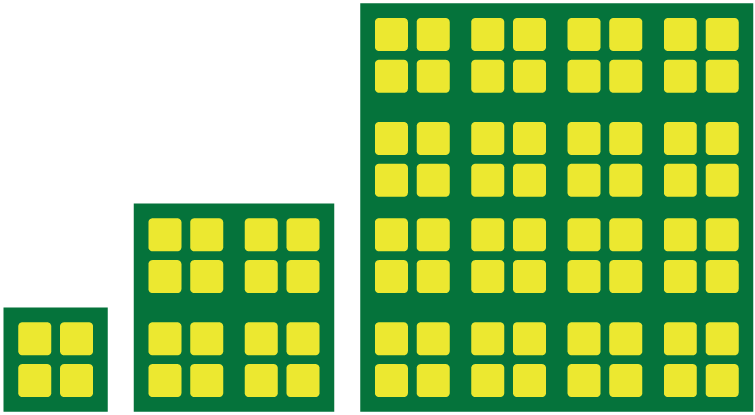
You're a sound engineer at a music studio. Each time you flip a switch, the volume doubles. The starting volume is 1 unit. After flipping the switch 3 times, the volume is 2³ = 2 × 2 × 2 = 8 units — that's 8 times louder! How loud does it get after more flips?
Concept Launch
💡 What does an exponent mean?
An exponent is a small raised number that tells you how many times to multiply a number by itself. We say 2³ as "two to the third power."
Powers & Exponents. Formula: Base^Exponent (b^n = b · b · ... · b n times). 1. Base is the factor being multiplied repeatedly. 2. Exponent tells how many times to multiply the base by itself. 3. Evaluate: 2³ = 2 × 2 × 2 = 8 (not 2 × 3 = 6)
Check for Understanding #2
Teacher: If >30% thumbs down, re-teach with a fresh example before moving on.
Now it's your turn
VOCABULARY
⏱ ~8 min
| Term / Término | Meaning / Significado | Example / Ejemplo | Visual |
|---|---|---|---|
| Powers and Exponents Potencias y exponentes |
A power uses a base and an exponent to show repeated multiplication. Una potencia usa una base y un exponente para mostrar multiplicación repetida. |
2⁴ = 2 × 2 × 2 × 2 = 16 | |
| Exponent Exponente |
A small number that tells how many times to multiply a number by itself. Un número pequeño que dice cuántas veces multiplicar un número por sí mismo. |
In 2³, the small 3 means multiply 2 by itself 3 times: 2 × 2 × 2 = 8 | |
| Base Base |
The number that gets multiplied by itself. El número que se multiplica por sí mismo. |
In 5², the base is 5 — it is the number being multiplied: 5 × 5 = 25 | |
| Power Potencia |
A number written with a base and an exponent, like 2³. Un número escrito con una base y un exponente, como 2³. |
10³ = 10 × 10 × 10 = 1,000 — read as '10 to the third power' or '10 cubed' | |
| Evaluate Evaluar |
To find the value by putting numbers in for the letters. Encontrar el valor poniendo números en lugar de las letras. |
Evaluate 3⁴: write 3 × 3 × 3 × 3, then multiply step by step: 9 × 9 = 81 |
Which Word Fits?
A power writes repeated multiplication with a base and an ___.
Use It In a Sentence
Check for Understanding #3
Teacher: If >30% thumbs down, re-teach with a fresh example before moving on.
Turn & Talk — Launch
In the sound studio, the volume doubles each time you flip the switch. Why is the volume after 3 flips 2³ = 8 and not 2 × 3 = 6?
👂 Listen For
Students connect each switch flip to one more factor of 2 and explain that 2³ = 2 × 2 × 2 = 8, distinguishing repeated multiplication from repeated addition (which would give 6).
Extend: If the volume tripled instead of doubled each flip, how would you write the volume after 3 flips, and how many times louder would that be than the doubling case?
EXPLORE & PRACTICE
⏱ ~18 min
Visual Modeling Workspace
Use the drawing tray below to annotate the visual model. Teacher: say "Click to reveal" on key steps.
Explore Activity
Evaluate each exponential expression. Write the repeated multiplication and find the value.
✍️ Explore Discourse
How does the value change when you increase the exponent by 1? Why?
Whiteboard Moment
Show your work clearly. Be ready to explain your thinking to a partner.
Turn & Talk — Explore
Look at the table: when the exponent goes up by 1 (like from 2³ to 2⁴), what happens to the value, and why?
👂 Listen For
A strong answer states that the value gets multiplied by the base (e.g., 2³ = 8 becomes 2⁴ = 16, times 2) and ties it to adding one more factor, using the words base and exponent.
Extend: Compare 2⁵ and 5². Both use the digits 2 and 5, so why are they not equal? Generalize: does the bigger exponent or the bigger base have more effect on the value?
Practice Check A
What is the value of 4³?
✍️ Show Your Work
Explain why your answer is correct using today's vocabulary.
Practice Check B
What is the value of 6²?
✍️ Show Your Work
Explain why your answer is correct using today's vocabulary.
Equivalent Ratio Sort
Complete the interactive activity using today's strategy.
✍️ Justify Your Thinking
Sort each power by whether its value is greater than 50 or not.
A classmate turned in the work below. One step has a mistake. Read every step, find it, name it, and fix it.
Choose ONE option to show what you know — then do it in the workspace below.
Use evidence from today's lesson to complete each frame.
Today's key idea is: "Powers & Exponents. Formula: Base^Exponent (b^n = b · b · ... · b n times). 1. Base is the factor being multiplied repeatedly. 2. Exponent tells how many times to multiply the base by itself. 3. Evaluate: 2³ = 2 × 2 × 2 = 8 (not 2 × 3 = 6)" — and it works because ___.
Because Powers and Exponents means ___, but a tricky part is ___, so I have to ___.
A common mistake with Powers and Exponents is ___. It happens because ___, and the fix is ___.
I can prove my answer is correct by ___, using Exponent to check my work.
✍️ TWR · WRITE 3 SENTENCES · 7 MIN
Powers & Exponents. Formula: Base^Exponent (b^n = b · b · ... · b n times). 1. Base is the factor being multiplied repeatedly. 2. Exponent tells how many times to multiply the base by itself. 3. Evaluate: 2³ = 2 × 2 × 2 = 8 (not 2 × 3 = 6) because ___
Powers & Exponents. Formula: Base^Exponent (b^n = b · b · ... · b n times). 1. Base is the factor being multiplied repeatedly. 2. Exponent tells how many times to multiply the base by itself. 3. Evaluate: 2³ = 2 × 2 × 2 = 8 (not 2 × 3 = 6) but ___
Powers & Exponents. Formula: Base^Exponent (b^n = b · b · ... · b n times). 1. Base is the factor being multiplied repeatedly. 2. Exponent tells how many times to multiply the base by itself. 3. Evaluate: 2³ = 2 × 2 × 2 = 8 (not 2 × 3 = 6) so ___
🌱 TWR · GROW THE KERNEL · 6 MIN
Answer these to add detail
Sentence starters (tap to use)
Student Workspace
Evaluate each exponential expression. Write the repeated multiplication and find the value.
| Power | Repeated Multiplication | Value |
|---|---|---|
| 2⁴ | 2 × 2 × 2 × 2 | |
| 3³ | 3 × 3 × 3 | |
| 5² | 5 × 5 | |
| 10³ | 10 × 10 × 10 |
✏️ Sketch Your Strategy
Differentiation Paths
Step-by-step with a worked model and sentence frames.
What is the value of 4³?
Core practice aligned to the standard.
Extension with error analysis or multi-step reasoning.
Partner Activity
Work with your partner on the practice problems at your differentiation path level. Explain each step using math vocabulary.
Check for Understanding #4
Teacher: If >30% thumbs down, re-teach with a fresh example before moving on.
Real-World Connection
🌍 Math in the Wild
A music studio is recording tracks. Each track layer doubles the file size. A single track is 4 MB. The file size after n layers is given by 4 × 2ⁿ.
✍️ Connection Reasoning
How large is the file after 5 layers? Why does the file size grow so quickly?
After 5 layers the file is ___ MB because 4 × 2⁵ = 4 × ___ = ___. The file grows quickly because each layer ___ the size.
Turn & Talk — Connect
Each recording layer doubles the file size, modeled by 4 × 2ⁿ. Why does the file size grow so fast as you add layers?
👂 Listen For
Students evaluate 4 × 2⁵ = 4 × 32 = 128 MB and explain that exponential (doubling) growth multiplies the size each step, unlike adding a fixed amount.
Extend: Critique this claim: 'After 10 layers the file is just twice as big as after 5 layers.' Is that true? Justify with the powers involved.
Summarize: Explore Numerical Expressions with Exponents
Powers & Exponents. Formula: Base^Exponent (b^n = b · b · ... · b n times). 1. Base is the factor being multiplied repeatedly. 2. Exponent tells how many times to multiply the base by itself. 3. Evaluate: 2³ = 2 × 2 × 2 = 8 (not 2 × 3 = 6)
In your own words:
CLOSURE & REFLECT
⏱ ~8 min
Today I learned that ___ because ___.
One thing I am still not sure about is ___.
What is the value of 3⁴?
Bonus Exit Check
Which expression shows 5³ as repeated multiplication?
✍️ Show Your Work
Explain why your answer is correct using today's vocabulary.
Reflection & Self-Assessment
Continue Learning
Launch the Full Interactive Activity
Students continue practice in the HTML lesson engine with auto-check, hints, and differentiation.
Family Connection
Share tonight's family homework and discuss one vocabulary word at home.
Open Family Homework ↗Teacher Notes
⏱️ Pacing Guide
- Launch & vocab: 12 min
- I Do / We Do / You Do: 15 min
- Explore & practice: 15 min
- Connect & closure: 8 min
Total: ~45 min
🎯 Listen For · Common Errors
• Students connect each switch flip to one more factor of 2 and explain that 2³ = 2 × 2 × 2 = 8, distinguishing repeated multiplication from repeated addition (which would give 6).
• A strong answer states that the value gets multiplied by the base (e.g., 2³ = 8 becomes 2⁴ = 16, times 2) and ties it to adding one more factor, using the words base and exponent.
• Students evaluate 4 × 2⁵ = 4 × 32 = 128 MB and explain that exponential (doubling) growth multiplies the size each step, unlike adding a fixed amount.
• Listen for students naming a specific strategy tied to 6.AT.5 — not just "I multiplied." They should connect steps to the key idea.
Common mistake: A common mistake in Powers and Exponents is multiplying the base by the exponent instead of using the base as a repeated factor — for example, thinking 2³ = 2 × 3 = 6 instead of 2³ = 2 × 2 × 2 = 8. Before you submit, rewrite the power as repeated multiplication first, then multiply step by step.
Answer Key (Teacher Appendix)
Hide this slide during presentation or move to the end of your copy.
✓ Practice 1: 64 — 4³ = 4 × 4 × 4 = 64.
✓ Practice 2: 36 — 6² = 6 × 6 = 36.
✓ Practice 3: 5 × 5 × 5 — 5³ means use 5 as a factor 3 times: 5 × 5 × 5. The exponent tells how many times to multiply, not what to multiply by.
✓ Practice 4: 108 — 4 + 2 = 6. 6² = 36. 3 × 36 = 108.
✓ Exit ticket: 81 — 3⁴ means use 3 as a factor 4 times: 3 × 3 × 3 × 3 = 81. Choosing 12 means you multiplied the base by the exponent (3 × 4) instead of repeating the base as a factor. Choosing 34 means you just wrote the base and exponent digits side by side instead of evaluating. Choosing 64 mixes up this base and exponent with 4³ (4 × 4 × 4 = 64).