Learn It
What are the properties of operations?
Properties are math rules that are always true. The Commutative Property lets you change the order. The Associative Property lets you change the grouping (the parentheses).
Picture itSee what the math looks like before you read about it
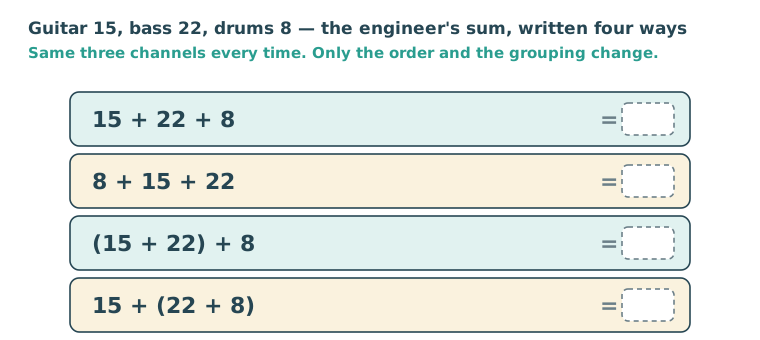
Watch me solve itI do — read one step at a time
- I have 3 guitarists, 5 drummers, and 2 keyboard players.
- I can add them as 3 + 5 + 2, which gives 10.3 + 5 + 2
- The says order does not matter: 5 + 3 + 2 also gives 10.5 + 3 + 2
- The says grouping does not matter: (3 + 5) + 2 = 3 + (5 + 2), both equal 10.(3 + 5) + 2 = 3 + (5 + 2)
Watch out — mistakes students make here
- Commutative changes the ORDER (8 + 5 vs. 5 + 8). Here 8, 5, 2 stay in order — only the parentheses moved.
- Identity adds 0 without changing the value (8 + 0 = 8). Here the grouping changed — no zero involved.
- Distributive multiplies across parentheses: a(b + c) = ab + ac. There's no multiplication here — just regrouped addition.
Try it with meWe do — you answer first, then check
Same steps, new numbers.
- Look at 6 + 9 and 9 + 6. Do they give the same total?6 + 9
- 6 + 9 = 15 and 9 + 6 = 15. Yes, the same.6 + 9 = 15
- Only the order changed, so this shows the .
On your ownYou do — solve this one by yourself
Before you start, remember:
- Sort each example into the it shows: commutative or associative.
- Ask: did the order change, or did the grouping change?
Solve: Which is shown? 5 + 13 = 13 + 5
My answer
Stuck? Open one hint at a time.
Hint 1
Compare the two sides: same numbers, same operation. What changed between left and right?
Hint 2
Match the change to the property: order swapping, regrouping with parentheses, or adding 0 / multiplying by 1.
Hint 3
Left is 5 + 13; right is 13 + 5. The addends traded places — find the property about changing order.
Check my answer
The order of the addends changed, so this is the Commutative Property of Addition.
Turn & TalkSay it out loud with a partner
The band has 3 guitarists, 5 drummers, and 2 keyboard players. Whether you seat guitarists or drummers first, you still have 10 musicians. Which explains this, and why does it work?
Try starting with:
- Changing the order still gives 10 because of the ___ property.Cambiar el orden todavía da 10 por la propiedad ___.
- It works because order does not change ___.Funciona porque el orden no cambia ___.