Represent Rational Numbers on the Coordinate Plane
I can plot and identify points on the coordinate plane using ordered pairs.
How to Use This Deck
Click Present or press F11 for fullscreen. Use arrow keys to advance.
Blue boxes show exactly what to say, ask, and how long to spend.
Text boxes, polls, and drag-sort save automatically in the browser.
Press N or click 📝 in the toolbar for pacing tips and answers.
Launch the full HTML activity for independent practice.
File → Print or the print button for handout copies.
🎯 Content Objective / Objetivo de contenido
I can plot and identify points on the coordinate plane using ordered pairs.
Today's Flow
Total pacing: ~45 min · Progress bar at top tracks your place
LAUNCH
⏱ ~10 min
⏱️ 3 MIN · THINK-PAIR-SHARE
On the coordinate plane, why do we always start at the origin (0, 0) and move sideways before we move up or down to plot a point?
Check for Understanding #1
Teacher: If >30% thumbs down, re-teach with a fresh example before moving on.
Treasure Map Navigation
Captain Vega left a treasure map, but instead of an 'X marks the spot,' she hid the directions as ordered pairs! To find the treasure, you need to plot each point on the coordinate plane and connect them in order. The first clue says: Start at (2, 1), then go to (5, 4), then (8, 1).
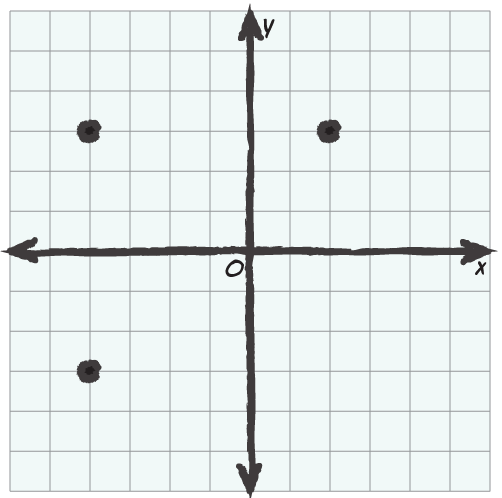
Concept Launch
💡 How do you plot a point on the coordinate plane?
An ordered pair (x, y) is two numbers that tell you exactly where a point goes. The first number moves you right or left. The second number moves you up or down.
Coordinate Plane: Plotting Points. Formula: Ordered Pair: (x, y) = (Horizontal, Vertical). 1. Always start at the Origin (0, 0). 2. x-coordinate: Move right for positive (+), left for negative (-). 3. y-coordinate: Move up for positive (+), down for negative (-)
Check for Understanding #2
Teacher: If >30% thumbs down, re-teach with a fresh example before moving on.
Now it's your turn
VOCABULARY
⏱ ~8 min
| Term / Término | Meaning / Significado | Example / Ejemplo | Visual |
|---|---|---|---|
| Graph on the Coordinate Plane Representar en el plano de coordenadas |
Plot a point by moving horizontally to its x-coordinate and vertically to its y-coordinate. Ubicar un punto moviéndose horizontalmente hasta su coordenada x y verticalmente hasta su coordenada y. |
For (3, −2), move right 3 and down 2. | |
| Coordinate plane Plano cartesiano |
A grid with a line going across and a line going up to plot points. Una cuadrícula con una línea horizontal y una vertical para marcar puntos. |
A grid with a horizontal line (x-axis) crossing a vertical line (y-axis), making four sections | |
| Ordered pair Par ordenado |
Two numbers (x, y) that tell where a point is on a grid. Dos números (x, y) que dicen dónde está un punto en una cuadrícula. |
(3, 5) means move right 3 from the origin, then up 5 | |
| Origin Origen |
The point (0, 0) where the two grid lines cross. El punto (0, 0) donde se cruzan las dos líneas de la cuadrícula. |
The starting point at the center where both axes cross — (0, 0) | |
| Quadrant Cuadrante |
One of the four parts of a coordinate grid, numbered I to IV. Una de las cuatro partes de una cuadrícula de coordenadas, numeradas I a IV. |
I (+,+) top-right, II (-,+) top-left, III (-,-) bottom-left, IV (+,-) bottom-right | |
| Reflection Reflexión |
A flipped, mirror image across a line. Una imagen reflejada al otro lado de una línea. |
(3, 2) reflected over the x-axis becomes (3, -2) — same x, opposite y |
Which Word Fits?
Plot a point by moving to its ___-coordinate first, then its ___-coordinate.
Use It In a Sentence
Check for Understanding #3
Teacher: If >30% thumbs down, re-teach with a fresh example before moving on.
Turn & Talk — Launch
On the coordinate plane, why do we always start at the origin (0, 0) and move sideways before we move up or down to plot a point?
👂 Listen For
Student states the x-coordinate is the sideways (horizontal) move and the y-coordinate is the up/down (vertical) move, both starting from the origin.
Extend: Push students to explain why (3, 5) and (5, 3) land on different points even though they use the same numbers.
EXPLORE & PRACTICE
⏱ ~18 min
Visual Modeling Workspace
Use the drawing tray below to annotate the visual model. Teacher: say "Click to reveal" on key steps.
Explore Activity
Plot Captain Vega's treasure map points and connect them to reveal the path!
✍️ Explore Discourse
You plotted a triangle. How did the ordered pairs tell you exactly where to place each point?
Whiteboard Moment
Show your work clearly. Be ready to explain your thinking to a partner.
Turn & Talk — Explore
You need to plot (4, 2). Walk your partner through every move you make from the origin, using the words x-axis and y-axis.
👂 Listen For
Student moves 4 right along the x-axis and 2 up along the y-axis, naming each axis and the origin as the start.
Extend: Ask students to predict which quadrant the point (4, 2) lands in and justify their answer using the signs of the coordinates.
Practice Check A
Which ordered pair names a point 3 units right and 7 units up from the origin?
✍️ Show Your Work
Explain why your answer is correct using today's vocabulary.
Practice Check B
What are the coordinates of the origin?
✍️ Show Your Work
Explain why your answer is correct using today's vocabulary.
Coordinate Treasure Hunt
Plot points to find the treasure! Target: (4, 3)
✍️ Justify Your Thinking
Sort each label into the correct box.
A classmate turned in the work below. One step has a mistake. Read every step, find it, name it, and fix it.
Choose ONE option to show what you know — then do it in the workspace below.
Use evidence from today's lesson to complete each frame.
Today's key idea is: "Coordinate Plane: Plotting Points. Formula: Ordered Pair: (x, y) = (Horizontal, Vertical). 1. Always start at the Origin (0, 0). 2. x-coordinate: Move right for positive (+), left for negative (-). 3. y-coordinate: Move up for positive (+), down for negative (-)" — and it works because ___.
Because Graph on the Coordinate Plane means ___, but a tricky part is ___, so I have to ___.
A common mistake with Graph on the Coordinate Plane is ___. It happens because ___, and the fix is ___.
I can prove my answer is correct by ___, using Coordinate plane to check my work.
✍️ TWR · WRITE 3 SENTENCES · 7 MIN
Coordinate Plane: Plotting Points. Formula: Ordered Pair: (x, y) = (Horizontal, Vertical). 1. Always start at the Origin (0, 0). 2. x-coordinate: Move right for positive (+), left for negative (-). 3. y-coordinate: Move up for positive (+), down for negative (-) because ___
Coordinate Plane: Plotting Points. Formula: Ordered Pair: (x, y) = (Horizontal, Vertical). 1. Always start at the Origin (0, 0). 2. x-coordinate: Move right for positive (+), left for negative (-). 3. y-coordinate: Move up for positive (+), down for negative (-) but ___
Coordinate Plane: Plotting Points. Formula: Ordered Pair: (x, y) = (Horizontal, Vertical). 1. Always start at the Origin (0, 0). 2. x-coordinate: Move right for positive (+), left for negative (-). 3. y-coordinate: Move up for positive (+), down for negative (-) so ___
🌱 TWR · GROW THE KERNEL · 6 MIN
Answer these to add detail
Sentence starters (tap to use)
Student Workspace
Plot Captain Vega's treasure map points and connect them to reveal the path!
| Column A | Column B |
|---|---|
✏️ Sketch Your Strategy
Differentiation Paths
Step-by-step with a worked model and sentence frames.
Which ordered pair names a point 3 units right and 7 units up from the origin?
Core practice aligned to the standard.
Extension with error analysis or multi-step reasoning.
Partner Activity
Work with your partner on the practice problems at your differentiation path level. Explain each step using math vocabulary.
Check for Understanding #4
Teacher: If >30% thumbs down, re-teach with a fresh example before moving on.
Real-World Connection
🌍 Math in the Wild
A drone delivery company programs flight paths using coordinate pairs. A drone starts at the warehouse (0, 0), flies to pickup at (3, 6), then delivers to (8, 2), then returns to base (0, 0).
✍️ Connection Reasoning
How do ordered pairs help the drone navigate? What shape does the flight path make?
The drone uses ordered pairs because the first number controls ___ movement and the second controls ___. The path makes a ___ shape.
Turn & Talk — Connect
How is reading a coordinate pair like reading directions on a map or in a video game?
👂 Listen For
Student connects the x-value to horizontal travel and the y-value to vertical travel, like map or grid directions from a starting point.
Extend: Push students to generalize a rule for plotting ANY ordered pair, including ones with zero in them.
Summarize: Represent Rational Numbers on the Coordinate Plane
Coordinate Plane: Plotting Points. Formula: Ordered Pair: (x, y) = (Horizontal, Vertical). 1. Always start at the Origin (0, 0). 2. x-coordinate: Move right for positive (+), left for negative (-). 3. y-coordinate: Move up for positive (+), down for negative (-)
In your own words:
CLOSURE & REFLECT
⏱ ~8 min
Today I learned that ___ because ___.
One thing I am still not sure about is ___.
Point P is located 6 units right and 3 units up from the origin. What ordered pair names point P?
Bonus Exit Check
A point is at (6, 2). What does the 6 tell you?
✍️ Show Your Work
Explain why your answer is correct using today's vocabulary.
Reflection & Self-Assessment
Continue Learning
Launch the Full Interactive Activity
Students continue practice in the HTML lesson engine with auto-check, hints, and differentiation.
Family Connection
Share tonight's family homework and discuss one vocabulary word at home.
Open Family Homework ↗Teacher Notes
⏱️ Pacing Guide
- Launch & vocab: 12 min
- I Do / We Do / You Do: 15 min
- Explore & practice: 15 min
- Connect & closure: 8 min
Total: ~45 min
🎯 Listen For · Common Errors
• Student states the x-coordinate is the sideways (horizontal) move and the y-coordinate is the up/down (vertical) move, both starting from the origin.
• Student moves 4 right along the x-axis and 2 up along the y-axis, naming each axis and the origin as the start.
• Student connects the x-value to horizontal travel and the y-value to vertical travel, like map or grid directions from a starting point.
• Student identifies that the x- and y-coordinates were swapped and explains the correct order (x first, then y).
Common mistake: A common mistake in Graph on the Coordinate Plane is swapping the order of the coordinates — moving up/down first instead of right/left first. For example, when plotting (5, 2), students often move up 5 and right 2, landing on the wrong point (2, 5) instead of (5, 2). Remember: the x-coordinate (first number) always tells you how far to move right or left along the x-axis; the y-coordinate (second number) tells you how far up or down along the y-axis.
Answer Key (Teacher Appendix)
Hide this slide during presentation or move to the end of your copy.
✓ Practice 1: (3, 7) — The first coordinate is horizontal (right 3), the second is vertical (up 7). So (3, 7).
✓ Practice 2: (0, 0) — The origin is where the x-axis and y-axis cross, at (0, 0).
✓ Practice 3: Move 6 units to the right — The first number (x-coordinate) tells you horizontal movement. 6 means go right 6 units from the origin.
✓ Practice 4: (7, 2) — The x-coordinate is the sideways move (right 7) and the y-coordinate is the up move (up 2), so the Sandy Dock is (7, 2).
✓ Exit ticket: (6, 3) — Right 6 = x-coordinate of 6, Up 3 = y-coordinate of 3. The ordered pair is (6, 3).