Learn It
The coordinates already know the side lengths
Graph the points, connect them in order, and the polygon appears. Then the same coordinates that placed the corners tell you exactly how long each side is.
Picture itSee what the math looks like before you read about it
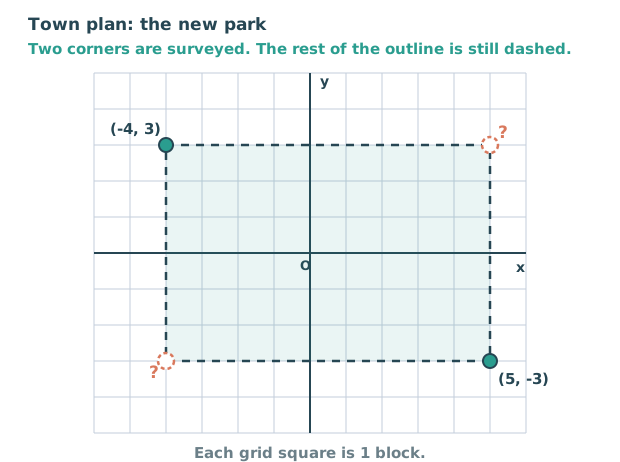
Watch me solve itI do — read one step at a time
- (-4.5, 3) and (5, 3) share y = 3, so the side between them is horizontal.
- Its length is the distance between the x-coordinates: |5 − (−4.5)| = 9.5 units.
- (5, 3) and (5, -3.75) share x = 5, so that side is vertical: |3 − (−3.75)| = 6.75 units.
Watch out — mistakes students make here
- 6 is only the width, from x = −1 to x = 5. Perimeter goes around all four sides: 6 + 3 + 6 + 3.
- 9 is the width plus the height, 6 + 3 — only two of the four sides. Add the other two sides as well.
- 3 is the number of UNITS — the scale turns units into feet.
Try it with meWe do — you answer first, then check
Same steps, new numbers.
- The shape is a rectangle, so the opposite sides match: two sides of 9.5 and two of 6.75.
- = 2(9.5) + 2(6.75) = 19 + 13.5 = 32.5 units.
- That is why two of the terms are multiplied by 2 — each length appears on two sides.
On your ownYou do — solve this one by yourself
Before you start, remember:
- A square has vertices (1, 2), (6, 2), (6, -3), (1, -3). Find one from the coordinates, then the .
- Say which pair of vertices you used and why their shared coordinate mattered.
Solve: The park's marked vertices are 3 units apart and each unit is 100 feet. What is the park's width?
My answer
Stuck? Open one hint at a time.
Hint 1
What does one unit stand for?
Hint 2
Each unit is 100 feet.
Hint 3
3 × 100.
Check my answer
3 units × 100 feet per unit = 300 feet.
Turn & TalkSay it out loud with a partner
The vertices (-4.5, 3) and (5, 3) share y = 3, so the side between them is horizontal, with length |5 − (−4.5)| = 9.5. Why is that side's length found by comparing the x-coordinates instead of the y-coordinates?
Try starting with:
- The side is horizontal because both vertices share the same ___-coordinate.El lado es horizontal porque ambos vértices comparten la misma coordenada ___.
- I subtract the ___-coordinates because that's the coordinate that ___.Resto las coordenadas ___ porque esa es la coordenada que ___.