Learn It
How do I turn a word clue into an equation?
An equation is a math sentence with an equal sign (=). To write one, I pick a letter (a variable) for the unknown number and match the words to math symbols.
Picture itSee what the math looks like before you read about it
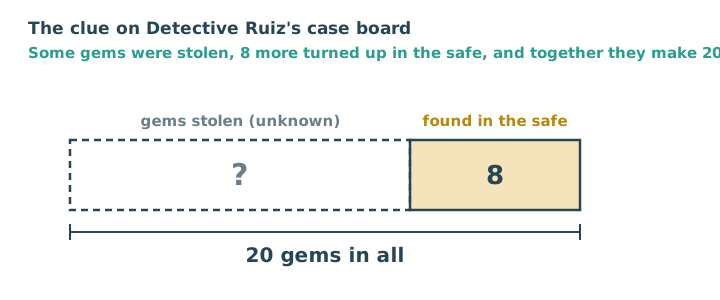
Watch me solve itI do — read one step at a time
- Clue: 'A number of stolen gems plus 8 more equals 20 total.'
- The is the number of gems. I let n stand for it.
- 'Plus 8 more' means + 8. 'Equals 20 total' means = 20.
- So my is n + 8 = 20.n + 8 = 20
Watch out — mistakes students make here
- An equation is either true or false when a value is substituted — close does not make it a solution.
- A number appearing in the equation is not automatically its solution; substitute and check.
- The 14 were found in addition to Monday's, so they are added, not subtracted.
Try it with meWe do — you answer first, then check
Same steps, new numbers.
- New clue: 'A number plus 5 equals 9.' What is the ?
- We let n be the . What does 'plus 5' tell us to write?
- What does 'equals 9' tell us?
Check this step
Put it together:n + 5 = 9
On your ownYou do — solve this one by yourself
Before you start, remember:
- Here is the from the clue: n + 5 = 9. A detective guesses n = 3.
- the guess: replace n with 3 to get 3 + 5 = 9.
- Is that statement true? 3 + 5 is 8, and 8 does not equal 9, so 3 is NOT a .
- Revise the guess and test again until the statement is true. Which value makes it true, and how do you know it is the ?
Solve: A detective found some fingerprints on Monday and 14 more on Tuesday, for a total of 30. Which represents this?
My answer
Stuck? Open one hint at a time.
Hint 1
Monday's fingerprints are the unknown f. On Tuesday she found 14 MORE, and the two days together total 30.
Hint 2
'More' means the two amounts combine into one total. Combining to reach a total is addition, not multiplying or dividing.
Hint 3
Write it in story order: f (Monday) plus 14 (Tuesday) equals 30 (total). Which choice shows that sum?
Check my answer
The detective's Monday fingerprints (f) plus 14 more equals 30: f + 14 = 30.
Turn & TalkSay it out loud with a partner
Detective Ruiz's clue says 'a number of stolen gems plus 8 more equals 20 total.' How would you turn this clue into an , and what does each part stand for?
Try starting with:
- The unknown is ___, so I write the variable ___.La incógnita es ___, así que escribo la variable ___.
- My equation is ___ because 'plus 8' means ___ and 'equals 20' means ___.Mi ecuación es ___ porque 'más 8' significa ___ y 'es igual a 20' significa ___.