Learn It
How do I graph an inequality on a number line?
Graphing an inequality shows every value that makes it true. I draw a circle at the boundary number and shade the side that works. The circle tells me if the boundary is included.
Picture itSee what the math looks like before you read about it
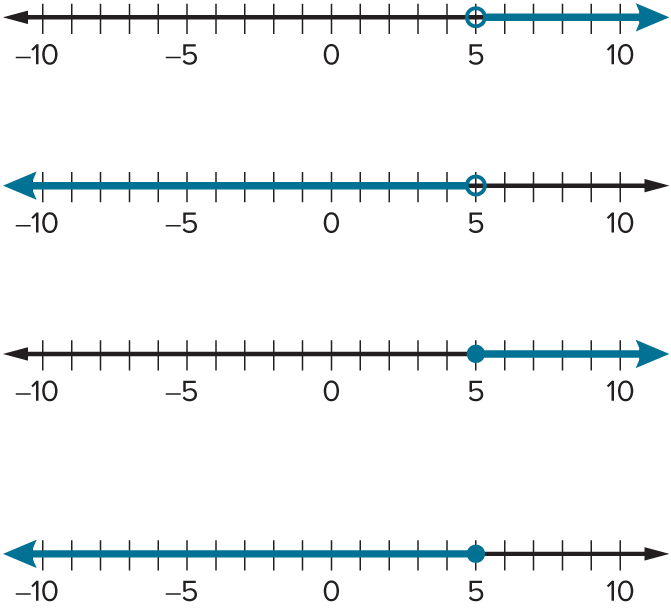
Watch me solve itI do — read one step at a time
- Graph t ≥ 2. The boundary number is 2.
- The symbol ≥ includes 2, so I draw a closed (filled) circle at 2.
- 'Greater than or equal to' means larger values work, so I shade to the right.
- Now the graph shows 2, 3, 4, and every value above 2.
Watch out — mistakes students make here
- '≥' includes 9, so the circle should be filled/closed.
- x ≥ 9 means 9 and up — shade toward larger numbers.
- Both parts are off — '≥' is a closed circle, shaded right.
Try it with meWe do — you answer first, then check
Same steps, new numbers.
- Graph x < 5. What number is the boundary?
- The symbol < does NOT include 5, so we use an open (empty) circle at 5.
- Which way do we shade for 'less than'?
Check this step
To the left, toward smaller numbers.
On your ownYou do — solve this one by yourself
Before you start, remember:
- Graph x > 4, x ≤ 7, and x ≥ 2 by choosing the right circle and shading.
- Then complete the practice graphs on your own.
Solve: A shows a at 8 and is shaded to the left. Which does this represent?
My answer
Stuck? Open one hint at a time.
Hint 1
Read the graph's two clues: the circle at 8 is CLOSED, and the shading runs LEFT toward smaller numbers.
Hint 2
A closed circle means 8 itself is a solution, so the symbol needs the 'or equal' bar. Shading left means solutions are 8 or smaller.
Hint 3
Test x = 5 (in the shaded part) and x = 8 (the circle): both must make the inequality true. Which choice passes both tests?
Check my answer
Closed circle means the value is included (≤ or ≥). Shaded left means less than or equal to: x ≤ 8.
Turn & TalkSay it out loud with a partner
Detective Okafor knows the suspect arrived 'no earlier than 2:00 PM,' so t ≥ 2. On the timeline, should the mark at 2 be an open or , and which way should she shade?
Try starting with:
- I use a ___ circle at 2 because 2:00 ___ included.Uso un círculo ___ en 2 porque las 2:00 ___ incluidas.
- I shade ___ because the times can be ___.Sombreo ___ porque las horas pueden ser ___.