EduWonderLab · An interactive Grade 6 series

Lumen
Harbor

Every issue starts with a mystery. Follow the crew through a living harbor, read the clues in the art, and use mathematics to decide what happens next.

Choose a path. Read at your pace. Your progress stays in this browser.

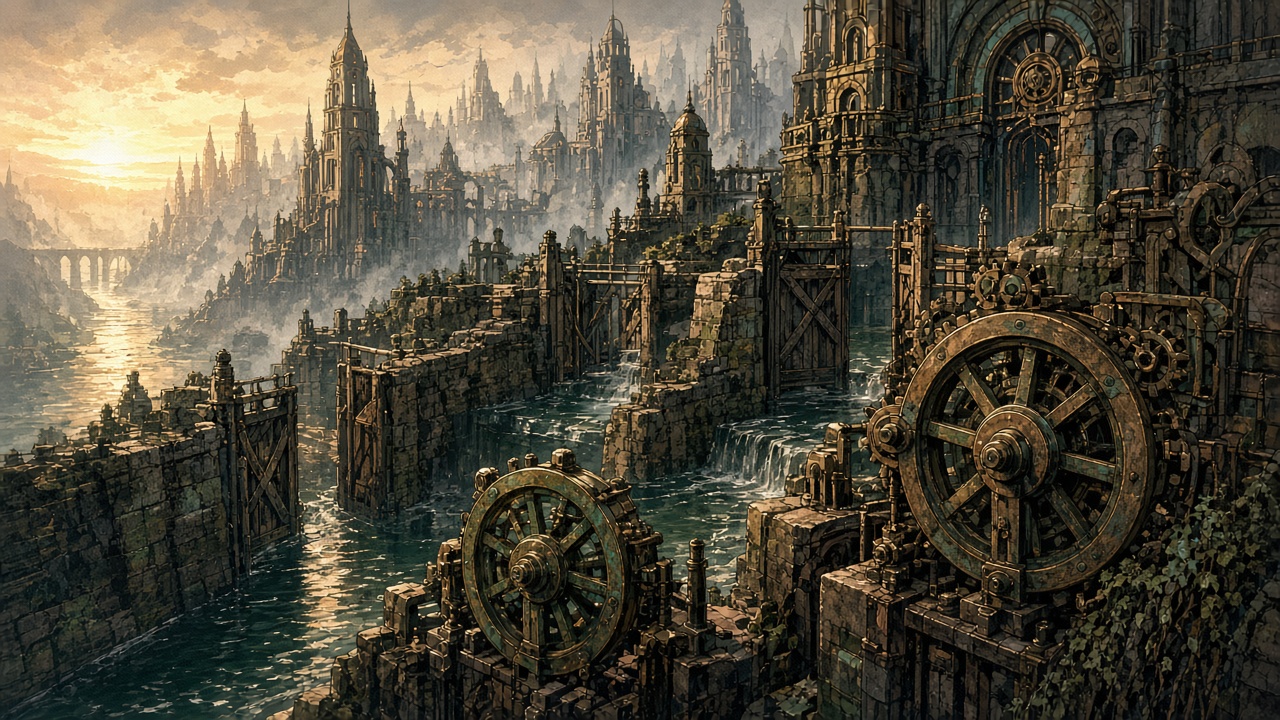
The harbor city at dusk8
STORY ARCS

STORY ARC 01 · 6.DS

The Data Files

A harbor brief has collapsed a week of measurements into one frightening number. The crew has to decide which questions, displays, and measures the evidence can actually support.

Statistics and Data Displays

ISSUE 01The Data Files

Lessons 2.1–2.2

The Question Under the Headline

Commissioner Rudd wants the harbor brief to say the air is unsafe. Mara will not print a headline until the question is statistical and the histogram can carry it.

9 scenes · 12 minRead this issue
ISSUE 02The Data Files

Lessons 2.3–2.4

The Middle of the Record

Seven nights of sky clarity can be summarized without averaging yet. Theo needs a median and a box plot before the observatory will reopen the dome.

9 scenes · 13 minRead this issue
ISSUE 03The Data Files

Lesson 2.5

The Consistency Cup

Two crews claim the steadier hand. Range makes one look chaotic. The interquartile range tells a different, fairer story.

9 scenes · 12 minRead this issue
ISSUE 04The Data Files

Lessons 2.6–2.7

The Split Shipment

The data crew is stuck behind a division problem: equal kits from a whole-number crate, then a decimal fuel log that must check by multiplication.

9 scenes · 13 minRead this issue
ISSUE 05The Data Files

Lessons 2.8–2.9

Fair Share at the Night Desk

Volunteer hours look uneven until they are redistributed into a mean. Mean absolute deviation then shows which desk stayed close to that fair share.

9 scenes · 13 minRead this issue
ISSUE 06The Data Files

Lesson 2.10

The Sensor That Shouted

One broken probe drags the mean far from the week everyone actually measured. The crew has to choose a measure that still describes a typical day.

9 scenes · 12 minRead this issue
ISSUE 07The Data Files

Lessons 2.11–2.12

The Sliding Decimal

The print shop's invoice adds, subtracts, and multiplies decimals as if the point were decoration. One corrected receipt keeps the brief in print.

9 scenes · 12 minRead this issue
STORY ARC 02 · 6.AT

The Ratio Realm

The harbor locks, railway, and outfitters all depend on pairs that must scale together. Someone has been changing only one quantity.

Ratios and Rates

ISSUE 08The Ratio Realm

Lessons 3.1–3.2

The Lock That Lost Its Mix

A tide gate is supposed to mix fresh water and salt water in the ratio 3 to 5. The wheel has been scaling only one of the two quantities.

9 scenes · 12 minRead this issue

ISSUE 09The Ratio Realm

Lessons 3.3–3.4

Signal Railway

Trains may leave only when a table and a graph describe the same equivalent ratios. One plotted point is a polite lie.

9 scenes · 13 minRead this issue
ISSUE 10The Ratio Realm

Lesson 3.5

Mixture Matchup

Two paint recipes cannot be judged by which can is larger. The crew compares blue per liter of white and restores the buoy color.

8 scenes · 12 minRead this issue
ISSUE 11The Ratio Realm

Lessons 3.6–3.7

World Expedition Outfitters

Theo's crew converts lengths inside the customary system, inside the metric system, and then across them with a stated factor.

9 scenes · 13 minRead this issue
ISSUE 12The Ratio Realm

Lesson 3.8

Best Buy Boulevard

Two jar prices look like a race toward the lowest unit rate. The storage limit makes the cheaper rate the wrong purchase.

8 scenes · 12 minRead this issue
ISSUE 13The Ratio Realm

Lessons 3.9–3.10

Scale and Sail

A 1-to-20 model of the tide gate has to stay proportional, and its lengths have to be converted before the basin test.

9 scenes · 13 minRead this issue

STORY ARC 03 · 6.AT

The Discount Conspiracy

Lantern Row is papered with percent signs that do not describe the same amount. The crew follows one honest hundred-square until the missing whole order reappears.

Percents

ISSUE 14The Discount Conspiracy

Lessons 4.1–4.2

The Hundred Lanterns

A shop on Lantern Row shades 40 lanterns out of 100 and calls the same picture 4 percent, 0.04, and 'almost half.' The crew makes one amount wear three true names.

9 scenes · 13 minRead this issue
ISSUE 15The Discount Conspiracy

Lessons 4.3–4.4

The Sign That Overreaches

A discount sign estimates kindly and charges something else. The crew benchmarks a percent, finds the exact sale price, and compares two offers.

9 scenes · 14 minRead this issue
ISSUE 16The Discount Conspiracy

Lesson 4.5

The Missing Order

Fifteen lanterns are all that remain of a packing list, and they are 30 percent of the order. The crew rebuilds the whole from a part and a percent.

9 scenes · 13 minRead this issue

STORY ARC 04 · 6.GR

The Geometry Architects

A pavilion bid has priced the wrong region: slanted sides treated as heights, faces counted twice, and square units ordered where cubic units belong.

Area, Surface Area, and Volume

ISSUE 17The Geometry Architects

Lessons 5.1–5.2

The Garden That Would Not Sit Still

A pavilion garden is drawn as a parallelogram and a triangle with the same base and height. The bid uses a slanted side as the height. The areas disagree until the perpendicular height is restored.

9 scenes · 13 minRead this issue
ISSUE 18The Geometry Architects

Lessons 5.3–5.4

The Floor That Counted Twice

A festival floor is a trapezoid plus a composite of a rectangle and a triangle. One decomposition counts the shared region twice. The crew finds an area that can be walked exactly once.

9 scenes · 13 minRead this issue
ISSUE 19The Geometry Architects

Lessons 5.5–5.6

The Crate and Its Shadow

A rectangular prism of stone is priced as if its net were its volume. The crew counts cubic units, then chooses the net that could actually fold into the crate.

9 scenes · 13 minRead this issue
ISSUE 20The Geometry Architects

Lessons 5.7–5.8

Cloth for the Scaffold

Wrapping a prism and a square pyramid means counting every face once. The pyramid's slant height, not its standing height, belongs on the triangular faces.

9 scenes · 13 minRead this issue
ISSUE 21The Geometry Architects

Lessons 5.9–5.10

The Pavilion's Two Questions

A regular polygon floor and a storage prism sit in the same pavilion and on the same dishonest invoice. The crew separates square units from cubic units and closes the architectural file.

9 scenes · 12 minRead this issue

STORY ARC 05 · 6.NOS

The Expression Code

The Archive door will open only for expressions that keep their value. Exponents, factors, and fraction division are parts of the same key.

Expressions

ISSUE 22The Expression Code

Lessons 6.1–6.2

Servings at the Night Kitchen

The Archive kitchen will not open until a division expression says how many servings fit in a pot. The quotient counts groups, not leftovers.

9 scenes · 12 minRead this issue
ISSUE 23The Expression Code

Lessons 6.3–6.4

The Power Cell

A cell labeled 2⁵ has been wired as 2×5. The crew evaluates the power, then a numerical expression where exponents outrank multiplication.

9 scenes · 12 minRead this issue
ISSUE 24The Expression Code

Lessons 6.5–6.6

The Gate Expression

An archive gate substitutes a number for x and then checks whether two expressions stay equal. Equivalent has to mean equal for the value that matters, and not by accident of one sloppy rewrite.

9 scenes · 13 minRead this issue
ISSUE 25The Expression Code

Lessons 6.7–6.8

Gears in Common

Two gears mesh only at a common factor, and an expression factors only when the shared factor is pulled from every term. The factory lock wants both.

9 scenes · 12 minRead this issue
ISSUE 26The Expression Code

Lessons 6.9–6.10

Ribbon Rescue

Whole yards of ribbon are cut into fractional bows, and a mixed-number spool is cut the same way. The last spool does not divide evenly, so complete bows and leftover length must be told apart.

9 scenes · 13 minRead this issue
ISSUE 27The Expression Code

Lesson 6.11

The Supply That Would Not Stretch

A field team has nine liters of water and bottles of three-quarters of a liter. The quotient is exact, the leftover case is not, and the meaning of each number decides whether the team can leave.

9 scenes · 12 minRead this issue
ISSUE 28The Expression Code

Lessons 6.12–6.13

When the Signals Meet

Two beacons flash on different cycles. Their first shared minute is a least common multiple, and a gear inside one beacon only makes sense after it is written as a product of primes.

9 scenes · 12 minRead this issue
ISSUE 29The Expression Code

Lessons 6.14–6.15

The Simplified Key

The Archive's last expression must be expanded with the distributive property and then simplified by combining like terms. The value has to survive both rewrites.

9 scenes · 13 minRead this issue

STORY ARC 06 · 6.NOS

The Coordinate Expedition

A backup depot was surveyed from sea level and then copied onto a map that may be mirrored. Elevation, order, and distance have to agree.

Integers and the Coordinate Plane

ISSUE 30The Coordinate Expedition

Lessons 7.1–7.2

Above and Below the Lock

Sea level is zero on the depot survey. Elevations and their opposites have to be named before anyone climbs or dives with the wrong sign.

9 scenes · 12 minRead this issue
ISSUE 31The Coordinate Expedition

Lessons 7.3–7.4

Distance from the Surface

Absolute value tells the crew how far a reading is from sea level. Ordering the same readings tells them which is greater. Mixing the two sends the rescue the wrong way.

9 scenes · 12 minRead this issue
ISSUE 32The Coordinate Expedition

Lessons 7.5–7.6

Couriers of the Four Quadrants

A parcel for the backup depot belongs in quadrant II. Couriers must plot the point and then measure the horizontal and vertical street distances that actually exist.

9 scenes · 13 minRead this issue
ISSUE 33The Coordinate Expedition

Lessons 7.7–7.8

The Park on the Grid

A rectangular park crosses the axes. Its corners, side lengths, perimeter, and area all have to come from the coordinates, including the ones in negative quadrants.

9 scenes · 13 minRead this issue
ISSUE 34The Coordinate Expedition

Lesson 7.9

The Mirror Check

A filed point may be a reflection of the depot. The crew reflects across each axis, checks the distance to the mirror, and refuses the flipped map.

9 scenes · 12 minRead this issue

STORY ARC 07 · 6.AT

The Equation Protocol

The vault accepts a value only when both sides name the same amount, and the repair budget is a boundary, not a single target.

Equations and Inequalities

ISSUE 35The Equation Protocol

Lessons 8.1–8.2

The Scale That Would Not Rest

A vault scale shows an equation. A value is a solution only when both sides match, and addition or subtraction has to happen on both sides or the scale tips again.

9 scenes · 13 minRead this issue
ISSUE 36The Equation Protocol

Lesson 8.3

The Vault Key

Multiplication and division equations lock a drawer. The crew solves them with inverse operations and checks by putting the key back into the original equation.

9 scenes · 12 minRead this issue
ISSUE 37The Equation Protocol

Lessons 8.4–8.5

The Entry Rule

The arcade's rules are inequalities. The crew writes them, decides whether the boundary is included, and tests values before anyone is turned away by a bad symbol.

9 scenes · 12 minRead this issue
ISSUE 38The Equation Protocol

Lessons 8.6–8.7

The Repair Budget

A parts budget is an inequality to solve and graph. The final purchase has to satisfy the mathematics and the practical constraint of whole parts.

9 scenes · 13 minRead this issue

STORY ARC 08 · 6.AT

The Pattern Network

The city's last locked brief is not one number. It is a relationship between two changing quantities, and the fair on the hill is running out of time to use it.

Two-Variable Relationships

ISSUE 39The Pattern Network

Lessons 9.1–9.2

The Two Needles

A weather station records hours of a storm and centimeters of rain as a relationship. The table, the graph, and the claim have to describe the same pair of variables.

9 scenes · 13 minRead this issue
ISSUE 40The Pattern Network

Lessons 9.3–9.4

The Booth That Told the Truth

Two fair plans relate hours to cost. The crew writes the equations, compares them at more than one input, and chooses with the relationship still attached. The harbor's long argument about single numbers finally has an answer.

9 scenes · 14 minRead this issue