Touch and changeToca y cambia
Move, type, tap, or drag in the model. Watch what changes.Mueve, escribe, toca o arrastra en el modelo. Observa qué cambia.
Unit 10 · MPP.7
Math is Playful · Lesson 10-3
English: Use the pictures and short steps. Ask questions; let your student do the thinking. Español: Usen los dibujos y los pasos cortos. Hagan preguntas; dejen que su estudiante piense.
Tonight we play with the Tower of Hanoi puzzle and look for a pattern that predicts the number of moves.
Esta noche jugamos con el rompecabezas de la Torre de Hanói y buscamos un patrón que prediga la cantidad de movimientos.
Follow the picture pathSigan la ruta visual
The puzzle: move a stack of discs to another rod, one disc at a time, never putting a bigger disc on a smaller one.
El rompecabezas: mover una pila de discos a otra varilla, un disco a la vez, sin poner nunca un disco grande sobre uno pequeño.
One disc takes 1 move.
Un disco toma 1 movimiento.
Two discs take 3 moves. Three discs take 7 moves.
Dos discos toman 3. Tres discos toman 7.
Look at the pattern: 1, 3, 7 … each answer is double the one before, plus 1.
Miren el patrón: 1, 3, 7… cada respuesta es el doble de la anterior, más 1.
So four discs take 7 × 2 + 1 = 15 moves — predicted from the pattern, without playing it.
Entonces cuatro discos toman 7 × 2 + 1 = 15 movimientos, predicho por el patrón, sin jugarlo.
Listen for "pattern rule" (regla del patrón) — the sentence "double it and add one."
Escucha "regla del patrón": la frase "duplícalo y suma uno".
You can play at home with coins of different sizes and three spots on the table.
Pueden jugar en casa con monedas de distintos tamaños y tres lugares en la mesa.
Starting with the smallest case is a real math strategy, not a shortcut.
Empezar por el caso más pequeño es una estrategia matemática real, no un atajo.
Use the same interactive model from the lesson. Change it, notice the pattern, and explain what the model shows.Usa el mismo modelo interactivo de la lección. Cámbialo, observa el patrón y explica lo que muestra.
Move, type, tap, or drag in the model. Watch what changes.Mueve, escribe, toca o arrastra en el modelo. Observa qué cambia.
Record one equation, value, or relationship you can see.Escribe una ecuación, un valor o una relación que puedas ver.
I notice ___ changes when ___ changes. This shows ___.Noto que ___ cambia cuando ___ cambia. Esto muestra ___.
Algorithmic Thinking & Recursive Patterns. 1. Deconstruct complex multi-step problems into smaller, repeatable sub-tasks. 2. Trace patterns from simple cases to formulate general mathematical rules. 3. Verify algorithmic rules across edge cases and increasing problem sizes
A quick, no-timer review game for tonight's lesson — sort, match, and choose. A wrong answer just gives a hint and lets your student try again. Un juego de repaso sin reloj para la lección de hoy — clasificar, emparejar y elegir. Si se equivocan, reciben una pista y pueden intentar de nuevo.
↗ Play full screen ↗ Jugar en pantalla completa
Tap a card to flip. Use these words when you talk about the math together. Toquen una tarjeta para voltearla. Usen estas palabras cuando hablen de la matemática juntos.

rompecabezas
A problem designed to be played with — it has rules, a goal, and room to imagine solutions.
Un problema diseñado para jugarse: tiene reglas, una meta y espacio para imaginar soluciones.
📌 Tower of Hanoi: three rods, a stack of discs, and two rules.
patrón
Something that repeats or changes in a predictable way.
Algo que se repite o cambia de una manera predecible.
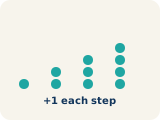
📌 Circle, square, triangle, circle, square, triangle …
regla del patrón
A rule that tells you how to get the next value in a pattern from the one before it.
Una regla que te dice cómo obtener el siguiente valor de un patrón a partir del anterior.
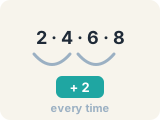
📌 1 → 3 → 7 → 15: the rule is “double it and add 1”.
predecir
To say what will happen before it happens, using a pattern or reasoning.
Decir lo que va a pasar antes de que pase, usando un patrón o el razonamiento.
📌 The rule says a five-disc tower needs 31 steps — before moving a disc.

organizar
To arrange information — often in a table — so patterns become easier to see.
Ordenar la información, muchas veces en una tabla, para que los patrones sean más fáciles de ver.
📌 Discs 1, 2, 3 in one column and steps 1, 3, 7 in the next.
Use three coins of different sizes and three spots on the table.
Usen tres monedas de distintos tamaños y tres lugares en la mesa.
Work side by side. You ask questions; your student does the thinking. Trabajen juntos. Tú haces preguntas; tu estudiante piensa.
Move a stack of 2 coins to another spot. Count the moves.
Muevan una pila de 2 monedas a otro lugar. Cuenten los movimientos.
Now try 3 coins and count.
Ahora prueben con 3 monedas y cuenten.
Predict 4 coins before trying it.
Predigan 4 monedas antes de intentarlo.
Do these together. Start at ★ and climb to ★★★ when ready. Háganlos juntos. Empiecen en ★ y suban a ★★★ cuando estén listos.
What is the fewest number of moves needed to solve a three-disc Tower of Hanoi puzzle?
A. 7 moves
Which move is against the rules of the Tower of Hanoi?
A. Placing a larger disc on top of a smaller disc
The table shows 1 disc → 1 step, 2 discs → 3 steps, 3 discs → 7 steps. What is the pattern rule for the number of steps when you add one more disc?
A. Double the number of steps and add 1
Use the pattern rule to complete the table: how many steps for a four-disc tower?
A. 15 steps
A five-disc tower takes 31 steps. Using the pattern rule, how many steps would a SIX-disc tower take?
A. 63 steps
⏱️ Plan on about 15–20 minutes for the 6 problems below. The extra practice at the bottom is optional. ⏱️ Calculen unos 15–20 minutos para los 6 problemas de abajo. La práctica extra al final es opcional.
A few problems to practice together. Each one has a step-by-step guide, a picture to draw on, and a space to show your work. Use Check This Problem for instant feedback — no need to finish everything at once. Unos problemas para practicar juntos. Cada uno tiene una guía paso a paso, un dibujo para trabajar y un espacio para mostrar el trabajo. Usen Revisar esta pregunta para retroalimentación al instante — no tienen que terminar todo de una vez.
Easier problems to practice the idea. Do these first together. Problemas más fáciles para practicar la idea. Hagan estos primero juntos.
Why is finding a pattern MORE powerful than just solving the three-disc puzzle by hand?¿Por qué encontrar un patrón es MÁS poderoso que solo resolver a mano el rompecabezas de tres discos?
👪 Read the question together, then let your student pick an answer before you discuss why.👪 Lean la pregunta juntos; dejen que su estudiante elija antes de hablar del porqué.
Will the fewest number of steps for a Tower of Hanoi puzzle always be an ODD number?¿El menor número de pasos de la Torre de Hanói siempre será un número IMPAR?
👪 Read the question together, then let your student pick an answer before you discuss why.👪 Lean la pregunta juntos; dejen que su estudiante elija antes de hablar del porqué.
The table shows 1 disc → 1 step, 2 discs → 3 steps, 3 discs → 7 steps. What is the pattern rule for the number of steps when you add one more disc?La tabla muestra 1 disco → 1 paso, 2 discos → 3 pasos, 3 discos → 7 pasos. ¿Cuál es la regla del patrón para el número de pasos cuando agregas un disco más?
👪 Read the question together, then let your student pick an answer before you discuss why.👪 Lean la pregunta juntos; dejen que su estudiante elija antes de hablar del porqué.
Try these once the warm-up feels easy. It's okay to use the steps and pictures. Intenten estos cuando el calentamiento sea fácil. Está bien usar los pasos y los dibujos.
El Rompecabezas del 15 es un rompecabezas deslizante con 15 fichas en un marco de 4 fichas de alto por 4 de ancho. Ordenas las fichas del 1 al 15 deslizando una a la vez hacia el espacio vacío. A veces tiene solución y a veces no. ¿Cómo construirías un argumento sobre si un Rompecabezas del 15 en particular tiene solución, usando lo que esta lección enseñó sobre ser juguetón?
👪 A complete sentence with math vocabulary is the goal — not a perfect paragraph.👪 Una oración completa con vocabulario matemático es la meta — no un párrafo perfecto.
El resumen dice que jugar con las matemáticas nos permite pensar de otra manera al buscar patrones Y al imaginar formas de visualizar un problema. Describe cómo usaste AMBAS con la Torre de Hanói.
👪 A complete sentence with math vocabulary is the goal — not a perfect paragraph.👪 Una oración completa con vocabulario matemático es la meta — no un párrafo perfecto.
Look at the table a different way: 1 disc → 1, 2 discs → 3, 3 discs → 7, 4 discs → 15, 5 discs → 31. Which describes the relationship between the number of discs and the number of steps?Mira la tabla de otra manera: 1 disco → 1, 2 discos → 3, 3 discos → 7, 4 discos → 15, 5 discos → 31. ¿Cuál describe la relación entre el número de discos y el número de pasos?
👪 Read the question together, then let your student pick an answer before you discuss why.👪 Lean la pregunta juntos; dejen que su estudiante elija antes de hablar del porqué.
Optional. Only if your student wants more — these are bonus problems. Opcional. Solo si tu estudiante quiere más — son problemas adicionales.
Which move is against the rules of the Tower of Hanoi?¿Cuál movimiento va contra las reglas de la Torre de Hanói?
👪 Read the question together, then let your student pick an answer before you discuss why.👪 Lean la pregunta juntos; dejen que su estudiante elija antes de hablar del porqué.
Sort each move: legal or against the rules?Clasifica cada movimiento: ¿legal o contra las reglas?
👪 On a phone, use Move to. On a computer, drag cards or tap a card then tap a column.👪 En el teléfono usen Mover a. En la computadora arrastren o toquen tarjeta y columna.
💡 Only the TOP disc of a stack can move, and only one at a time.Solo el disco de ARRIBA de una pila puede moverse, y solo uno a la vez.
💡 The size rule: smaller may rest on bigger, never the reverse.La regla del tamaño: el pequeño puede descansar sobre el grande, nunca al revés.
¿Cómo puedes ORGANIZAR la información sobre discos y movimientos para ayudarte a ver patrones?
👪 A complete sentence with math vocabulary is the goal — not a perfect paragraph.👪 Una oración completa con vocabulario matemático es la meta — no un párrafo perfecto.
Use the pattern rule to complete the table: how many steps for a four-disc tower?Usa la regla del patrón para completar la tabla: ¿cuántos pasos para una torre de cuatro discos?
👪 Read the question together, then let your student pick an answer before you discuss why.👪 Lean la pregunta juntos; dejen que su estudiante elija antes de hablar del porqué.
What is the minimum number of steps to solve a FIVE-disc Tower of Hanoi puzzle?¿Cuál es el número mínimo de pasos para resolver la Torre de Hanói de CINCO discos?
👪 Read the question together, then let your student pick an answer before you discuss why.👪 Lean la pregunta juntos; dejen que su estudiante elija antes de hablar del porqué.
Antes de resolver, la lección te pidió DESCRIBIR cómo se verá la solución. ¿Por qué imaginar el final es una manera útil de empezar un rompecabezas?
👪 A complete sentence with math vocabulary is the goal — not a perfect paragraph.👪 Una oración completa con vocabulario matemático es la meta — no un párrafo perfecto.
A five-disc tower takes 31 steps. Using the pattern rule, how many steps would a SIX-disc tower take?Una torre de cinco discos toma 31 pasos. Usando la regla del patrón, ¿cuántos pasos tomaría una torre de SEIS discos?
👪 Read the question together, then let your student pick an answer before you discuss why.👪 Lean la pregunta juntos; dejen que su estudiante elija antes de hablar del porqué.
What is the fewest number of moves needed to solve a three-disc Tower of Hanoi puzzle?¿Cuál es el menor número de movimientos necesarios para resolver la Torre de Hanói de tres discos?
👪 Read the question together, then let your student pick an answer before you discuss why.👪 Lean la pregunta juntos; dejen que su estudiante elija antes de hablar del porqué.
A digital scratch pad to draw models, line up decimals, and show your work. It opens in a new tab so you keep your place on this homework. Una pizarra digital para dibujar modelos, alinear decimales y mostrar el trabajo. Se abre en una pestaña nueva para no perder tu lugar en esta tarea.
🧮 Open the Math Workbench ↗ 🧮 Abrir la Pizarra de matemáticas ↗
What happened with just two discs?
¿Qué pasó con solo dos discos?
How does each answer relate to the one before it?
¿Cómo se relaciona cada respuesta con la anterior?
Can you predict before you play?
¿Puedes predecir antes de jugar?
Just keep moving pieces until it works.
Solo sigue moviendo piezas hasta que salga.
There is no pattern, it is just a game.
No hay patrón, es solo un juego.
Let me solve it for you.
Deja que yo lo resuelva por ti.
These links go to specific videos and lessons about tonight's topic — not general math pages. Estos enlaces van a videos y lecciones específicas sobre el tema de hoy — no páginas generales.
Reinforce tonight's topic with a quick family game. You ask; your student decides! Refuercen el tema de hoy con un juego rápido en familia. ¡Ustedes preguntan; su estudiante decide!
🎮 Play together! Use tonight's vocabulary words as you play! 🎮 ¡Jueguen juntos! ¡Usen las palabras del vocabulario de hoy mientras juegan!
High five! Whether every answer was perfect or not, you showed up for your student tonight. That matters.
¡Chócalas! No importa si cada respuesta fue perfecta — estuviste con tu estudiante esta noche. Eso importa.
Answers save automatically on this device. Tap Check This Problem anytime. Las respuestas se guardan solas en este dispositivo. Toquen Revisar esta pregunta cuando quieran.
Signed on:Firmado el:
Note to teacher / Nota para el maestro:
This certifies that the homework for was completed and reviewed collaboratively.
Parent/Guardian Signature
Date