Understand Rates and Unit Rates
I can find a unit rate to compare prices and decide the better buy.
How to Use This Deck
Click Present or press F11 for fullscreen. Use arrow keys to advance.
Blue boxes show exactly what to say, ask, and how long to spend.
Text boxes, polls, and drag-sort save automatically in the browser.
Press N or click 📝 in the toolbar for pacing tips and answers.
Launch the full HTML activity for independent practice.
File → Print or the print button for handout copies.
🎯 Content Objective / Objetivo de contenido
I can find a unit rate to compare prices and decide the better buy.
Today's Flow
Total pacing: ~45 min · Progress bar at top tracks your place
LAUNCH
⏱ ~10 min
⏱️ 3 MIN · THINK-PAIR-SHARE
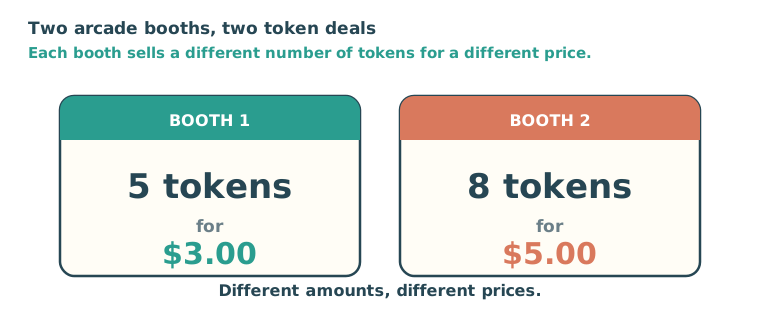
Booth A charges $3 for 5 games and Booth B charges $5 for 8 games. Just by looking, which booth seems like the better deal, and what makes it hard to be sure?
Check for Understanding #1
Teacher: If >30% thumbs down, re-teach with a fresh example before moving on.
Arcade Builder Challenge
You're comparing ticket prices at different game booths in the arcade. Booth A charges $3 for 5 games, and Booth B charges $5 for 8 games. Which booth gives you a better deal? To find out, you need to figure out the cost per game — that's the unit rate!
Concept Launch
💡 What is a unit rate, and how does it help me find the better buy?
A rate compares two amounts with different units. A unit rate tells you the amount for just 1 of something, like the cost for 1 game.
Rates & Unit Rates. Formula: Unit Rate = (Total Quantity) ÷ (Number of Units). 1. Rate: A ratio comparing two quantities with different units (e.g. $12 for 3 lbs). 2. Unit Rate: A rate simplified to a denominator of 1 unit ($4 per 1 lb). 3. Divide numerator by denominator to compute the per-one amount
Check for Understanding #2
Teacher: If >30% thumbs down, re-teach with a fresh example before moving on.
Now it's your turn
VOCABULARY
⏱ ~8 min
| Term / Término | Meaning / Significado | Example / Ejemplo | Visual |
|---|---|---|---|
| Rates and Unit Rates Tasas y tasas unitarias |
A rate compares different units; a unit rate compares a quantity to 1 unit. Una tasa compara unidades diferentes; una tasa unitaria compara una cantidad con 1 unidad. |
180 miles in 3 hours = 60 miles per 1 hour. | |
| Rate Tasa |
A ratio comparing two amounts with different units, like miles per hour. Una razón que compara dos cantidades con unidades distintas, como millas por hora. |
$12 for 4 games is a rate | |
| Unit Rate Tasa unitaria |
A rate for just 1 of something, like cost for 1 item. Una tasa para solo 1 de algo, como el precio de 1 artículo. |
$3 per 1 game | |
| Per Por |
For each one. Example: 5 dollars per book. Por cada uno. Ejemplo: 5 dólares por libro. |
60 miles per hour means 60 miles for every 1 hour | |
| Ratio Razón |
A way to compare two amounts, like 3 to 2. Una manera de comparar dos cantidades, como 3 a 2. |
5 to 3 or 5:3 | |
| Unit price Precio unitario |
A unit rate that gives the cost of exactly 1 item, like $0.60 per game. Una tasa unitaria que da el costo de exactamente 1 artículo, como $0.60 por juego. |
$3 for 5 games → $0.60 per 1 game |
Which Word Fits?
A rate compares different units; a ___ ___ compares a quantity to exactly 1 unit.
Use It In a Sentence
Check for Understanding #3
Teacher: If >30% thumbs down, re-teach with a fresh example before moving on.
Turn & Talk — Launch
Booth A charges $3 for 5 games and Booth B charges $5 for 8 games. Just by looking, which booth seems like the better deal, and what makes it hard to be sure?
👂 Listen For
Students notice the prices cannot be compared directly because the number of games differs, so they need the cost for one game (the unit rate) to compare fairly.
Extend: Why can you not just pick the booth with the lower total price of $3? Explain what a fair comparison actually needs.
EXPLORE & PRACTICE
⏱ ~18 min
Visual Modeling Workspace
Use the drawing tray below to annotate the visual model. Teacher: say "Click to reveal" on key steps.
Explore Activity
Calculate the unit rate (cost per game) for each arcade booth. Divide the total cost by the number of games.
✍️ Explore Discourse
How does finding the unit rate help you compare the booths?
Whiteboard Moment
Show your work clearly. Be ready to explain your thinking to a partner.
Turn & Talk — Explore
How did you find the cost per game (the unit rate) for each booth, and what did you divide?
👂 Listen For
Students explain they divided total cost by number of games (e.g., $5.00 div 8 = $0.625) and state the result as a cost per one game.
Extend: Two booths in your table had different totals but the same unit rate. How is that possible, and what does it tell you about the deals?
Practice Check A
Token packs: Pack A is 20 tokens for $5.00, Pack B is 35 tokens for $7.00, and Pack C is 50 tokens for $12.50. Which pack is the best deal per token?
✍️ Show Your Work
Explain why your answer is correct using today's vocabulary.
Practice Check B
Runner A completes 4 laps in 12 minutes. Runner B completes 5 laps in 14 minutes. Who runs more laps per minute?
✍️ Show Your Work
Explain why your answer is correct using today's vocabulary.
Ratio Table Builder
Fill the ratio table. Each row must be equivalent.
| Factor | A | B |
|---|---|---|
| ×1 | ||
| ×2 | ||
| ×3 |
✍️ Justify Your Thinking
Sort each situation by whether the unit rate is 'per item' or 'per time'.
A classmate turned in the work below. One step has a mistake. Read every step, find it, name it, and fix it.
Choose ONE option to show what you know — then do it in the workspace below.
Use evidence from today's lesson to complete each frame.
Today's key idea is: "Rates & Unit Rates. Formula: Unit Rate = (Total Quantity) ÷ (Number of Units). 1. Rate: A ratio comparing two quantities with different units (e.g. $12 for 3 lbs). 2. Unit Rate: A rate simplified to a denominator of 1 unit ($4 per 1 lb). 3. Divide numerator by denominator to compute the per-one amount" — and it works because ___.
Because Rates and Unit Rates means ___, but a tricky part is ___, so I have to ___.
A common mistake with Rates and Unit Rates is ___. It happens because ___, and the fix is ___.
I can prove my answer is correct by ___, using Rate to check my work.
✍️ TWR · WRITE 3 SENTENCES · 7 MIN
Rates & Unit Rates. Formula: Unit Rate = (Total Quantity) ÷ (Number of Units). 1. Rate: A ratio comparing two quantities with different units (e.g. $12 for 3 lbs). 2. Unit Rate: A rate simplified to a denominator of 1 unit ($4 per 1 lb). 3. Divide numerator by denominator to compute the per-one amount because ___
Rates & Unit Rates. Formula: Unit Rate = (Total Quantity) ÷ (Number of Units). 1. Rate: A ratio comparing two quantities with different units (e.g. $12 for 3 lbs). 2. Unit Rate: A rate simplified to a denominator of 1 unit ($4 per 1 lb). 3. Divide numerator by denominator to compute the per-one amount but ___
Rates & Unit Rates. Formula: Unit Rate = (Total Quantity) ÷ (Number of Units). 1. Rate: A ratio comparing two quantities with different units (e.g. $12 for 3 lbs). 2. Unit Rate: A rate simplified to a denominator of 1 unit ($4 per 1 lb). 3. Divide numerator by denominator to compute the per-one amount so ___
🌱 TWR · GROW THE KERNEL · 6 MIN
Answer these to add detail
Sentence starters (tap to use)
Student Workspace
Calculate the unit rate (cost per game) for each arcade booth. Divide the total cost by the number of games.
| Booth | Games | Total Cost | Cost per Game (Unit Rate) |
|---|---|---|---|
| Booth A | 5 | $3.00 | $0.60 |
| Booth B | 8 | $5.00 | |
| Booth C | 4 | $2.80 | |
| Booth D | 10 | $6.50 | |
| Booth E | 6 | $3.90 | |
| Booth F | 3 | $2.25 |
✏️ Sketch Your Strategy
Differentiation Paths
Step-by-step with a worked model and sentence frames.
A booth charges $4.50 for 9 games. What is the unit rate?
Core practice aligned to the standard.
Extension with error analysis or multi-step reasoning.
Partner Activity
Work with your partner on the practice problems at your differentiation path level. Explain each step using math vocabulary.
Check for Understanding #4
Teacher: If >30% thumbs down, re-teach with a fresh example before moving on.
Real-World Connection
🌍 Math in the Wild
The arcade snack bar sells popcorn in two sizes: a small bag with 3 cups for $2.25 and a large bag with 8 cups for $5.60. You want the most popcorn for your money.
✍️ Connection Reasoning
Which size is the better deal, and how do you know?
The ___ bag is the better deal because its unit rate is $___ per cup, which is ___ than $___ per cup for the other size.
Turn & Talk — Connect
The snack bar sells popcorn as 3 cups for $2.25 or 8 cups for $5.60. How do unit rates help you decide the better buy?
👂 Listen For
Students compute $0.75/cup and $0.70/cup, and choose the large bag because the lower unit rate means each cup costs less.
Extend: A friend says the large bag must be the better buy because it costs less per cup AND gives more popcorn. Is 'more popcorn' a fair reason to call it the better buy? Justify using the unit rate.
Summarize: Understand Rates and Unit Rates
Rates & Unit Rates. Formula: Unit Rate = (Total Quantity) ÷ (Number of Units). 1. Rate: A ratio comparing two quantities with different units (e.g. $12 for 3 lbs). 2. Unit Rate: A rate simplified to a denominator of 1 unit ($4 per 1 lb). 3. Divide numerator by denominator to compute the per-one amount
In your own words:
CLOSURE & REFLECT
⏱ ~8 min
Today I learned that ___ because ___.
One thing I am still not sure about is ___.
A store sells 6 pencils for $1.50 and 10 pencils for $2.80. Which is the better buy?
Bonus Exit Check
A booth charges $4.50 for 9 games. What is the unit rate?
✍️ Show Your Work
Explain why your answer is correct using today's vocabulary.
Reflection & Self-Assessment
Continue Learning
Launch the Full Interactive Activity
Students continue practice in the HTML lesson engine with auto-check, hints, and differentiation.
Family Connection
Share tonight's family homework and discuss one vocabulary word at home.
Open Family Homework ↗Teacher Notes
⏱️ Pacing Guide
- Launch & vocab: 12 min
- I Do / We Do / You Do: 15 min
- Explore & practice: 15 min
- Connect & closure: 8 min
Total: ~45 min
🎯 Listen For · Common Errors
• Students notice the prices cannot be compared directly because the number of games differs, so they need the cost for one game (the unit rate) to compare fairly.
• Students explain they divided total cost by number of games (e.g., $5.00 div 8 = $0.625) and state the result as a cost per one game.
• Students compute $0.75/cup and $0.70/cup, and choose the large bag because the lower unit rate means each cup costs less.
• Listen for students naming a specific strategy tied to 6.AT.2 — not just "I multiplied." They should connect steps to the key idea.
Common mistake: A common mistake in Rates and Unit Rates is comparing total costs instead of unit rates: a student sees Pack X at $4.00 for 10 tokens and Pack Y at $6.00 for 16 tokens and picks Pack X just because $4.00 is the smaller number, without dividing to find the cost per token ($0.40 for Pack X vs. $0.375 for Pack Y — Pack Y is actually the better buy). A second common mistake is dividing backwards — finding tokens ÷ cost instead of cost ÷ tokens — which turns 'dollars per token' into 'tokens per dollar' and gives an answer that looks reasonable but answers the wrong question. Always divide the total cost by the number of items, and check that your unit rate answers 'the cost for ONE item,' not the reverse.
Answer Key (Teacher Appendix)
Hide this slide during presentation or move to the end of your copy.
✓ Practice 1: Pack B — Pack B has a unit rate of $0.20 per token, which is the lowest cost per token.
✓ Practice 2: Runner B — Runner A: 4÷12 ≈ 0.33 laps/min. Runner B: 5÷14 ≈ 0.36 laps/min. Runner B runs slightly more laps per minute.
✓ Practice 3: $0.50 per game — $4.50 ÷ 9 = $0.50 per game.
✓ Practice 4: 30 miles per gallon — 180 miles ÷ 6 gallons = 30 miles per gallon.
✓ Exit ticket: 6 for $1.50 — $0.25 each — $1.50 ÷ 6 = $0.25 per pencil. $2.80 ÷ 10 = $0.28 per pencil. $0.25 < $0.28, so 6 for $1.50 is the better buy.