Understand Percent
I can explain a percent as a rate per 100, model it on a decimal grid or tape diagram, and interpret percents greater than 100%.
How to Use This Deck
Click Present or press F11 for fullscreen. Use arrow keys to advance.
Blue boxes show exactly what to say, ask, and how long to spend.
Text boxes, polls, and drag-sort save automatically in the browser.
Press N or click 📝 in the toolbar for pacing tips and answers.
Launch the full HTML activity for independent practice.
File → Print or the print button for handout copies.
🎯 Content Objective / Objetivo de contenido
I can explain a percent as a rate per 100, model it on a decimal grid or tape diagram, and interpret percents greater than 100%.
Today's Flow
Total pacing: ~45 min · Progress bar at top tracks your place
LAUNCH
⏱ ~10 min
⏱️ 3 MIN · THINK-PAIR-SHARE
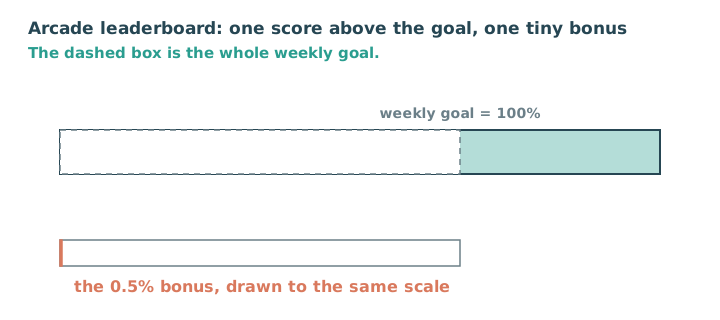
The leaderboard shows one player hit 150% of the goal and a bonus round gives a 0.5% boost. How can a percent be more than the whole, and how can one be a tiny sliver?
Check for Understanding #1
Teacher: If >30% thumbs down, re-teach with a fresh example before moving on.
Percent Builder
The arcade posts every result as a percent of the weekly goal. A percent compares a number to 100 — so 40% means 40 out of every 100. Some players land under the goal, and some blow past it: a score of 150% means one and a half times the whole goal. Your job is to read and model each result as a comparison to 100.
Concept Launch
💡 What a percent really says
Percent means per hundred. Any part-to-whole comparison becomes a percent by rewriting it as an equivalent ratio whose second term is 100. A decimal grid makes that visible: 100 squares, one for each percent.
Understanding Percent. Formula: Percent = Parts per 100 = Ratio of a number to 100. 1. Percent means 'per hundred' (% = /100). 2. On a 100-grid, each square represents 1% = 0.01 = 1/100. 3. Fraction to Percent: Scale fraction to a denominator of 100
Check for Understanding #2
Teacher: If >30% thumbs down, re-teach with a fresh example before moving on.
Your turn
VOCABULARY
⏱ ~8 min
| Term / Término | Meaning / Significado | Example / Ejemplo | Visual |
|---|---|---|---|
| Understand Percent Comprender el porcentaje |
A percent is a ratio that compares a number to 100, so every percent answers the question “how many out of 100?” Un porcentaje es una razón que compara un número con 100, así que todo porcentaje responde “¿cuántos de cada 100?” |
4 out of 10 = 40 out of 100 = 40% | |
| Percent Porcentaje |
A ratio that compares a number to 100. The word means “per hundred,” and the symbol is %. Una razón que compara un número con 100. La palabra significa “por cada cien” y su símbolo es %. |
40% = 40 out of 100 = 40/100 | |
| Per hundred Por cada cien |
The meaning hidden inside the word percent: for every group of 100. It is why every percent can be written as a fraction over 100. El significado dentro de la palabra porcentaje: por cada grupo de 100. Por eso todo porcentaje se puede escribir como fracción sobre 100. |
23% = 23/100 | |
| Decimal grid Cuadrícula decimal |
A 10-by-10 grid of 100 squares. Shading squares shows a percent directly, one square per percent. Una cuadrícula de 10 por 10 con 100 cuadros. Sombrear cuadros muestra un porcentaje directamente, un cuadro por cada uno por ciento. |
40 shaded squares out of 100 = 40% | |
| Part-to-whole Parte a todo |
A comparison of one part against the whole amount. In a percent, the whole is always 100%. Una comparación de una parte con el total. En un porcentaje, el total siempre es 100 %. |
The whole = 100%; the part = the percent | |
| Greater than 100% Mayor que 100 % |
More than one whole. A percent above 100 means the amount is larger than the thing it is being compared to. Más de un entero. Un porcentaje mayor que 100 significa que la cantidad es mayor que aquello con lo que se compara. |
150% of the gray kitten = 1.5 times its weight |
Which Word Fits?
A ratio comparing a number to 100 is a ___.
Use It In a Sentence
Check for Understanding #3
Teacher: If >30% thumbs down, re-teach with a fresh example before moving on.
Turn & Talk — Launch
The leaderboard shows one player hit 150% of the goal and a bonus round gives a 0.5% boost. How can a percent be more than the whole, and how can one be a tiny sliver?
👂 Listen For
Students explain 150% is more than one whole (the player beat the goal) and 0.5% is far less than one whole (a tiny boost), connecting to the idea of 100% as the whole.
Extend: 100% means the whole goal. Explain why scoring 150% does NOT mean the player made an error, but scoring '150% correct on a test' usually would.
EXPLORE & PRACTICE
⏱ ~18 min
Visual Modeling Workspace
Use the drawing tray below to annotate the visual model. Teacher: say "Click to reveal" on key steps.
Explore Activity
Compare each percent to ONE WHOLE. Sort it by what it means.
✍️ Explore Discourse
A friend says "a percent can never be more than 100, because you cannot have more than all of something." How would you answer using the mascot vote and the kittens?
Whiteboard Moment
Show your work clearly. Be ready to explain your thinking to a partner.
Turn & Talk — Explore
When you wrote percents like 150% and 0.5% as decimals, what did you notice about their size compared to 1?
👂 Listen For
Students state 150% = 1.5 (greater than 1) and 0.5% = 0.005 (much less than 0.01), and recognize these forms are equivalent.
Extend: Why does 0.5% turn into 0.005 and not 0.05? Explain the role of dividing by 100, and write 150% as a mixed number too.
Practice Check A
The orange kitten weighs 1.5 times as much as the gray kitten. What percent of the gray kitten's weight is that?
✍️ Show Your Work
Explain why your answer is correct using today's vocabulary.
Practice Check B
What does the word percent mean?
✍️ Show Your Work
Explain why your answer is correct using today's vocabulary.
Ratio Table Builder
Fill the ratio table. Each row must be equivalent.
| Factor | A | B |
|---|---|---|
| ×1 | ||
| ×2 | ||
| ×3 |
✍️ Justify Your Thinking
Sort each label into the correct box.
A classmate turned in the work below. One step has a mistake. Read every step, find it, name it, and fix it.
Choose ONE option to show what you know — then do it in the workspace below.
Use evidence from today's lesson to complete each frame.
Today's key idea is: "Understanding Percent. Formula: Percent = Parts per 100 = Ratio of a number to 100. 1. Percent means 'per hundred' (% = /100). 2. On a 100-grid, each square represents 1% = 0.01 = 1/100. 3. Fraction to Percent: Scale fraction to a denominator of 100" — and it works because ___.
Because Understand Percent means ___, but a tricky part is ___, so I have to ___.
A common mistake with Understand Percent is ___. It happens because ___, and the fix is ___.
I can prove my answer is correct by ___, using Percent to check my work.
✍️ TWR · WRITE 3 SENTENCES · 7 MIN
Understanding Percent. Formula: Percent = Parts per 100 = Ratio of a number to 100. 1. Percent means 'per hundred' (% = /100). 2. On a 100-grid, each square represents 1% = 0.01 = 1/100. 3. Fraction to Percent: Scale fraction to a denominator of 100 because ___
Understanding Percent. Formula: Percent = Parts per 100 = Ratio of a number to 100. 1. Percent means 'per hundred' (% = /100). 2. On a 100-grid, each square represents 1% = 0.01 = 1/100. 3. Fraction to Percent: Scale fraction to a denominator of 100 but ___
Understanding Percent. Formula: Percent = Parts per 100 = Ratio of a number to 100. 1. Percent means 'per hundred' (% = /100). 2. On a 100-grid, each square represents 1% = 0.01 = 1/100. 3. Fraction to Percent: Scale fraction to a denominator of 100 so ___
🌱 TWR · GROW THE KERNEL · 6 MIN
Answer these to add detail
Sentence starters (tap to use)
Student Workspace
Fill in the table using today's strategy.
| Column A | Column B |
|---|---|
✏️ Sketch Your Strategy
Differentiation Paths
Step-by-step with a worked model and sentence frames.
What does the word percent mean?
Match each comparison to its percent.
Extension with error analysis or multi-step reasoning.
Partner Activity
Work with your partner on the practice problems at your differentiation path level. Explain each step using math vocabulary.
Check for Understanding #4
Teacher: If >30% thumbs down, re-teach with a fresh example before moving on.
Real-World Connection
🌍 Math in the Wild
Shanice's cat had two kittens. The gray kitten weighs 4 ounces. The orange kitten weighs 1.5 times as much as the gray kitten.
✍️ Connection Reasoning
What percent of the gray kitten's weight does the orange kitten weigh, and how does the tape diagram show it?
The gray kitten is the ___, so its weight is ___%. The orange kitten needs one whole tape plus ___ of another. Adding the parts, ___% + 50% = ___%. A percent greater than 100% means the orange kitten weighs ___ than one whole gray kitten.
Turn & Talk — Connect
A jackpot pays 250% of your tokens and you inserted 40 tokens. One friend says 100 tokens, another says 60. Who is right, and why does '250%' mean more than your tokens?
👂 Listen For
Students convert 250% to 2.5, multiply 2.5 x 40 = 100, and explain that over 100% means more than the original 40 tokens.
Extend: The friend who said 60 found 150% of 40. Explain the mistake they likely made, and describe a jackpot percent that WOULD give exactly 40 tokens.
Summarize: Understand Percent
Understanding Percent. Formula: Percent = Parts per 100 = Ratio of a number to 100. 1. Percent means 'per hundred' (% = /100). 2. On a 100-grid, each square represents 1% = 0.01 = 1/100. 3. Fraction to Percent: Scale fraction to a denominator of 100
In your own words:
CLOSURE & REFLECT
⏱ ~8 min
Today I learned that ___ because ___.
One thing I am still not sure about is ___.
Four out of every ten voters chose the tiger. What percent chose the tiger, and how do you know?
Bonus Exit Check
3 out of every 10 students walk to school. What percent is that?
✍️ Show Your Work
Explain why your answer is correct using today's vocabulary.
Reflection & Self-Assessment
Continue Learning
Launch the Full Interactive Activity
Students continue practice in the HTML lesson engine with auto-check, hints, and differentiation.
Family Connection
Share tonight's family homework and discuss one vocabulary word at home.
Open Family Homework ↗Teacher Notes
⏱️ Pacing Guide
- Launch & vocab: 12 min
- I Do / We Do / You Do: 15 min
- Explore & practice: 15 min
- Connect & closure: 8 min
Total: ~45 min
🎯 Listen For · Common Errors
• Students explain 150% is more than one whole (the player beat the goal) and 0.5% is far less than one whole (a tiny boost), connecting to the idea of 100% as the whole.
• Students state 150% = 1.5 (greater than 1) and 0.5% = 0.005 (much less than 0.01), and recognize these forms are equivalent.
• Students convert 250% to 2.5, multiply 2.5 x 40 = 100, and explain that over 100% means more than the original 40 tokens.
• Listen for students naming a specific strategy tied to 6.AT.4 — not just "I multiplied." They should connect steps to the key idea.
Common mistake: A common mistake with percent is scaling only one term of the ratio: reading 7 out of 10 as 7%. A percent compares to 100, so BOTH terms must be multiplied by the same factor — 10 × 10 = 100, so 7 × 10 = 70, giving 70%. Reading it as 7% describes seats that are nearly empty when they are nearly full. A second mistake is treating a percent as an amount: 150% of a 200-point goal is 1.5 × 200 = 300 points, not 150 points.
Answer Key (Teacher Appendix)
Hide this slide during presentation or move to the end of your copy.
✓ Practice 1: 150% — The gray kitten is the whole, or 100%. One and a half wholes is 100% + 50% = 150%.
✓ Practice 2: Per hundred — Percent means per hundred, which is why every percent can be written as a fraction with a denominator of 100.
✓ Practice 3: 30% — Multiply both terms of the ratio by 10 to compare to 100: 3 out of 10 becomes 30 out of 100, or 30%.
✓ Practice 4: 65% — Each square is one percent, so 65 shaded squares is 65%.
✓ Exit ticket: 40%, because 4 out of 10 equals 40 out of 100 — Percent means per hundred. Multiplying both terms of 4 : 10 by 10 gives the equivalent ratio 40 : 100, which is 40%.