Area of Regular Polygons
I can find the area of a regular polygon by decomposing it into triangles.
How to Use This Deck
Click Present or press F11 for fullscreen. Use arrow keys to advance.
Blue boxes show exactly what to say, ask, and how long to spend.
Text boxes, polls, and drag-sort save automatically in the browser.
Press N or click 📝 in the toolbar for pacing tips and answers.
Launch the full HTML activity for independent practice.
File → Print or the print button for handout copies.
🎯 Content Objective / Objetivo de contenido
I can find the area of a regular polygon by decomposing it into triangles.
Today's Flow
Total pacing: ~45 min · Progress bar at top tracks your place
LAUNCH
⏱ ~10 min
⏱️ 3 MIN · THINK-PAIR-SHARE
The hexagonal skylight has sides of 6 feet, and each triangle from the center has a height of 5.2 feet. Why is it helpful to break a hexagon into triangles to find its area?
Check for Understanding #1
Teacher: If >30% thumbs down, re-teach with a fresh example before moving on.
Blueprint Review
Your architecture firm is designing a hexagonal skylight for the lobby of a new museum. The glass fabricator needs to know the total area so they can cut the correct amount of glass. Each side of the hexagon is 6 feet, and the height of each triangle formed from the center is 5.2 feet.
Concept Launch
💡 How do we find the area of a regular polygon?
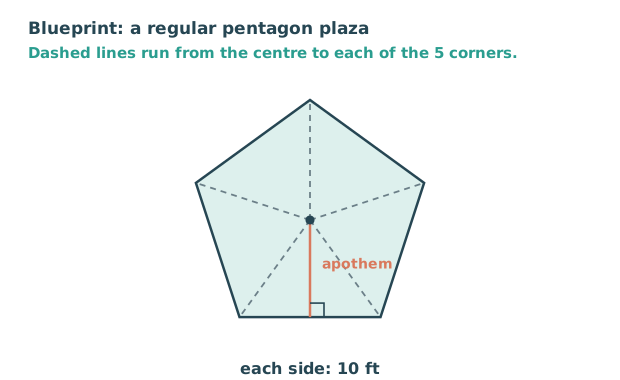
A regular polygon is a closed shape with straight sides where every side is the same length and every angle is the same size. We can decompose it (break it apart) into equal triangles from the center, then add up their areas.
Area of Regular Polygons. Formula: Area = (Number of Sides) × (Area of One Triangle). 1. Decompose the regular polygon from center into n congruent triangles. 2. Find the area of one triangle using A = ½ × side × apothem (height). 3. Multiply by the total number of sides
Check for Understanding #2
Teacher: If >30% thumbs down, re-teach with a fresh example before moving on.
Now it's your turn
VOCABULARY
⏱ ~8 min
| Term / Término | Meaning / Significado | Example / Ejemplo | Visual |
|---|---|---|---|
| Area of Regular Polygons Área de polígonos regulares |
The space a regular polygon covers. Split it from the center into identical triangles, find one triangle's area, then multiply by how many there are. El espacio que cubre un polígono regular. Divídelo desde el centro en triángulos idénticos, halla el área de uno y multiplícala por cuántos hay. |
A hexagon splits into 6 identical triangles: (½ × 4 × 3.5) × 6 = 42 square units | |
| Regular Polygon Polígono regular |
A closed flat shape made of straight sides, where every side is the same length and every angle is the same size. Una figura plana cerrada de lados rectos, donde todos los lados miden lo mismo y todos los ángulos son iguales. |
A stop sign is a regular octagon — all 8 sides are the same length and all 8 angles are equal | |
| Decompose Descomponer |
To break a shape into smaller, simpler shapes. Separar una figura en figuras más pequeñas y simples. |
Draw lines from the center of a hexagon to each corner → you get 6 equal triangles you can find the area of | |
| Triangle Triángulo |
A shape with three sides. Una figura de tres lados. |
Each triangle inside a decomposed hexagon has a base = one side of the hexagon and height = distance from center to side | |
| Composite Compuesto |
Made by putting two or more simple shapes together. Formada al juntar dos o más figuras simples. |
6 triangles, each with area 15 sq ft, combine to form a hexagon with total area = 6 × 15 = 90 sq ft | |
| Formula Fórmula |
A math rule written with symbols. Una regla matemática escrita con símbolos. |
For a regular hexagon: Total Area = 6 × (½ × b × h), where b = side length and h = height of each triangle |
Which Word Fits?
The space inside a regular polygon, found with A = (½bh) × n, is the ___.
Use It In a Sentence
Check for Understanding #3
Teacher: If >30% thumbs down, re-teach with a fresh example before moving on.
Turn & Talk — Launch
The hexagonal skylight has sides of 6 feet, and each triangle from the center has a height of 5.2 feet. Why is it helpful to break a hexagon into triangles to find its area?
👂 Listen For
Students explain that splitting the hexagon into 6 equal triangles lets them use the triangle area formula they already know, then combine the parts.
Extend: Predict whether this decompose-into-triangles strategy works for ANY regular polygon. Justify using the relationship between sides and triangles.
EXPLORE & PRACTICE
⏱ ~18 min
Visual Modeling Workspace
Use the drawing tray below to annotate the visual model. Teacher: say "Click to reveal" on key steps.
Explore Activity
A regular polygon splits into congruent triangles that all meet at the center. Find the area of ONE triangle, count the triangles, then multiply to get the whole polygon. The first two columns are done for you — fill in the total area.
✍️ Explore Discourse
The hexagon and the octagon both have triangles, but the totals are different. What two things decide the total area of a regular polygon?
Whiteboard Moment
Show your work clearly. Be ready to explain your thinking to a partner.
Turn & Talk — Explore
You matched each regular polygon to its number of center triangles. What pattern connects the number of SIDES to the number of TRIANGLES, and why?
👂 Listen For
A strong answer states the number of triangles equals the number of sides, because each side becomes the base of one triangle drawn to the center.
Extend: A classmate says you should ADD the 6 triangle areas, but another says MULTIPLY one area by 6. Are both correct? Justify when each works for a regular polygon.
Practice Check A
A regular hexagon is divided into 6 equal triangles from the center. Each triangle has a base of 6 ft and a height of 5.2 ft. What is the area of one triangle?
✍️ Show Your Work
Explain why your answer is correct using today's vocabulary.
Practice Check B
Using the triangle from the previous question, what is the total area of the hexagonal skylight?
✍️ Show Your Work
Explain why your answer is correct using today's vocabulary.
Area Grid Shading
Click cells to shade area. Count shaded squares.
✍️ Justify Your Thinking
Find the TOTAL area of each regular polygon, then sort it against the 90 sq ft cutoff.
A classmate turned in the work below. One step has a mistake. Read every step, find it, name it, and fix it.
Choose ONE option to show what you know — then do it in the workspace below.
Use evidence from today's lesson to complete each frame.
Today's key idea is: "Area of Regular Polygons. Formula: Area = (Number of Sides) × (Area of One Triangle). 1. Decompose the regular polygon from center into n congruent triangles. 2. Find the area of one triangle using A = ½ × side × apothem (height). 3. Multiply by the total number of sides" — and it works because ___.
Because Area of Regular Polygons means ___, but a tricky part is ___, so I have to ___.
A common mistake with Area of Regular Polygons is ___. It happens because ___, and the fix is ___.
I can prove my answer is correct by ___, using Regular Polygon to check my work.
✍️ TWR · WRITE 3 SENTENCES · 7 MIN
Area of Regular Polygons. Formula: Area = (Number of Sides) × (Area of One Triangle). 1. Decompose the regular polygon from center into n congruent triangles. 2. Find the area of one triangle using A = ½ × side × apothem (height). 3. Multiply by the total number of sides because ___
Area of Regular Polygons. Formula: Area = (Number of Sides) × (Area of One Triangle). 1. Decompose the regular polygon from center into n congruent triangles. 2. Find the area of one triangle using A = ½ × side × apothem (height). 3. Multiply by the total number of sides but ___
Area of Regular Polygons. Formula: Area = (Number of Sides) × (Area of One Triangle). 1. Decompose the regular polygon from center into n congruent triangles. 2. Find the area of one triangle using A = ½ × side × apothem (height). 3. Multiply by the total number of sides so ___
🌱 TWR · GROW THE KERNEL · 6 MIN
Answer these to add detail
Sentence starters (tap to use)
Student Workspace
A regular polygon splits into congruent triangles that all meet at the center. Find the area of ONE triangle, count the triangles, then multiply to get the whole polygon. The first two columns are done for you — fill in the total area.
| Column A | Column B |
|---|---|
✏️ Sketch Your Strategy
Differentiation Paths
Step-by-step with a worked model and sentence frames.
A regular hexagon is divided into 6 equal triangles from the center. Each triangle has a base of 6 ft and a height of 5.2 ft. What is the area of one triangle?
Core practice aligned to the standard.
Extension with error analysis or multi-step reasoning.
Partner Activity
Work with your partner on the practice problems at your differentiation path level. Explain each step using math vocabulary.
Check for Understanding #4
Teacher: If >30% thumbs down, re-teach with a fresh example before moving on.
Real-World Connection
🌍 Math in the Wild
The parks department hired your firm to finish a regular octagonal gazebo at the center of Patterson Park. Seen from above, the gazebo floor decomposes into 8 congruent triangles that meet at the center point, and each triangle has a base of 5 feet and a height of 6 feet. The flooring contractor charges $3 per square foot and needs a total price before Friday's budget meeting.
✍️ Connection Reasoning
How much will the gazebo flooring cost?
One triangle's area is ___ sq ft. The octagon has ___ triangles, so total area = ___ sq ft. The cost is ___ x $3 = $___.
Turn & Talk — Connect
The octagonal gazebo has 8 center triangles, each with base 5 ft and height 6 ft, and flooring costs $3 per sq ft. Walk through finding the total cost.
👂 Listen For
Students compute one triangle = 15 sq ft, total = 8 x 15 = 120 sq ft, and cost = 120 x $3 = $360, explaining each step.
Extend: If the city switched the gazebo from an octagon to a hexagon but kept the same triangle base and height, would the flooring cost more or less? Generalize why.
Summarize: Area of Regular Polygons
Area of Regular Polygons. Formula: Area = (Number of Sides) × (Area of One Triangle). 1. Decompose the regular polygon from center into n congruent triangles. 2. Find the area of one triangle using A = ½ × side × apothem (height). 3. Multiply by the total number of sides
In your own words:
CLOSURE & REFLECT
⏱ ~8 min
Today I learned that ___ because ___.
One thing I am still not sure about is ___.
A regular pentagon is decomposed into 5 triangles from its center. Each triangle has a base of 7 inches and a height of 4.8 inches. What is the total area of the pentagon?
Bonus Exit Check
A regular hexagon is split into 6 triangles, each with base 4 cm and height 3.5 cm. What is the total area?
✍️ Show Your Work
Explain why your answer is correct using today's vocabulary.
Reflection & Self-Assessment
Continue Learning
Launch the Full Interactive Activity
Students continue practice in the HTML lesson engine with auto-check, hints, and differentiation.
Family Connection
Share tonight's family homework and discuss one vocabulary word at home.
Open Family Homework ↗Teacher Notes
⏱️ Pacing Guide
- Launch & vocab: 12 min
- I Do / We Do / You Do: 15 min
- Explore & practice: 15 min
- Connect & closure: 8 min
Total: ~45 min
🎯 Listen For · Common Errors
• Students explain that splitting the hexagon into 6 equal triangles lets them use the triangle area formula they already know, then combine the parts.
• A strong answer states the number of triangles equals the number of sides, because each side becomes the base of one triangle drawn to the center.
• Students compute one triangle = 15 sq ft, total = 8 x 15 = 120 sq ft, and cost = 120 x $3 = $360, explaining each step.
• Listen for students naming a specific strategy tied to 6.GR.1 — not just "I multiplied." They should connect steps to the key idea.
Common mistake: A common mistake in Area of Regular Polygons is stopping after finding the area of ONE triangle and reporting that as the total area — or adding the number of triangles instead of multiplying. Remember: total area = (one triangle's area) × (number of sides), not (one triangle's area) + (number of sides).
Answer Key (Teacher Appendix)
Hide this slide during presentation or move to the end of your copy.
✓ Practice 1: 15.6 sq ft — A = ½ × b × h = ½ × 6 × 5.2 = 15.6 square feet.
✓ Practice 2: 93.6 sq ft — Total area = 6 triangles × 15.6 sq ft = 93.6 square feet.
✓ Practice 3: 42 sq cm — Each triangle: ½ × 4 × 3.5 = 7 sq cm. Total: 6 × 7 = 42 sq cm.
✓ Practice 4: 5 — A regular pentagon has 5 sides, so drawing lines from the center to each vertex creates 5 equal triangles.
✓ Exit ticket: 84 sq in — One triangle: A = 1/2 x 7 x 4.8 = 16.8 sq in. Total = 5 x 16.8 = 84 square inches.