Division Expressions with Fractions and Whole Numbers
I can divide a whole number by a unit fraction and a unit fraction by a whole number by writing the whole number over 1 and using Keep, Change, Flip.
How to Use This Deck
Click Present or press F11 for fullscreen. Use arrow keys to advance.
Blue boxes show exactly what to say, ask, and how long to spend.
Text boxes, polls, and drag-sort save automatically in the browser.
Press N or click 📝 in the toolbar for pacing tips and answers.
Launch the full HTML activity for independent practice.
File → Print or the print button for handout copies.
🎯 Content Objective / Objetivo de contenido
I can divide a whole number by a unit fraction and a unit fraction by a whole number by writing the whole number over 1 and using Keep, Change, Flip.
Today's Flow
Total pacing: ~45 min · Progress bar at top tracks your place
LAUNCH
⏱ ~10 min
⏱️ 3 MIN · THINK-PAIR-SHARE
Agent Reyes cuts a 3-foot strip of tape into 1/4-foot sections. Before calculating, will the number of sections be more or less than 3? Why?
Check for Understanding #1
Teacher: If >30% thumbs down, re-teach with a fresh example before moving on.
Detective Agency Case File
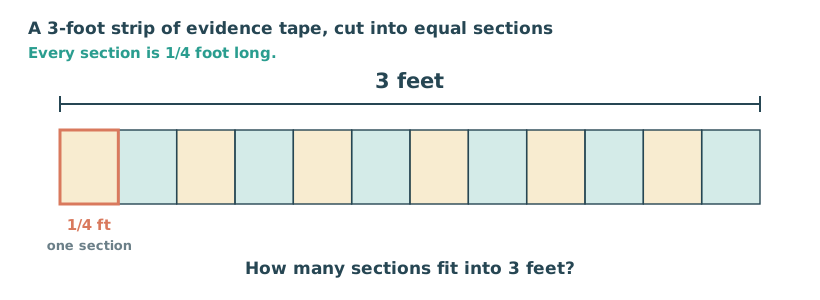
Agent Reyes finds a 3-foot strip of tape at the crime scene. The lab needs the tape cut into 1/4-foot sections for analysis. How many sections can be made? The answer cracks the code to the locked evidence vault.
Concept Launch
💡 What does it mean to divide by a fraction?
Dividing by a fraction asks one question: how many of that small piece fit inside the whole amount? For 3 ÷ 1/4, we ask how many 1/4-foot pieces fit into 3 feet.
Dividing Whole Numbers & Unit Fractions. 1. Put a 1 under the whole number: 3 ÷ 1/4 = 3/1 ÷ 1/4. 2. Keep, Change, Flip: 3/1 ÷ 1/4 = 3/1 × 4/1. 3. Multiply across: 3/1 × 4/1 = 12/1 = 12
Check for Understanding #2
Teacher: If >30% thumbs down, re-teach with a fresh example before moving on.
Your turn — same three steps, the other direction
VOCABULARY
⏱ ~8 min
| Term / Término | Meaning / Significado | Example / Ejemplo | Visual |
|---|---|---|---|
| Division of Fractions División de fracciones |
Finding how many groups of one fraction fit inside another amount. Hallar cuántos grupos de una fracción caben dentro de otra cantidad. |
3 ÷ 1/2 asks how many halves fit in 3; the answer is 6. | |
| Reciprocal Recíproco |
A fraction turned upside down. Una fracción volteada de arriba abajo. |
The reciprocal of 1/4 is 4/1 = 4. A whole number like 3 is 3/1, so its reciprocal is 1/3. | |
| Quotient Cociente |
The answer when you divide. La respuesta cuando divides. |
In 3 ÷ 1/4 = 12, the quotient is 12 — there are 12 quarter-size pieces in 3 | |
| Dividend Dividendo |
The total number being divided into equal groups (the number inside the division bracket). El número total que se divide en partes iguales (el número dentro de la casilla de división). |
In 3 ÷ 1/4 = 12, the dividend is 3 — it is the total being split | |
| Divisor Divisor |
The number of equal groups you are dividing into (the number outside the division bracket). El número de partes iguales en las que divides (el número fuera de la casilla de división). |
In 3 ÷ 1/4 = 12, the divisor is 1/4 — it is the size of each piece | |
| Unit fraction Fracción unitaria |
A fraction with 1 on top, like 1/4. Una fracción con 1 arriba, como 1/4. |
1/2, 1/3, 1/4, 1/5 — each represents one equal part of a whole |
Which Word Fits?
Dividing asks how many groups of one ___ fit inside another amount.
Use It In a Sentence
Check for Understanding #3
Teacher: If >30% thumbs down, re-teach with a fresh example before moving on.
Turn & Talk — Launch
Agent Reyes cuts a 3-foot strip of tape into 1/4-foot sections. Before calculating, will the number of sections be more or less than 3? Why?
👂 Listen For
Students reason that dividing by a number less than 1 gives a quotient greater than the dividend, so there are more than 3 sections.
Extend: Predict how the number of sections would change if each piece were 1/8 foot instead of 1/4 foot. Justify your prediction.
EXPLORE & PRACTICE
⏱ ~18 min
Visual Modeling Workspace
Use the drawing tray below to annotate the visual model. Teacher: say "Click to reveal" on key steps.
Explore Activity
Use the bar model to see how many 1/3-size pieces fit into 2 wholes.
✍️ Explore Discourse
Why does dividing by a unit fraction always give a number larger than the dividend?
Whiteboard Moment
Show your work clearly. Be ready to explain your thinking to a partner.
Turn & Talk — Explore
What does 3 ÷ 1/4 actually mean? Show your partner with the bar model.
👂 Listen For
Students name 3 as the dividend and 1/4 as the divisor, and explain the model shows 12 fourths fit into 3.
Extend: Why is 3 ÷ 1/4 NOT the same as 1/4 of 3? Critique a classmate who confuses the two.
Practice Check A
A shelf is 5 feet long. Books are each 1/4 foot wide. How many books fit on the shelf? Which expression represents this?
✍️ Show Your Work
Explain why your answer is correct using today's vocabulary.
Practice Check B
What does 3 ÷ 1/4 mean?
✍️ Show Your Work
Explain why your answer is correct using today's vocabulary.
Expression Simplify
Complete the interactive activity using today's strategy.
✍️ Justify Your Thinking
A detective must label each story: is the question asking 'how many groups (pieces)?' or 'how big is each share?'
A classmate turned in the work below. One step has a mistake. Read every step, find it, name it, and fix it.
Choose ONE option to show what you know — then do it in the workspace below.
Use evidence from today's lesson to complete each frame.
Today's key idea is: "Dividing Whole Numbers & Unit Fractions. 1. Put a 1 under the whole number: 3 ÷ 1/4 = 3/1 ÷ 1/4. 2. Keep, Change, Flip: 3/1 ÷ 1/4 = 3/1 × 4/1. 3. Multiply across: 3/1 × 4/1 = 12/1 = 12" — and it works because ___.
Because Division of Fractions means ___, but a tricky part is ___, so I have to ___.
A common mistake with Division of Fractions is ___. It happens because ___, and the fix is ___.
I can prove my answer is correct by ___, using Reciprocal to check my work.
✍️ TWR · WRITE 3 SENTENCES · 7 MIN
Dividing Whole Numbers & Unit Fractions. 1. Put a 1 under the whole number: 3 ÷ 1/4 = 3/1 ÷ 1/4. 2. Keep, Change, Flip: 3/1 ÷ 1/4 = 3/1 × 4/1. 3. Multiply across: 3/1 × 4/1 = 12/1 = 12 because ___
Dividing Whole Numbers & Unit Fractions. 1. Put a 1 under the whole number: 3 ÷ 1/4 = 3/1 ÷ 1/4. 2. Keep, Change, Flip: 3/1 ÷ 1/4 = 3/1 × 4/1. 3. Multiply across: 3/1 × 4/1 = 12/1 = 12 but ___
Dividing Whole Numbers & Unit Fractions. 1. Put a 1 under the whole number: 3 ÷ 1/4 = 3/1 ÷ 1/4. 2. Keep, Change, Flip: 3/1 ÷ 1/4 = 3/1 × 4/1. 3. Multiply across: 3/1 × 4/1 = 12/1 = 12 so ___
🌱 TWR · GROW THE KERNEL · 6 MIN
Answer these to add detail
Sentence starters (tap to use)
Student Workspace
Use the bar model to see how many 1/3-size pieces fit into 2 wholes.
| Column A | Column B |
|---|---|
✏️ Sketch Your Strategy
Differentiation Paths
Step-by-step with a worked model and sentence frames.
What does 3 ÷ 1/4 mean?
Core practice aligned to the standard.
Extension with error analysis or multi-step reasoning.
Partner Activity
Work with your partner on the practice problems at your differentiation path level. Explain each step using math vocabulary.
Check for Understanding #4
Teacher: If >30% thumbs down, re-teach with a fresh example before moving on.
Real-World Connection
🌍 Math in the Wild
A detective has 6 yards of crime scene tape. She needs to mark off sections that are each 1/3 of a yard. She wants to know how many sections she can mark.
✍️ Connection Reasoning
How does interpreting fraction division help the detective?
The detective can mark ___ sections because 6 ÷ 1/3 = ___.
Turn & Talk — Connect
Where in cooking, sharing, or building might you divide a whole by a fraction?
👂 Listen For
Students give a 'how many fit' scenario and correctly identify the whole as the dividend and the piece size as the divisor.
Extend: Generalize: how can you tell from the words of a problem that you should divide by a fraction rather than multiply?
Summarize: Division Expressions with Fractions and Whole Numbers
Dividing Whole Numbers & Unit Fractions. 1. Put a 1 under the whole number: 3 ÷ 1/4 = 3/1 ÷ 1/4. 2. Keep, Change, Flip: 3/1 ÷ 1/4 = 3/1 × 4/1. 3. Multiply across: 3/1 × 4/1 = 12/1 = 12
In your own words:
CLOSURE & REFLECT
⏱ ~8 min
Today I learned that ___ because ___.
One thing I am still not sure about is ___.
What does 5 ÷ 1/4 mean, and what is the quotient?
Bonus Exit Check
Which expression means 'how many 1/3-size pieces are in 2'?
✍️ Show Your Work
Explain why your answer is correct using today's vocabulary.
Reflection & Self-Assessment
Continue Learning
Launch the Full Interactive Activity
Students continue practice in the HTML lesson engine with auto-check, hints, and differentiation.
Family Connection
Share tonight's family homework and discuss one vocabulary word at home.
Open Family Homework ↗Teacher Notes
⏱️ Pacing Guide
- Launch & vocab: 12 min
- I Do / We Do / You Do: 15 min
- Explore & practice: 15 min
- Connect & closure: 8 min
Total: ~45 min
🎯 Listen For · Common Errors
• Students reason that dividing by a number less than 1 gives a quotient greater than the dividend, so there are more than 3 sections.
• Students name 3 as the dividend and 1/4 as the divisor, and explain the model shows 12 fourths fit into 3.
• Students give a 'how many fit' scenario and correctly identify the whole as the dividend and the piece size as the divisor.
• Listen for students naming a specific strategy tied to 6.NOS.1 — not just "I multiplied." They should connect steps to the key idea.
Common mistake: A common mistake in Interpret Division of Fractions is assuming that dividing always makes the answer smaller. For 4 ÷ 1/3, students reason 'dividing shrinks the number' and compute 4 ÷ 3 ≈ 1.3 instead of asking how many 1/3-foot pieces fit into 4 feet (each whole foot holds 3 thirds, so 4 × 3 = 12). Before you submit, check: if the divisor is a fraction smaller than 1, the quotient must be BIGGER than the dividend, not smaller.
Answer Key (Teacher Appendix)
Hide this slide during presentation or move to the end of your copy.
✓ Practice 1: 5 ÷ 1/4 = 20 books — The expression is 5 ÷ 1/4. Put a 1 under the 5, then Keep, Change, Flip: 5/1 × 4/1 = 20 books.
✓ Practice 2: How many 1/4-size pieces fit into 3 — 3 ÷ 1/4 asks how many 1/4-size pieces fit into 3. To find that, put a 1 under the 3 and use Keep, Change, Flip: 3/1 × 4/1 = 12.
✓ Practice 3: 2 ÷ 1/3 — Finding how many 1/3-size pieces fit into 2 is written 2 ÷ 1/3. Put a 1 under the 2, then Keep, Change, Flip: 2/1 × 3/1 = 6.
✓ Practice 4: 8 pieces — Write 4 ÷ 1/2. Put a 1 under the 4, then Keep, Change, Flip: 4/1 × 2/1 = 8 pieces.
✓ Exit ticket: How many 1/4-size pieces fit into 5; quotient is 20 — 5 ÷ 1/4 means 'how many 1/4-size pieces fit into 5.' Put a 1 under the 5, then Keep, Change, Flip: 5/1 × 4/1 = 20.