Touch and changeToca y cambia
Move, type, tap, or drag in the model. Watch what changes.Mueve, escribe, toca o arrastra en el modelo. Observa qué cambia.
Unit 6 · 6.NOS.1
Division Expressions with Fractions and Whole Numbers · Lesson 6-1
English: Use the pictures and short steps. Ask questions; let your student do the thinking. Español: Usen los dibujos y los pasos cortos. Hagan preguntas; dejen que su estudiante piense.
Tonight we use models to divide BOTH ways: a whole number divided by a fraction, and a fraction divided by a whole number.
Esta noche usamos modelos para dividir en AMBOS sentidos: un número entero entre una fracción, y una fracción entre un número entero.
Follow the picture pathSigan la ruta visual
Real example: there is a 3-foot strip of tape.
Ejemplo real: hay una tira de cinta de 3 pies.
We cut it into pieces that are each 1/4 foot long. We ask: how many 1/4-foot pieces fit into 3 feet?
La cortamos en piezas de 1/4 de pie cada una. Preguntamos: ¿cuántas piezas de 1/4 de pie caben en 3 pies?
Look at just 1 foot first.
Mira primero solo 1 pie.
How many 1/4-foot pieces fit in 1 foot? Four, because 4 fourths make one whole.
¿Cuántas piezas de 1/4 de pie caben en 1 pie? Cuatro, porque 4 cuartos forman un entero.
Now there are 3 feet.
Ahora hay 3 pies.
So we do 3 groups of 4: 3 × 4 = 12.
Entonces hacemos 3 grupos de 4: 3 × 4 = 12.
So 3 ÷ 1/4 = 12.
Entonces 3 ÷ 1/4 = 12.
There are 12 pieces. The answer is bigger than 3 because each piece is very small.
Hay 12 piezas. La respuesta es más grande que 3 porque cada pieza es muy pequeña.
Listen for "divisor" — it means the size of each piece you divide by, like 1/4.
Escucha la palabra "divisor" — significa el tamaño de cada pieza entre la que divides, como 1/4.
Listen for "cociente" — it means the answer when you divide, like 12.
Escucha la palabra "cociente" — significa la respuesta cuando divides, como 12.
Let your student try first. Ask "How many small pieces fit into one whole?" before helping.
Deja que tu estudiante intente primero. Pregunta "¿Cuántas piezas pequeñas caben en un entero?" antes de ayudar.
The two directions move opposite ways: 2 ÷ 1/3 = 6 (bigger), but 1/2 ÷ 4 = 1/8 (smaller).
Los dos sentidos van en direcciones opuestas: 2 ÷ 1/3 = 6 (mayor), pero 1/2 ÷ 4 = 1/8 (menor).
Use the same interactive model from the lesson. Change it, notice the pattern, and explain what the model shows.Usa el mismo modelo interactivo de la lección. Cámbialo, observa el patrón y explica lo que muestra.
Move, type, tap, or drag in the model. Watch what changes.Mueve, escribe, toca o arrastra en el modelo. Observa qué cambia.
Record one equation, value, or relationship you can see.Escribe una ecuación, un valor o una relación que puedas ver.
I notice ___ changes when ___ changes. This shows ___.Noto que ___ cambia cuando ___ cambia. Esto muestra ___.
Dividing Whole Numbers & Unit Fractions. 1. Put a 1 under the whole number: 3 ÷ 1/4 = 3/1 ÷ 1/4. 2. Keep, Change, Flip: 3/1 ÷ 1/4 = 3/1 × 4/1. 3. Multiply across: 3/1 × 4/1 = 12/1 = 12
A quick, no-timer review game for tonight's lesson — sort, match, and choose. A wrong answer just gives a hint and lets your student try again. Un juego de repaso sin reloj para la lección de hoy — clasificar, emparejar y elegir. Si se equivocan, reciben una pista y pueden intentar de nuevo.
↗ Play full screen ↗ Jugar en pantalla completa
Tap a card to flip. Use these words when you talk about the math together. Toquen una tarjeta para voltearla. Usen estas palabras cuando hablen de la matemática juntos.
División de fracciones
Finding how many groups of one fraction fit inside another amount.
Hallar cuántos grupos de una fracción caben dentro de otra cantidad.
📌 3 ÷ 1/2 asks how many halves fit in 3; the answer is 6.
Recíproco
A fraction turned upside down.
Una fracción volteada de arriba abajo.
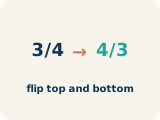
📌 The reciprocal of 1/4 is 4/1 = 4. A whole number like 3 is 3/1, so its reciprocal is 1/3.
Cociente
The answer when you divide.
La respuesta cuando divides.
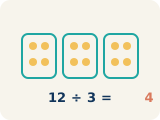
📌 In 3 ÷ 1/4 = 12, the quotient is 12 — there are 12 quarter-size pieces in 3
Dividendo
The total number being divided into equal groups (the number inside the division bracket).
El número total que se divide en partes iguales (el número dentro de la casilla de división).
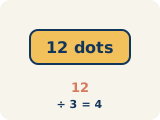
📌 In 3 ÷ 1/4 = 12, the dividend is 3 — it is the total being split
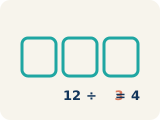
Divisor
The number of equal groups you are dividing into (the number outside the division bracket).
El número de partes iguales en las que divides (el número fuera de la casilla de división).
📌 In 3 ÷ 1/4 = 12, the divisor is 1/4 — it is the size of each piece
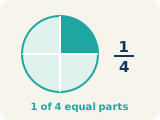
Fracción unitaria
A fraction with 1 on top, like 1/4.
Una fracción con 1 arriba, como 1/4.
📌 1/2, 1/3, 1/4, 1/5 — each represents one equal part of a whole
Use a smaller example. Imagine 2 whole sandwiches cut into 1/3 pieces. How many 1/3 pieces fit into 2?
Usen un ejemplo más pequeño. Imaginen 2 sándwiches enteros cortados en piezas de 1/3. ¿Cuántas piezas de 1/3 caben en 2?
Work side by side. You ask questions; your student does the thinking. Trabajen juntos. Tú haces preguntas; tu estudiante piensa.
First ask: how many 1/3 pieces fit into 1 whole sandwich?
Primero pregunten: ¿cuántas piezas de 1/3 caben en 1 sándwich entero?
Now there are 2 sandwiches. Do 2 groups of 3: 2 × 3 = 6. So 2 ÷ 1/3 = 6.
Ahora hay 2 sándwiches. Hagan 2 grupos de 3: 2 × 3 = 6. Entonces 2 ÷ 1/3 = 6.
Check together: why is the answer 6 bigger than the 2 we started with?
Revisen juntos: ¿por qué la respuesta 6 es más grande que el 2 con el que empezamos?
Do these together. Start at ★ and climb to ★★★ when ready. Háganlos juntos. Empiecen en ★ y suban a ★★★ cuando estén listos.
What does 3 ÷ 1/4 mean?
A. How many 1/4-size pieces fit into 3
Which expression means 'how many 1/3-size pieces are in 2'?
A. 2 ÷ 1/3
A shelf is 5 feet long. Books are each 1/4 foot wide. How many books fit on the shelf? Which expression represents this?
A. 5 ÷ 1/4 = 20 books
Agent Cole has 8 feet of evidence rope and cuts it into 1/3-foot pieces for tagging. What does 8 ÷ 1/3 mean?
A. How many 1/3-foot pieces fit into 8 feet
Dividing 6 by 1/2 gives 12, but dividing 6 by 2 gives 3. How can dividing by a smaller number (1/2) give a bigger answer than dividing by a larger number (2)? Explain using a real-world example.
⏱️ Plan on about 15–20 minutes for the 6 problems below. The extra practice at the bottom is optional. ⏱️ Calculen unos 15–20 minutos para los 6 problemas de abajo. La práctica extra al final es opcional.
A few problems to practice together. Each one has a step-by-step guide, a picture to draw on, and a space to show your work. Use Check This Problem for instant feedback — no need to finish everything at once. Unos problemas para practicar juntos. Cada uno tiene una guía paso a paso, un dibujo para trabajar y un espacio para mostrar el trabajo. Usen Revisar esta pregunta para retroalimentación al instante — no tienen que terminar todo de una vez.
Easier problems to practice the idea. Do these first together. Problemas más fáciles para practicar la idea. Hagan estos primero juntos.
Match each detective story to the fraction-division expression and quotient that solves it.Une cada historia del detective con la expresión de división de fracciones y el cociente que la resuelve.
👪 Say each term out loud, then talk through which match makes sense before choosing.👪 Digan cada término en voz alta y hablen de cuál pareja tiene sentido antes de elegir.
A detective must label each story: is the question asking 'how many groups (pieces)?' or 'how big is each share?'Un detective debe etiquetar cada historia: ¿la pregunta busca 'cuántos grupos (pedazos)?' o 'de qué tamaño es cada parte?'
👪 On a phone, use Move to. On a computer, drag cards or tap a card then tap a column.👪 En el teléfono usen Mover a. En la computadora arrastren o toquen tarjeta y columna.
What does 3 ÷ 1/4 mean?¿Qué significa 3 ÷ 1/4?
👪 Read the question together, then let your student pick an answer before you discuss why.👪 Lean la pregunta juntos; dejen que su estudiante elija antes de hablar del porqué.
Try these once the warm-up feels easy. It's okay to use the steps and pictures. Intenten estos cuando el calentamiento sea fácil. Está bien usar los pasos y los dibujos.
Picture clue: a 5-inch fingerprint strip is split into 1/6-inch slivers under the microscope. Which division does the picture show, and what is the count?Pista visual: una tira de huella digital de 5 pulgadas se divide en tiritas de 1/6 de pulgada bajo el microscopio. ¿Qué división muestra la imagen y cuál es el conteo?
👪 Read the question together, then let your student pick an answer before you discuss why.👪 Lean la pregunta juntos; dejen que su estudiante elija antes de hablar del porqué.
Complete the pattern: as the unit fraction divisor gets smaller, what happens to the quotient?Completa el patrón: a medida que el divisor de fracción unitaria se hace más pequeño, ¿qué le pasa al cociente?
👪 Encourage your student to show work on paper if a box feels tricky.👪 Animen a mostrar el trabajo en papel si una casilla se siente difícil.
| Expression | Quotient | Pattern |
|---|---|---|
| 2 ÷ 1/2 |
|
|
| 2 ÷ 1/3 | quotient increases |
|
| 2 ÷ 1/4 | quotient increases |
|
| 2 ÷ 1/6 | quotient increases |
|
| 2 ÷ 1/10 | smaller divisor → larger quotient |
|
Match each division expression to its quotient.Une cada expresión de división con su cociente.
👪 Say each term out loud, then talk through which match makes sense before choosing.👪 Digan cada término en voz alta y hablen de cuál pareja tiene sentido antes de elegir.
Optional. Only if your student wants more — these are bonus problems. Opcional. Solo si tu estudiante quiere más — son problemas adicionales.
Sort each statement: does dividing by the fraction give a result GREATER than the dividend, or LESS than the dividend?Clasifica cada afirmación: ¿dividir entre la fracción da un resultado MAYOR que el dividendo o MENOR que el dividendo?
👪 On a phone, use Move to. On a computer, drag cards or tap a card then tap a column.👪 En el teléfono usen Mover a. En la computadora arrastren o toquen tarjeta y columna.
💡 Work out each quotient first, then compare it with the dividend — the number being divided.Cada tarjeta ya muestra el cociente y el dividendo, como 5 ÷ 1/3 = 15. Compara esos dos números.
💡 Check the divisor: dividing by a fraction under 1 makes the quotient grow; dividing by a whole number bigger than 1 shrinks it.Revisa el divisor: dividir entre una fracción menor que 1 hace crecer el cociente; dividir entre un entero mayor que 1 lo achica.
💡 Try the first card: put a 1 under the 5 and flip 1/3, so 5/1 × 3/1 = 15. Is 15 more or less than the dividend 5?Prueba la primera tarjeta: pon un 1 debajo del 5 y voltea 1/3, así 5/1 × 3/1 = 15. ¿Es 15 más o menos que el dividendo 5?
A shelf is 5 feet long. Books are each 1/4 foot wide. How many books fit on the shelf? Which expression represents this?Un estante mide 5 pies de largo. Cada libro tiene 1/4 de pie de ancho. ¿Cuántos libros caben en el estante? ¿Qué expresión representa esto?
👪 Read the question together, then let your student pick an answer before you discuss why.👪 Lean la pregunta juntos; dejen que su estudiante elija antes de hablar del porqué.
Agent Cole has 8 feet of evidence rope and cuts it into 1/3-foot pieces for tagging. What does 8 ÷ 1/3 mean?El agente Cole tiene 8 pies de cuerda de evidencia y la corta en piezas de 1/3 de pie para etiquetarlas. ¿Qué significa 8 ÷ 1/3?
👪 Read the question together, then let your student pick an answer before you discuss why.👪 Lean la pregunta juntos; dejen que su estudiante elija antes de hablar del porqué.
Which expression means 'how many 1/3-size pieces are in 2'?¿Qué expresión significa "cuántas piezas del tamaño de 1/3 hay en 2"?
👪 Read the question together, then let your student pick an answer before you discuss why.👪 Lean la pregunta juntos; dejen que su estudiante elija antes de hablar del porqué.
A half-pan of brownies is shared equally among 4 people. How much of the whole pan does each get?Medio molde de brownies se reparte en partes iguales entre 4 personas. ¿Cuánto del molde entero recibe cada una?
👪 Read the question together, then let your student pick an answer before you discuss why.👪 Lean la pregunta juntos; dejen que su estudiante elija antes de hablar del porqué.
Dividing 6 by 1/2 gives 12, but dividing 6 by 2 gives 3. How can dividing by a smaller number (1/2) give a bigger answer than dividing by a larger number (2)? Explain using a real-world example.Dividir 6 entre 1/2 da 12, pero dividir 6 entre 2 da 3. ¿Cómo puede dividir entre un número más pequeño (1/2) dar una respuesta más grande que dividir entre un número más grande (2)? Explica con un ejemplo de la vida real.
👪 A complete sentence with math vocabulary is the goal — not a perfect paragraph.👪 Una oración completa con vocabulario matemático es la meta — no un párrafo perfecto.
A rope is 4 feet long. How many 1/2-foot pieces can be cut from it?Una cuerda mide 4 pies de largo. ¿Cuántas piezas de 1/2 pie se pueden cortar de ella?
👪 Read the question together, then let your student pick an answer before you discuss why.👪 Lean la pregunta juntos; dejen que su estudiante elija antes de hablar del porqué.
What is 6 ÷ 1/5?¿Cuánto es 6 ÷ 1/5?
👪 Read the question together, then let your student pick an answer before you discuss why.👪 Lean la pregunta juntos; dejen que su estudiante elija antes de hablar del porqué.
A digital scratch pad to draw models, line up decimals, and show your work. It opens in a new tab so you keep your place on this homework. Una pizarra digital para dibujar modelos, alinear decimales y mostrar el trabajo. Se abre en una pestaña nueva para no perder tu lugar en esta tarea.
🧮 Open the Math Workbench ↗ 🧮 Abrir la Pizarra de matemáticas ↗
How many small pieces fit into just one whole? Let's start there.
¿Cuántas piezas pequeñas caben en solo un entero? Empecemos ahí.
We have more than one whole. How many wholes are there?
Tenemos más de un entero. ¿Cuántos enteros hay?
Will the answer be more or less than what we started with? Why?
¿La respuesta será más o menos que con lo que empezamos? ¿Por qué?
Dividing always makes the answer smaller.
Dividir siempre hace la respuesta más pequeña.
3 ÷ 1/4 is the same as 1/4 of 3.
3 ÷ 1/4 es lo mismo que 1/4 de 3.
Just divide 3 by 4 to get the answer.
Solo divide 3 entre 4 para obtener la respuesta.
These links go to specific videos and lessons about tonight's topic — not general math pages. Estos enlaces van a videos y lecciones específicas sobre el tema de hoy — no páginas generales.
Reinforce tonight's topic with a quick family game. You ask; your student decides! Refuercen el tema de hoy con un juego rápido en familia. ¡Ustedes preguntan; su estudiante decide!
🎮 Play together! Substitute the value, then follow order of operations. 🎮 ¡Jueguen juntos! Sustituyan el valor, luego sigan el orden de operaciones.
High five! Whether every answer was perfect or not, you showed up for your student tonight. That matters.
¡Chócalas! No importa si cada respuesta fue perfecta — estuviste con tu estudiante esta noche. Eso importa.
Answers save automatically on this device. Tap Check This Problem anytime. Las respuestas se guardan solas en este dispositivo. Toquen Revisar esta pregunta cuando quieran.
Signed on:Firmado el:
Note to teacher / Nota para el maestro:
This certifies that the homework for was completed and reviewed collaboratively.
Parent/Guardian Signature
Date