Touch and changeToca y cambia
Move, type, tap, or drag in the model. Watch what changes.Mueve, escribe, toca o arrastra en el modelo. Observa qué cambia.
Unit 6 · Numerical and Algebraic ExpressionsUnidad 6 · Expresiones numéricas y algebraicas
Score boardMarcador
A rec-center band has 3 guitarists, 5 drummers and 2 keyboard players. Ana counts 3 + 5 + 2. Ben counts 5 + 3 + 2. Will they get the same total?Una banda del centro recreativo tiene 3 guitarristas, 5 bateristas y 2 tecladistas. Ana cuenta 3 + 5 + 2. Ben cuenta 5 + 3 + 2. ¿Obtendrán el mismo total?
Five short steps, about 15–20 minutes: watch the idea, try one together, solve 10 in three levels, check, celebrate.Cinco pasos cortos, unos 15–20 minutos: miren la idea, prueben uno juntos, resuelvan 10 en tres niveles, revisen y celebren.
Optional. No grades, no account. Your place is saved on this device.Opcional. Sin calificaciones ni cuenta. Su avance se guarda en este dispositivo.
Tonight's ideaLa idea de hoy Use the order, grouping and identity properties to write equal expressions.Usar las propiedades del orden, la agrupación y la identidad para escribir expresiones iguales.
💡 Draw fraction bars, tape diagrams, equations, or line up decimals together!💡 ¡Dibujen barras de fracciones, modelos o alineen decimales juntos!
Step 1 of 5Paso 1 de 5
Read the goal and look at the picture. Then go through the example one step at a time.Lean la meta y miren el dibujo. Luego sigan el ejemplo un paso a la vez.
Use the order, grouping and identity properties to write equal expressions.
Usar las propiedades del orden, la agrupación y la identidad para escribir expresiones iguales.
In class we usedEn clase usamos the order and grouping ruleslas reglas de orden y agrupación.
Why it worksPor qué funciona Adding the same musicians in any order or any groups still counts the same band, so the total stays 10. These rules work for adding and multiplying, not for subtracting or dividing.Sumar a los mismos músicos en cualquier orden o grupo cuenta la misma banda, así que el total sigue siendo 10. Estas reglas sirven al sumar y multiplicar, no al restar ni dividir.
The example:El ejemplo: I have 3 guitarists, 5 drummers, and 2 keyboard players.Tengo 3 guitarristas, 5 bateristas y 2 tecladistas.
Your case:Su caso: Tonight we learn math rules called properties. They let us change the order or the grouping of numbers without changing the answer.Esta noche aprendemos reglas matemáticas llamadas propiedades. Nos dejan cambiar el orden o la agrupación de los números sin cambiar la respuesta.
Tap a clue to read what it means.Toquen una pista para leer qué significa.
Look at the picture and the story. Say it out loud, or type a few words. There is no wrong answer here.Mira el dibujo y la historia. Dilo en voz alta o escribe unas palabras. Aquí no hay respuestas incorrectas.
Just for you. It stays on this device. We ask again at the end.Solo para ti. Se queda en este dispositivo. Preguntamos otra vez al final.
Which number is a multiple of 7?¿Cuál número es un múltiplo de 7?
Not yet. Try another look.Todavía no. Intenta otra mirada.
7 × 3 = 21, so 21 is a multiple of 7.7 × 3 = 21, así que 21 es un múltiplo de 7.
2x + 3x and 5x are equivalent. What is the value of 5x when x = 4?2x + 3x y 5x son equivalentes. ¿Cuál es el valor de 5x cuando x = 4?
Not yet. Try another look.Todavía no. Intenta otra mirada.
5 × 4 = 20. Check the other one: 2 × 4 + 3 × 4 = 8 + 12 = 20.5 × 4 = 20. Comprueba la otra: 2 × 4 + 3 × 4 = 8 + 12 = 20.
Step 2 of 5Paso 2 de 5
Do this one side by side. Use the model, and ask for a hint whenever you want one.Háganlo lado a lado. Usen el modelo y pidan una pista cuando quieran.
Try this one togetherPrueben este juntos
Use a smaller band: 6 singers and 9 dancers. Check that the order does not change the total.Usen una banda más pequeña: 6 cantantes y 9 bailarines. Comprueben que el orden no cambia el total.
Add them in order: 6 + 9. What do you get?Súmenlos en orden: 6 + 9. ¿Cuánto da?
6 + 9 = 15 people in all.6 + 9 = 15 personas en total.
Count up from 9: ten, eleven, twelve, thirteen, fourteen, fifteen.Cuenten a partir de 9: diez, once, doce, trece, catorce, quince.
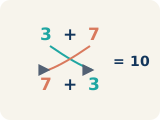
Now switch the order: 9 + 6. Is the answer the same?Ahora cambien el orden: 9 + 6. ¿Es la misma respuesta?
9 + 6 = 15 too. The order did not change the total.9 + 6 = 15 también. El orden no cambió el total.
Because the answer stayed 15, this shows the commutative property.Como la respuesta se quedó en 15, esto muestra la propiedad conmutativa.
Check together: would 6 − 9 give the same as 9 − 6? Try it and see why order matters for subtraction.Revisen juntos: ¿daría 6 − 9 lo mismo que 9 − 6? Pruébenlo y vean por qué el orden sí importa al restar.
9 − 6 = 3, but 6 − 9 is below zero, so they are not equal.9 − 6 = 3, pero 6 − 9 queda por debajo de cero, así que no son iguales.
This is why the property only works for adding and multiplying.Por eso la propiedad solo funciona al sumar y multiplicar.
Combine the x tiles and the number tiles. The value never changes.Combina los cuadros de x y los de números. El valor nunca cambia.
Change one value. Watch what changes in the picture and answer.Cambia un valor. Mira qué cambia en el dibujo y la respuesta. Say: “When ___ changes, ___ changes.”Di: “Cuando ___ cambia, ___ cambia.”
Before you go on: say one thing the model showed you.Antes de seguir: digan una cosa que les mostró el modelo.
Change the problem. Explain why each solving step keeps the value correct.Cambia el problema. Explica por qué cada paso mantiene correcto el valor.
🌐 Esta herramienta interactiva por ahora solo está en inglés. Para qué sirve: Escribe tu solución línea por línea; cada línea se revisa para confirmar que sigue siendo equivalente a la anterior, así encuentras tu propio error. Usen los pasos en español de esta tarjeta para guiarse.
Move, type, tap, or drag in the model. Watch what changes.Mueve, escribe, toca o arrastra en el modelo. Observa qué cambia.
Record one equation, value, or relationship you can see.Escribe una ecuación, un valor o una relación que puedas ver.
I notice ___ changes when ___ changes. This shows ___.Noto que ___ cambia cuando ___ cambia. Esto muestra ___.
Ask: "Where do you see the numbers from tonight's math in this model?"Pregunta: "¿Dónde ves los números de la tarea de hoy en este modelo?"
Use the order, grouping and identity properties to write equal expressions.
Usar las propiedades del orden, la agrupación y la identidad para escribir expresiones iguales.
Changing the order or the grouping of numbers that are being added or multiplied does not change the total. This only works for adding and multiplying, not for subtracting or dividing.
Cambiar el orden o la agrupación de los números que se suman o se multiplican no cambia el total. Esto solo funciona al sumar y multiplicar, no al restar ni dividir.
Count the band in order: 3 guitarists, 5 drummers, 2 keyboard players.
Cuenta la banda en orden: 3 guitarristas, 5 bateristas, 2 tecladistas.
3 + 5 + 2 = 10 musicians.
3 + 5 + 2 = 10 músicos.
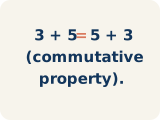
Change the order (Commutative Property): 5 + 3 + 2 = 10.
Cambia el orden (propiedad conmutativa): 5 + 3 + 2 = 10.
Still 10 musicians.
Siguen siendo 10 músicos.
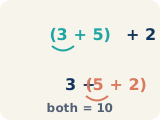
Group the first two (Associative Property): (3 + 5) + 2.
Agrupa los dos primeros (propiedad asociativa): (3 + 5) + 2.
Add 3 + 5 = 8, then 8 + 2 = 10.
Suma 3 + 5 = 8, luego 8 + 2 = 10.
Group the last two: 3 + (5 + 2).
Agrupa los dos últimos: 3 + (5 + 2).
Add 5 + 2 = 7, then 3 + 7 = 10. Same total.
Suma 5 + 2 = 7, luego 3 + 7 = 10. El mismo total.
Listen for "propiedad conmutativa" — it means you change the order (like 6 + 9 = 9 + 6).
Escuchen la palabra "propiedad conmutativa" — significa que cambian el orden (como 6 + 9 = 9 + 6).
Listen for "propiedad asociativa" — it means you change the grouping, the parentheses (like (3 + 5) + 2 = 3 + (5 + 2)).
Escuchen la palabra "propiedad asociativa" — significa que cambian la agrupación, los paréntesis (como (3 + 5) + 2 = 3 + (5 + 2)).
Ask which one changed: did the order move, or did the parentheses move?
Pregunten cuál cambió: ¿se movió el orden o se movieron los paréntesis?
Step 3 of 5Paso 3 de 5
One at a time. Work on your own; a grown-up can watch.Uno a la vez. Trabaja solo; un adulto puede observar.
10 problems. Hints are always okay. 10 problemas. Las pistas siempre están bien.
+0 bonusextraThe Commutative Property is about changing the ORDER of the numbers.
La propiedad conmutativa trata de cambiar el ORDEN de los números.
Which numbers moved: did they trade places, or did only the parentheses move?
¿Qué se movió: los números cambiaron de lugar o solo se movieron los paréntesis?
7 + 4 = 4 + 7 swaps the order of the two numbers, and the sum stays 11.
7 + 4 = 4 + 7 cambia el orden de los dos números y la suma sigue siendo 11.
Which equation shows the Commutative Property?¿Qué ecuación muestra la propiedad conmutativa?
Answer key for families — compare, then talk about why.Clave de respuestas para la familia — comparen y hablen del porqué.
Not tried yet? Close this and give it one try first. A wrong first try still helps.¿Todavía no lo intentaron? Ciérrenla y hagan un intento primero. Un primer intento equivocado también ayuda.
Why:Por qué: 7 + 4 = 4 + 7 swaps the order of the two numbers, and the sum stays 11.7 + 4 = 4 + 7 cambia el orden de los dos números y la suma sigue siendo 11.
Think of adding nothing at all.
Piensa en no sumar nada.
How much do you add to a number if you want it to stay the same?
¿Cuánto sumas a un número si quieres que se quede igual?
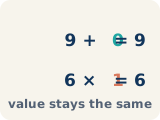
The Identity Property says adding 0 leaves a number the same, so 48 + 0 = 48.
La propiedad de identidad dice que sumar 0 deja el número igual, así que 48 + 0 = 48.
Which number makes this true? 48 + ___ = 48¿Qué número hace verdadera esta ecuación? 48 + ___ = 48
Answer key for families — compare, then talk about why.Clave de respuestas para la familia — comparen y hablen del porqué.
Not tried yet? Close this and give it one try first. A wrong first try still helps.¿Todavía no lo intentaron? Ciérrenla y hagan un intento primero. Un primer intento equivocado también ayuda.
Why:Por qué: The Identity Property says adding 0 leaves a number the same, so 48 + 0 = 48.La propiedad de identidad dice que sumar 0 deja el número igual, así que 48 + 0 = 48.
Thinking you can swap the order when you subtract, like 9 − 4 = 4 − 9. These properties work for adding and multiplying only.
Pensar que pueden cambiar el orden al restar, como 9 − 4 = 4 − 9. Estas propiedades solo funcionan al sumar y multiplicar.
I changed the ___, so I used the ___ Property. The total stayed ___.
Cambié el/la ___, así que usé la propiedad ___. El total se quedó en ___.
Multiplying can be reordered and regrouped. (5 × 2) × 8 = 10 × 8 = 80.
Multiplicar se puede reordenar y reagrupar. (5 × 2) × 8 = 10 × 8 = 80.
Each tray holds 5 cups. A table has 8 trays. There are 2 tables. How many cups are there in all?Cada bandeja tiene 5 vasos. Una mesa tiene 8 bandejas. Hay 2 mesas. ¿Cuántos vasos hay en total?
Answer key for families — compare, then talk about why.Clave de respuestas para la familia — comparen y hablen del porqué.
Not tried yet? Close this and give it one try first. A wrong first try still helps.¿Todavía no lo intentaron? Ciérrenla y hagan un intento primero. Un primer intento equivocado también ayuda.
Why:Por qué: Multiplying can be reordered and regrouped. (5 × 2) × 8 = 10 × 8 = 80.Multiplicar se puede reordenar y reagrupar. (5 × 2) × 8 = 10 × 8 = 80.
Both sides must use the same two numbers.
Los dos lados deben usar los mismos dos números.
What happens to the two numbers when the order is swapped?
¿Qué pasa con los dos números cuando se cambia el orden?
The Commutative Property lets 12 + 9 trade places to 9 + 12, so the blank is 12.
La propiedad conmutativa permite que 12 + 9 cambie a 9 + 12, así que el espacio es 12.
What number makes this true? 12 + 9 = 9 + ___¿Qué número hace verdadera esta ecuación? 12 + 9 = 9 + ___
Answer key for families — compare, then talk about why.Clave de respuestas para la familia — comparen y hablen del porqué.
Not tried yet? Close this and give it one try first. A wrong first try still helps.¿Todavía no lo intentaron? Ciérrenla y hagan un intento primero. Un primer intento equivocado también ayuda.
Why:Por qué: The Commutative Property lets 12 + 9 trade places to 9 + 12, so the blank is 12.La propiedad conmutativa permite que 12 + 9 cambie a 9 + 12, así que el espacio es 12.
Same order, different groups means one particular property.
Mismo orden, grupos distintos: eso señala una propiedad en particular.
Compare the two sides: did the numbers change places, or did the parentheses move?
Compara los dos lados: ¿los números cambiaron de lugar o se movieron los paréntesis?
The grouping changed from (3 + 8) + 2 to 3 + (8 + 2), so this is the Associative Property.
La agrupación cambió de (3 + 8) + 2 a 3 + (8 + 2), así que es la propiedad asociativa.
Which property is shown? (3 + 8) + 2 = 3 + (8 + 2)¿Qué propiedad se muestra? (3 + 8) + 2 = 3 + (8 + 2)
Answer key for families — compare, then talk about why.Clave de respuestas para la familia — comparen y hablen del porqué.
Not tried yet? Close this and give it one try first. A wrong first try still helps.¿Todavía no lo intentaron? Ciérrenla y hagan un intento primero. Un primer intento equivocado también ayuda.
Why:Por qué: The grouping changed from (3 + 8) + 2 to 3 + (8 + 2), so this is the Associative Property.La agrupación cambió de (3 + 8) + 2 a 3 + (8 + 2), así que es la propiedad asociativa.
You may add in any order. Try pairing the 5 and the 15 first.
Puedes sumar en cualquier orden. Prueba primero la pareja del 5 y el 15.
Which two numbers make a friendly 10 or 20 together?
¿Cuáles dos números forman juntos una decena fácil como 10 o 20?
Regroup to make a friendly ten: (5 + 15) + 18 = 20 + 18 = 38.
Reagrupa para formar una decena fácil: (5 + 15) + 18 = 20 + 18 = 38.
Use the properties to find 5 + 18 + 15. What is the total?Usa las propiedades para hallar 5 + 18 + 15. ¿Cuál es el total?
Answer key for families — compare, then talk about why.Clave de respuestas para la familia — comparen y hablen del porqué.
Not tried yet? Close this and give it one try first. A wrong first try still helps.¿Todavía no lo intentaron? Ciérrenla y hagan un intento primero. Un primer intento equivocado también ayuda.
Why:Por qué: Regroup to make a friendly ten: (5 + 15) + 18 = 20 + 18 = 38.Reagrupa para formar una decena fácil: (5 + 15) + 18 = 20 + 18 = 38.
Multiplying in any order gives the same product.
Multiplicar en cualquier orden da el mismo producto.
Which two factors make a number that is easy to multiply by?
¿Cuáles dos factores forman un número fácil de multiplicar?
Swap and regroup: (4 × 5) × 9 = 20 × 9 = 180.
Cambia el orden y reagrupa: (4 × 5) × 9 = 20 × 9 = 180.
Use the properties to find 4 × 9 × 5. What is the product?Usa las propiedades para hallar 4 × 9 × 5. ¿Cuál es el producto?
Answer key for families — compare, then talk about why.Clave de respuestas para la familia — comparen y hablen del porqué.
Not tried yet? Close this and give it one try first. A wrong first try still helps.¿Todavía no lo intentaron? Ciérrenla y hagan un intento primero. Un primer intento equivocado también ayuda.
Why:Por qué: Swap and regroup: (4 × 5) × 9 = 20 × 9 = 180.Cambia el orden y reagrupa: (4 × 5) × 9 = 20 × 9 = 180.
Easier problems to practice the idea. Do these first together. Problemas más fáciles para practicar la idea. Hagan estos primero juntos.
Use one signal per card: terms trading places, parentheses sliding, a number outside parentheses being multiplied by everything inside, or a 0 or 1 that changes nothing.
Usa una señal por tarjeta: términos que cambian de lugar, paréntesis que se desplazan, un número fuera del paréntesis que se multiplica por todo lo de adentro, o un 0 o un 1 que no cambia nada.
Four bins, eight tracks — two cards belong in each property. Ask what changed from the left side to the right side of each equation.
Cuatro contenedores, ocho tarjetas: dos cartas van en cada propiedad. Pregúntate qué cambió del lado izquierdo al lado derecho de cada ecuación.
2 + 5 = 5 + 2 and 5 × 9 = 9 × 5 only swap order, so they are Commutative. (2 + 6) + 4 = 2 + (6 + 4) and (3 × 2) × 5 = 3 × (2 × 5) only move parentheses, so they are Associative. 5(7 + 2) = 5 × 7 + 5 × 2 and 2(x + 5) = 2x + 10 spread a multiplier across a sum, so they are Distributive, while 11 + 0 = 11 and 6 × 1 = 6 leave the value unchanged, so they are Identity.
2 + 5 = 5 + 2 y 5 × 9 = 9 × 5 solo cambian el orden, así que son Conmutativa. (2 + 6) + 4 = 2 + (6 + 4) y (3 × 2) × 5 = 3 × (2 × 5) solo mueven los paréntesis, así que son Asociativa. 5(7 + 2) = 5 × 7 + 5 × 2 y 2(x + 5) = 2x + 10 reparten un multiplicador sobre una suma, así que son Distributiva, mientras que 11 + 0 = 11 y 6 × 1 = 6 dejan el valor igual, así que son Identidad.
Drag each track on the playlist into the property of operations it shows. Ask yourself: did the order change, the grouping change, or did a 0 or 1 keep the value the same?Arrastra cada pista de la lista de reproducción a la propiedad de las operaciones que muestra. Pregúntate: ¿cambió el orden, cambió la agrupación, o un 0 o un 1 mantuvo el mismo valor?
💡 Four bins, eight tracks — two cards belong in each property. Ask what changed from the left side to the right side of each equation.Cuatro contenedores, ocho tarjetas: dos cartas van en cada propiedad. Pregúntate qué cambió del lado izquierdo al lado derecho de cada ecuación.
💡 Use one signal per card: terms trading places, parentheses sliding, a number outside parentheses being multiplied by everything inside, or a 0 or 1 that changes nothing.Usa una señal por tarjeta: términos que cambian de lugar, paréntesis que se desplazan, un número fuera del paréntesis que se multiplica por todo lo de adentro, o un 0 o un 1 que no cambia nada.
💡 Start with 5(7 + 2) = 5 × 7 + 5 × 2: the 5 got multiplied by the 7 and by the 2 separately. Which bin does that spreading belong to?Empieza con 5(7 + 2) = 5 × 7 + 5 × 2: el 5 se multiplicó por el 7 y por el 2 por separado. ¿A qué contenedor pertenece ese reparto?
Answer key for families — compare, then talk about why.Clave de respuestas para la familia — comparen y hablen del porqué.
Not tried yet? Close this and give it one try first. A wrong first try still helps.¿Todavía no lo intentaron? Ciérrenla y hagan un intento primero. Un primer intento equivocado también ayuda.
Why:Por qué: 2 + 5 = 5 + 2 and 5 × 9 = 9 × 5 only swap order, so they are Commutative. (2 + 6) + 4 = 2 + (6 + 4) and (3 × 2) × 5 = 3 × (2 × 5) only move parentheses, so they are Associative. 5(7 + 2) = 5 × 7 + 5 × 2 and 2(x + 5) = 2x + 10 spread a multiplier across a sum, so they are Distributive, while 11 + 0 = 11 and 6 × 1 = 6 leave the value unchanged, so they are Identity.2 + 5 = 5 + 2 y 5 × 9 = 9 × 5 solo cambian el orden, así que son Conmutativa. (2 + 6) + 4 = 2 + (6 + 4) y (3 × 2) × 5 = 3 × (2 × 5) solo mueven los paréntesis, así que son Asociativa. 5(7 + 2) = 5 × 7 + 5 × 2 y 2(x + 5) = 2x + 10 reparten un multiplicador sobre una suma, así que son Distributiva, mientras que 11 + 0 = 11 y 6 × 1 = 6 dejan el valor igual, así que son Identidad.
Swapping order is one property; moving parentheses is another. Which happened here?
Cambiar el orden es una propiedad; mover los paréntesis es otra. ¿Cuál pasó aquí?
The factors 8 and 5 swapped positions. Nothing else changed — no parentheses, no new numbers.
Los factores 8 y 5 cambiaron de posición. Nada más cambió: ni paréntesis ni números nuevos.
Changing the order of factors is the Commutative Property of Multiplication.
Cambiar el orden de los factores es la Propiedad Conmutativa de la Multiplicación.
Which property lets you rearrange 8 × 5 to 5 × 8?¿Qué propiedad te permite reacomodar 8 × 5 como 5 × 8?
Answer key for families — compare, then talk about why.Clave de respuestas para la familia — comparen y hablen del porqué.
Not tried yet? Close this and give it one try first. A wrong first try still helps.¿Todavía no lo intentaron? Ciérrenla y hagan un intento primero. Un primer intento equivocado también ayuda.
Why:Por qué: Changing the order of factors is the Commutative Property of Multiplication.Cambiar el orden de los factores es la Propiedad Conmutativa de la Multiplicación.
Write the numbers in the order they appear on each side and compare the two lists.
Escribe los números en el orden en que aparecen en cada lado y compara las dos listas.
Two different properties involve rearranging — one moves numbers, the other moves parentheses.
Dos propiedades distintas implican reacomodar: una mueve números y la otra mueve paréntesis.
The grouping (parentheses) changed but the order of the numbers stayed the same, so this is the Associative Property.
La agrupación (los paréntesis) cambió pero el orden de los números se mantuvo igual, así que esta es la Propiedad Asociativa.
Track 3 plays (7 + 3) + 5 = 7 + (3 + 5). Only the parentheses moved. Which property is this?La Pista 3 reproduce (7 + 3) + 5 = 7 + (3 + 5). Solo se movieron los paréntesis. ¿Qué propiedad es esta?
Answer key for families — compare, then talk about why.Clave de respuestas para la familia — comparen y hablen del porqué.
Not tried yet? Close this and give it one try first. A wrong first try still helps.¿Todavía no lo intentaron? Ciérrenla y hagan un intento primero. Un primer intento equivocado también ayuda.
Why:Por qué: The grouping (parentheses) changed but the order of the numbers stayed the same, so this is the Associative Property.La agrupación (los paréntesis) cambió pero el orden de los números se mantuvo igual, así que esta es la Propiedad Asociativa.
Try these once the warm-up feels easy. It's okay to use the steps and pictures. Intenten estos cuando el calentamiento sea fácil. Está bien usar los pasos y los dibujos.
Use the commutative property to reorder so the friendly pair sits together, then associative to group them first.
Usa la propiedad conmutativa para reordenar y que la pareja amigable quede junta, y la asociativa para agruparla primero.
Look for number partners that make 100: one pair hides in 2 × 13 × 50 and one in 45 + 27 + 55.
Busca parejas de números que formen 100: una se esconde en 2 × 13 × 50 y otra en 45 + 27 + 55.
In 2 × 13 × 50, the commutative property lets you move the 50 next to the 2 and the associative property lets you group them: 2 × 50 × 13 = 100 × 13 = 1300. The same pair of properties turns 45 + 27 + 55 into 45 + 55 + 27 = 100 + 27 = 127, since 45 and 55 make a friendly 100.
En 2 × 13 × 50, la propiedad conmutativa te deja mover el 50 junto al 2 y la asociativa te deja agruparlos: 2 × 50 × 13 = 100 × 13 = 1300. El mismo par de propiedades convierte 45 + 27 + 55 en 45 + 55 + 27 = 100 + 27 = 127, ya que 45 y 55 forman un cómodo 100.
For each expression, use the commutative and/or associative properties to rearrange and simplify the mental math. Show which property you used.Para cada expresión, usa las propiedades conmutativa o asociativa para reacomodar y facilitar el cálculo mental. Indica qué propiedad usaste.
| ExpressionExpresión | RearrangedReordenado | Property UsedPropiedad usada | ValueValor |
|---|---|---|---|
| 2 × 13 × 50 |
|
|
|
| 45 + 27 + 55 |
|
|
|
Answer key for families — compare, then talk about why.Clave de respuestas para la familia — comparen y hablen del porqué.
Not tried yet? Close this and give it one try first. A wrong first try still helps.¿Todavía no lo intentaron? Ciérrenla y hagan un intento primero. Un primer intento equivocado también ayuda.
Why:Por qué: In 2 × 13 × 50, the commutative property lets you move the 50 next to the 2 and the associative property lets you group them: 2 × 50 × 13 = 100 × 13 = 1300. The same pair of properties turns 45 + 27 + 55 into 45 + 55 + 27 = 100 + 27 = 127, since 45 and 55 make a friendly 100.En 2 × 13 × 50, la propiedad conmutativa te deja mover el 50 junto al 2 y la asociativa te deja agruparlos: 2 × 50 × 13 = 100 × 13 = 1300. El mismo par de propiedades convierte 45 + 27 + 55 en 45 + 55 + 27 = 100 + 27 = 127, ya que 45 y 55 forman un cómodo 100.
Ask what happens to any value when it is multiplied by 1, then match that idea to a property name.
Pregúntate qué le pasa a cualquier valor cuando se multiplica por 1 y relaciona esa idea con el nombre de una propiedad.
One special number can be multiplied into an expression without changing its value at all.
Hay un número especial que se puede multiplicar en una expresión sin cambiar su valor.
Multiplying by 1 keeps the same value, so this is the Identity Property of Multiplication.
Multiplicar por 1 conserva el mismo valor, así que esta es la Propiedad de Identidad de la Multiplicación.
Track 4 plays 1 × y = y. Which property is this?La Pista 4 reproduce 1 × y = y. ¿Qué propiedad es esta?
Answer key for families — compare, then talk about why.Clave de respuestas para la familia — comparen y hablen del porqué.
Not tried yet? Close this and give it one try first. A wrong first try still helps.¿Todavía no lo intentaron? Ciérrenla y hagan un intento primero. Un primer intento equivocado también ayuda.
Why:Por qué: Multiplying by 1 keeps the same value, so this is the Identity Property of Multiplication.Multiplicar por 1 conserva el mismo valor, así que esta es la Propiedad de Identidad de la Multiplicación.
Read the operation in each label: swapping factors uses multiplication; swapping addends uses addition.
Lee la operación de cada etiqueta: intercambiar factores usa multiplicación; intercambiar sumandos usa suma.
Every track shows exactly one change. Name what happened before you go looking for a matching card.
Cada pista muestra exactamente un cambio. Nombra lo que pasó antes de buscar la tarjeta que le corresponde.
8 × 6 = 6 × 8 swaps factors: commutative property of multiplication. (4 × 2) × 3 = 4 × (2 × 3) regroups factors: associative property of multiplication. 6(2 + 3) = 6 × 2 + 6 × 3 is distributive. Multiplying by 1 is the multiplication identity; adding 0 is the addition identity. 9 + 5 = 5 + 9 swaps addends: commutative property of addition.
8 × 6 = 6 × 8 intercambia factores: propiedad conmutativa de la multiplicación. (4 × 2) × 3 = 4 × (2 × 3) reagrupa factores: propiedad asociativa de la multiplicación. 6(2 + 3) = 6 × 2 + 6 × 3 es distributiva. Multiplicar por 1 es la identidad multiplicativa; sumar 0 es la identidad aditiva. 9 + 5 = 5 + 9 intercambia sumandos: propiedad conmutativa de la suma.
Match each playlist track to the property it plays.Une cada pista de la lista de reproducción con la propiedad que toca.
Answer key for families — compare, then talk about why.Clave de respuestas para la familia — comparen y hablen del porqué.
Not tried yet? Close this and give it one try first. A wrong first try still helps.¿Todavía no lo intentaron? Ciérrenla y hagan un intento primero. Un primer intento equivocado también ayuda.
Why:Por qué: 8 × 6 = 6 × 8 swaps factors: commutative property of multiplication. (4 × 2) × 3 = 4 × (2 × 3) regroups factors: associative property of multiplication. 6(2 + 3) = 6 × 2 + 6 × 3 is distributive. Multiplying by 1 is the multiplication identity; adding 0 is the addition identity. 9 + 5 = 5 + 9 swaps addends: commutative property of addition.8 × 6 = 6 × 8 intercambia factores: propiedad conmutativa de la multiplicación. (4 × 2) × 3 = 4 × (2 × 3) reagrupa factores: propiedad asociativa de la multiplicación. 6(2 + 3) = 6 × 2 + 6 × 3 es distributiva. Multiplicar por 1 es la identidad multiplicativa; sumar 0 es la identidad aditiva. 9 + 5 = 5 + 9 intercambia sumandos: propiedad conmutativa de la suma.
Optional. Only if your student wants more — these are bonus problems. Opcional. Solo si tu estudiante quiere más — son problemas adicionales.
Match the change to the property: order swapping, regrouping with parentheses, or adding 0 / multiplying by 1.
Une el cambio con la propiedad: cambiar el orden, reagrupar con paréntesis, o sumar 0 / multiplicar por 1.
Compare the two sides: same numbers, same operation. What changed between left and right?
Compara los dos lados: mismos números, misma operación. ¿Qué cambió entre la izquierda y la derecha?
The order of the addends changed, so this is the Commutative Property of Addition.
Cambió el orden de los sumandos, así que esta es la Propiedad Conmutativa de la Suma.
Which property is shown? 5 + 13 = 13 + 5¿Qué propiedad se muestra? 5 + 13 = 13 + 5
Answer key for families — compare, then talk about why.Clave de respuestas para la familia — comparen y hablen del porqué.
Not tried yet? Close this and give it one try first. A wrong first try still helps.¿Todavía no lo intentaron? Ciérrenla y hagan un intento primero. Un primer intento equivocado también ayuda.
Why:Por qué: The order of the addends changed, so this is the Commutative Property of Addition.Cambió el orden de los sumandos, así que esta es la Propiedad Conmutativa de la Suma.
Ask: did the ORDER change, or did the GROUPING change? Each property handles one of those.
Pregunta: ¿cambió el ORDEN o cambió la AGRUPACIÓN? Cada propiedad se encarga de una de esas.
Read both sides carefully: 6, 3, 2 stay in the same order. Only the parentheses moved.
Lee ambos lados con cuidado: 6, 3 y 2 siguen en el mismo orden. Solo se movieron los paréntesis.
The grouping (parentheses) changed but the order stayed the same, so this is the Associative Property of Multiplication.
La agrupación (los paréntesis) cambió pero el orden se mantuvo igual, así que esta es la Propiedad Asociativa de la Multiplicación.
Which property is shown? (6 × 3) × 2 = 6 × (3 × 2)¿Qué propiedad se muestra? (6 × 3) × 2 = 6 × (3 × 2)
Answer key for families — compare, then talk about why.Clave de respuestas para la familia — comparen y hablen del porqué.
Not tried yet? Close this and give it one try first. A wrong first try still helps.¿Todavía no lo intentaron? Ciérrenla y hagan un intento primero. Un primer intento equivocado también ayuda.
Why:Por qué: The grouping (parentheses) changed but the order stayed the same, so this is the Associative Property of Multiplication.La agrupación (los paréntesis) cambió pero el orden se mantuvo igual, así que esta es la Propiedad Asociativa de la Multiplicación.
Think about what each property does. Which one is about a number staying itself?
Piensa en lo que hace cada propiedad. ¿Cuál trata de que un número siga siendo el mismo?
Notice what was added: 0. Did adding it change 47 at all?
Fíjate en lo que se sumó: 0. ¿Cambió eso al 47 en algo?
Adding 0 does not change the value, so this is the Identity Property of Addition.
Sumar 0 no cambia el valor, así que esta es la Propiedad de Identidad de la Suma.
Which property is shown? 47 + 0 = 47¿Qué propiedad se muestra? 47 + 0 = 47
Answer key for families — compare, then talk about why.Clave de respuestas para la familia — comparen y hablen del porqué.
Not tried yet? Close this and give it one try first. A wrong first try still helps.¿Todavía no lo intentaron? Ciérrenla y hagan un intento primero. Un primer intento equivocado también ayuda.
Why:Por qué: Adding 0 does not change the value, so this is the Identity Property of Addition.Sumar 0 no cambia el valor, así que esta es la Propiedad de Identidad de la Suma.
Match the clue to the property: order → Commutative, grouping → Associative, unchanged by 0 or 1 → Identity.
Une la pista con la propiedad: orden → Conmutativa, agrupación → Asociativa, sin cambios por 0 o 1 → Identidad.
For each equation ask: did the order swap, did the parentheses move, or did a 0 or 1 leave the number unchanged?
En cada ecuación pregunta: ¿cambió el orden, se movieron los paréntesis, o un 0 o un 1 dejó el número sin cambios?
In 9 + 4 = 4 + 9 the addends only swapped places, which is Commutative. In (5 + 1) + 3 = 5 + (1 + 3) the numbers stayed in the same order and only the parentheses moved, which is Associative. In 7 × 1 = 7 nothing moved at all — multiplying by 1 left the value unchanged, which is Identity.
En 9 + 4 = 4 + 9 los sumandos solo cambiaron de lugar, y eso es Conmutativa. En (5 + 1) + 3 = 5 + (1 + 3) los números quedaron en el mismo orden y solo se movieron los paréntesis, y eso es Asociativa. En 7 × 1 = 7 nada se movió: multiplicar por 1 dejó el valor igual, y eso es Identidad.
Sort each equation by the property it shows.Clasifica cada ecuación según la propiedad que muestra.
💡 For each equation ask: did the order swap, did the parentheses move, or did a 0 or 1 leave the number unchanged?En cada ecuación pregunta: ¿cambió el orden, se movieron los paréntesis, o un 0 o un 1 dejó el número sin cambios?
💡 Match the clue to the property: order → Commutative, grouping → Associative, unchanged by 0 or 1 → Identity.Une la pista con la propiedad: orden → Conmutativa, agrupación → Asociativa, sin cambios por 0 o 1 → Identidad.
💡 First card: 9 + 4 = 4 + 9. The 9 and 4 switched places. Which property allows swapping? Drop it there.Primera tarjeta: 9 + 4 = 4 + 9. El 9 y el 4 cambiaron de lugar. ¿Qué propiedad permite el intercambio? Colócala ahí.
Answer key for families — compare, then talk about why.Clave de respuestas para la familia — comparen y hablen del porqué.
Not tried yet? Close this and give it one try first. A wrong first try still helps.¿Todavía no lo intentaron? Ciérrenla y hagan un intento primero. Un primer intento equivocado también ayuda.
Why:Por qué: In 9 + 4 = 4 + 9 the addends only swapped places, which is Commutative. In (5 + 1) + 3 = 5 + (1 + 3) the numbers stayed in the same order and only the parentheses moved, which is Associative. In 7 × 1 = 7 nothing moved at all — multiplying by 1 left the value unchanged, which is Identity.En 9 + 4 = 4 + 9 los sumandos solo cambiaron de lugar, y eso es Conmutativa. En (5 + 1) + 3 = 5 + (1 + 3) los números quedaron en el mismo orden y solo se movieron los paréntesis, y eso es Asociativa. En 7 × 1 = 7 nada se movió: multiplicar por 1 dejó el valor igual, y eso es Identidad.
Scan each card for its signal: letters trading places, parentheses shifting, or a 1 or 0 doing nothing.
Busca la señal en cada tarjeta: letras que cambian de lugar, paréntesis que se mueven, o un 1 o 0 que no hace nada.
These use letters, but the same clues apply: swapped order, moved parentheses, or a lone + 0 / × 1.
Estas usan letras, pero aplican las mismas pistas: orden intercambiado, paréntesis movidos, o un + 0 / × 1 solitario.
The letters follow the same rules as numbers: a + b = b + a and c × d = d × c are Commutative because the terms trade places, (m + n) + p = m + (n + p) and (a × b) × c = a × (b × c) are Associative because only the parentheses shift, and x × 1 = x and y + 0 = y are Identity because 1 and 0 leave the value untouched.
Las letras siguen las mismas reglas que los números: a + b = b + a y c × d = d × c son Conmutativa porque los términos cambian de lugar, (m + n) + p = m + (n + p) y (a × b) × c = a × (b × c) son Asociativa porque solo se mueven los paréntesis, y x × 1 = x y y + 0 = y son Identidad porque el 1 y el 0 dejan el valor intacto.
Match each equation with the property it demonstrates.Une cada ecuación con la propiedad que demuestra.
💡 These use letters, but the same clues apply: swapped order, moved parentheses, or a lone + 0 / × 1.Estas usan letras, pero aplican las mismas pistas: orden intercambiado, paréntesis movidos, o un + 0 / × 1 solitario.
💡 Scan each card for its signal: letters trading places, parentheses shifting, or a 1 or 0 doing nothing.Busca la señal en cada tarjeta: letras que cambian de lugar, paréntesis que se mueven, o un 1 o 0 que no hace nada.
💡 First card: a + b = b + a — the letters swapped order. Sort it by that clue, then find the next card's signal.Primera tarjeta: a + b = b + a — las letras cambiaron de orden. Clasifícala por esa pista y luego busca la señal de la siguiente.
Answer key for families — compare, then talk about why.Clave de respuestas para la familia — comparen y hablen del porqué.
Not tried yet? Close this and give it one try first. A wrong first try still helps.¿Todavía no lo intentaron? Ciérrenla y hagan un intento primero. Un primer intento equivocado también ayuda.
Why:Por qué: The letters follow the same rules as numbers: a + b = b + a and c × d = d × c are Commutative because the terms trade places, (m + n) + p = m + (n + p) and (a × b) × c = a × (b × c) are Associative because only the parentheses shift, and x × 1 = x and y + 0 = y are Identity because 1 and 0 leave the value untouched.Las letras siguen las mismas reglas que los números: a + b = b + a y c × d = d × c son Conmutativa porque los términos cambian de lugar, (m + n) + p = m + (n + p) y (a × b) × c = a × (b × c) son Asociativa porque solo se mueven los paréntesis, y x × 1 = x y y + 0 = y son Identidad porque el 1 y el 0 dejan el valor intacto.
Identify TWO things per card: the property AND the operation, since matches say (Add) or (Mult).
Identifica DOS cosas por tarjeta: la propiedad Y la operación, porque las parejas dicen (Suma) o (Mult).
Each equation shows exactly one change: order swap, regrouping, or a number staying the same.
Cada ecuación muestra exactamente un cambio: intercambio de orden, reagrupación, o un número que queda igual.
Each match names both the property and the operation, so read for two clues. 7 + 9 = 9 + 7 is Commutative (Add) and 6 × 4 = 4 × 6 is Commutative (Mult); (8 + 3) + 7 = 8 + (3 + 7) is Associative (Add) and (2 × 5) × 3 = 2 × (5 × 3) is Associative (Mult); 0 + 23 = 23 is Identity (Add) and 15 × 1 = 15 is Identity (Mult).
Cada pareja nombra la propiedad y la operación, así que busca dos pistas. 7 + 9 = 9 + 7 es Conmutativa (Suma) y 6 × 4 = 4 × 6 es Conmutativa (Mult); (8 + 3) + 7 = 8 + (3 + 7) es Asociativa (Suma) y (2 × 5) × 3 = 2 × (5 × 3) es Asociativa (Mult); 0 + 23 = 23 es Identidad (Suma) y 15 × 1 = 15 es Identidad (Mult).
Match each equation to its property.Une cada ecuación con su propiedad.
Answer key for families — compare, then talk about why.Clave de respuestas para la familia — comparen y hablen del porqué.
Not tried yet? Close this and give it one try first. A wrong first try still helps.¿Todavía no lo intentaron? Ciérrenla y hagan un intento primero. Un primer intento equivocado también ayuda.
Why:Por qué: Each match names both the property and the operation, so read for two clues. 7 + 9 = 9 + 7 is Commutative (Add) and 6 × 4 = 4 × 6 is Commutative (Mult); (8 + 3) + 7 = 8 + (3 + 7) is Associative (Add) and (2 × 5) × 3 = 2 × (5 × 3) is Associative (Mult); 0 + 23 = 23 is Identity (Add) and 15 × 1 = 15 is Identity (Mult).Cada pareja nombra la propiedad y la operación, así que busca dos pistas. 7 + 9 = 9 + 7 es Conmutativa (Suma) y 6 × 4 = 4 × 6 es Conmutativa (Mult); (8 + 3) + 7 = 8 + (3 + 7) es Asociativa (Suma) y (2 × 5) × 3 = 2 × (5 × 3) es Asociativa (Mult); 0 + 23 = 23 es Identidad (Suma) y 15 × 1 = 15 es Identidad (Mult).
Finish the easy calculation shown after the equals sign in the Rearranged column.
¿Por qué es razonable tu respuesta? Usa la pregunta para comprobarla.
The middle column already rearranged each problem into friendly pairs like 25 × 4 = 100.
Nombra cada cantidad. Traduce una operación a la vez usando paréntesis cuando haga falta.
Reordering never changes the answer, so finish the friendly version: 100 × 7 = 700, 20 + 36 = 56, and 100 × 9 = 900. Pairing 25 with 4, 19 with 1, and 50 with 2 makes a round number first, which is why the mental math gets easy.
Reordenar nunca cambia el resultado, así que termina la versión sencilla: 100 × 7 = 700, 20 + 36 = 56 y 100 × 9 = 900. Emparejar 25 con 4, 19 con 1 y 50 con 2 forma primero un número redondo, y por eso el cálculo mental se vuelve fácil.
Use properties to rewrite each expression in a way that makes mental math easier. Then calculate.
| Original | Rearranged (using properties) | ValueValor |
|---|---|---|
| 25 × 7 × 4 | 25 × 4 × 7 = 100 × 7 |
|
| 19 + 36 + 1 | 19 + 1 + 36 = 20 + 36 |
|
| 50 × 9 × 2 | 50 × 2 × 9 = 100 × 9 |
|
Answer key for families — compare, then talk about why.Clave de respuestas para la familia — comparen y hablen del porqué.
Not tried yet? Close this and give it one try first. A wrong first try still helps.¿Todavía no lo intentaron? Ciérrenla y hagan un intento primero. Un primer intento equivocado también ayuda.
Why:Por qué: Reordering never changes the answer, so finish the friendly version: 100 × 7 = 700, 20 + 36 = 56, and 100 × 9 = 900. Pairing 25 with 4, 19 with 1, and 50 with 2 makes a round number first, which is why the mental math gets easy.Reordenar nunca cambia el resultado, así que termina la versión sencilla: 100 × 7 = 700, 20 + 36 = 56 y 100 × 9 = 900. Emparejar 25 con 4, 19 con 1 y 50 con 2 forma primero un número redondo, y por eso el cálculo mental se vuelve fácil.
Pick two numbers and run all four operations both ways. Note which give matching results and which don't.
Escoge dos números y haz las cuatro operaciones en ambos órdenes. Anota cuáles dan resultados iguales y cuáles no.
The commutative property claims order doesn't matter. Your job is to show when that claim breaks.
La propiedad conmutativa afirma que el orden no importa. Tu tarea es mostrar cuándo esa afirmación falla.
Addition and multiplication combine two amounts into a total or a product, and swapping which one you name first does not change that total: 10 + 2 = 2 + 10 = 12 and 10 × 2 = 2 × 10 = 20. Subtraction and division ask 'how much is left' or 'how many fit,' which depends on which number starts: 10 − 2 = 8 but 2 − 10 = −8, and 10 ÷ 2 = 5 but 2 ÷ 10 = 0.2.
La suma y la multiplicación combinan dos cantidades en un total o un producto, y cambiar cuál nombras primero no altera ese resultado: 10 + 2 = 2 + 10 = 12 y 10 × 2 = 2 × 10 = 20. La resta y la división preguntan «cuánto queda» o «cuántos caben», y eso depende de cuál número va primero: 10 − 2 = 8 pero 2 − 10 = −8, y 10 ÷ 2 = 5 pero 2 ÷ 10 = 0.2.
Explain why the commutative property works for addition and multiplication but NOT for subtraction and division. Give a specific number example for each operation to prove your point.
Answer key for families — compare, then talk about why.Clave de respuestas para la familia — comparen y hablen del porqué.
Not tried yet? Close this and give it one try first. A wrong first try still helps.¿Todavía no lo intentaron? Ciérrenla y hagan un intento primero. Un primer intento equivocado también ayuda.
Why:Por qué: Addition and multiplication combine two amounts into a total or a product, and swapping which one you name first does not change that total: 10 + 2 = 2 + 10 = 12 and 10 × 2 = 2 × 10 = 20. Subtraction and division ask 'how much is left' or 'how many fit,' which depends on which number starts: 10 − 2 = 8 but 2 − 10 = −8, and 10 ÷ 2 = 5 but 2 ÷ 10 = 0.2.La suma y la multiplicación combinan dos cantidades en un total o un producto, y cambiar cuál nombras primero no altera ese resultado: 10 + 2 = 2 + 10 = 12 y 10 × 2 = 2 × 10 = 20. La resta y la división preguntan «cuánto queda» o «cuántos caben», y eso depende de cuál número va primero: 10 − 2 = 8 pero 2 − 10 = −8, y 10 ÷ 2 = 5 pero 2 ÷ 10 = 0.2.
Step 4 of 5Paso 4 de 5
See what each answer shows. Fix one, then try a fresh one.Vean qué muestra cada respuesta. Corrijan una y prueben una nueva.
Finish Your Turn first. Then this page shows what each answer tells us.Primero terminen Tu turno. Luego esta página muestra qué nos dice cada respuesta.
Step 5 of 5Paso 5 de 5
Celebrate what you did, see what it showed, then take one next step or stop here.Celebren lo que hicieron, vean lo que mostró y den un siguiente paso o paren aquí.
Saved only on this device. Your teacher has not received it.Se guarda solo en este dispositivo. Su maestro o maestra no lo ha recibido.
The last stepEl último paso
Compare it with how you felt at the start.Compáralo con cómo te sentías al empezar.
Weekends never break it. Saved only on this device.Los fines de semana no la interrumpen. Se guarda solo en este dispositivo.
Name one strategy that helped, or one question to ask next time. You can stop here; no adult signature is needed.
Di una estrategia que te ayudó o una pregunta para la próxima vez. Puedes terminar aquí; no necesitas la firma de un adulto.
Answers save automatically on this device. Tap Check This Problem anytime. Las respuestas se guardan solas en este dispositivo. Toquen Revisar esta pregunta cuando quieran.
These extras are not required. Photos, recordings and reflections stay on this device. To send anything to Mr. Neft, use ClassDojo.Estos extras no son obligatorios. Las fotos, grabaciones y reflexiones quedan en este dispositivo. Para enviar algo al Sr. Neft, usa ClassDojo.
Saved on:Guardado el:
🔥 1-Night StreakRacha de 1 noche
Question draft (not sent):Borrador de pregunta (no enviado):
Family reflection:Reflexión familiar:
Student Work Photo:Foto del trabajo:
Student Voice Memo:Nota de voz del estudiante:
A personal record of practice for . Saved on this device; not submitted to the teacher.
Practice partner (optional)
Date
Ask at the table
Which property did you use: did you change the order (Commutative) or the grouping (Associative)? Did the total change?
Try it together
Pick three small numbers, such as 2, 5 and 8. Write their sum in two different orders, like 2 + 5 + 8 and 8 + 5 + 2. Then write it with new parentheses, like 2 + (5 + 8). Check that every expression gives the same total, then try 9 − 4 and 4 − 9 to see what happens with subtraction.
To start talking
I changed the ___, so I used the ___ Property. The total stayed ___.
Pregunten en la mesa
¿Qué propiedad usaron: cambiaron el orden (conmutativa) o la agrupación (asociativa)? ¿Cambió el total?
Prueben juntos
Elijan tres números pequeños, por ejemplo 2, 5 y 8. Escriban su suma en dos órdenes distintos, como 2 + 5 + 8 y 8 + 5 + 2. Luego escríbela con otros paréntesis, como 2 + (5 + 8). Comprueben que todas las expresiones dan el mismo total y después prueben 9 − 4 y 4 − 9 para ver qué pasa con la resta.
Para empezar a hablar
Cambié el/la ___, así que usé la propiedad ___. El total se quedó en ___.
Which property did you use: did you change the order (Commutative) or the grouping (Associative)? Did the total change?¿Qué propiedad usaron: cambiaron el orden (conmutativa) o la agrupación (asociativa)? ¿Cambió el total?
Start your answer like this:Empiecen su respuesta así: I changed the ___, so I used the ___ Property. The total stayed ___.Cambié el/la ___, así que usé la propiedad ___. El total se quedó en ___.
A strong answer sounds like:Una respuesta sólida suena así: In class we name the rules. The Commutative Property changes the order: 5 + 3 + 2 = 10. The Associative Property changes the grouping: (3 + 5) + 2 = 3 + (5 + 2) = 10.En clase les ponemos nombre a las reglas. La propiedad conmutativa cambia el orden: 5 + 3 + 2 = 10. La propiedad asociativa cambia la agrupación: (3 + 5) + 2 = 3 + (5 + 2) = 10.
No grown-up nearby? Say your answer out loud to yourself, then write one sentence that proves it. Either language is fine.¿No hay un adulto cerca? Di tu respuesta en voz alta y escribe una oración que la pruebe. Sirve cualquiera de los dos idiomas.
Thinking you can swap the order when you subtract, like 9 − 4 = 4 − 9. These properties work for adding and multiplying only. Pensar que pueden cambiar el orden al restar, como 9 − 4 = 4 − 9. Estas propiedades solo funcionan al sumar y multiplicar.
Grown-up: you will say one wrong answer, on purpose. Student: you are the math coach. Fix it, and explain why. Nothing is timed, and nobody has to know the answer first. Adulto: van a decir una respuesta equivocada, a propósito. Estudiante: tú eres el entrenador de matemáticas. Corrígela y explica por qué. Nada tiene cronómetro y nadie necesita saber la respuesta primero.
Round 1 of 3Ronda 1 de 3
The problem:El problema: What is the GCF of 18 and 24?¿Cuál es el máximo factor común de 18 y 24?
🎭 Grown-up says (out loud, with confidence):🎭 El adulto dice (en voz alta, con seguridad):
“I'm pretty sure the answer is 72.”“Estoy casi seguro de que la respuesta es 72.”
Your job: fix the answer. Which one is right?Tu trabajo: corregir la respuesta. ¿Cuál es la correcta?
🎉 You fixed it!¡Lo corregiste! Factors of 18: 1, 2, 3, 6, 9, 18. Factors of 24: 1, 2, 3, 4, 6, 8, 12, 24. The greatest shared factor is 6.Factores de 18: 1, 2, 3, 6, 9, 18. Factores de 24: 1, 2, 3, 4, 6, 8, 12, 24. El mayor factor compartido es 6.
Why this slip is easy to make:Por qué es fácil cometer este error: 72 is the least common multiple, not the greatest common factor. A factor has to fit inside both numbers.72 es el mínimo común múltiplo, no el máximo factor común. Un factor tiene que caber dentro de los dos números.
Question to ask next time:Pregunta para la próxima vez: Which number divides evenly into which?¿Cuál número se divide exactamente entre cuál?
Round 2 of 3Ronda 2 de 3
The problem:El problema: What is the LCM of 4 and 6?¿Cuál es el mínimo común múltiplo de 4 y 6?
🎭 Grown-up says (out loud, with confidence):🎭 El adulto dice (en voz alta, con seguridad):
“I'm pretty sure the answer is 2.”“Estoy casi seguro de que la respuesta es 2.”
Your job: fix the answer. Which one is right?Tu trabajo: corregir la respuesta. ¿Cuál es la correcta?
🎉 You fixed it!¡Lo corregiste! Multiples of 4: 4, 8, 12… Multiples of 6: 6, 12… The smallest shared multiple is 12.Múltiplos de 4: 4, 8, 12… Múltiplos de 6: 6, 12… El menor múltiplo compartido es 12.
Why this slip is easy to make:Por qué es fácil cometer este error: 2 is the greatest common factor of 4 and 6, not a common multiple. A multiple is bigger than the numbers, not smaller.2 es el máximo factor común de 4 y 6, no un múltiplo común. Un múltiplo es más grande que los números, no más pequeño.
Question to ask next time:Pregunta para la próxima vez: Which number divides evenly into which?¿Cuál número se divide exactamente entre cuál?
Round 3 of 3Ronda 3 de 3
The problem:El problema: One bell rings every 8 minutes and another every 12 minutes. They just rang together. After how many minutes will they ring together again?Una campana suena cada 8 minutos y otra cada 12 minutos. Acaban de sonar juntas. ¿Después de cuántos minutos volverán a sonar juntas?
🎭 Grown-up says (out loud, with confidence):🎭 El adulto dice (en voz alta, con seguridad):
“I'm pretty sure the answer is 4 minutes.”“Estoy casi seguro de que la respuesta es 4 minutos.”
Your job: fix the answer. Which one is right?Tu trabajo: corregir la respuesta. ¿Cuál es la correcta?
🎉 You fixed it!¡Lo corregiste! This asks for the LCM of 8 and 12, which is 24.Esto pide el mínimo común múltiplo de 8 y 12, que es 24.
Why this slip is easy to make:Por qué es fácil cometer este error: 4 is the greatest common factor of 8 and 12 — this problem needs their least common multiple instead.4 es el máximo factor común de 8 y 12 — este problema necesita su mínimo común múltiplo.
Question to ask next time:Pregunta para la próxima vez: Which number divides evenly into which?¿Cuál número se divide exactamente entre cuál?
Quick practice shows round 1. Choose Learn & practice for every round.La práctica breve muestra la ronda 1. Elijan Aprender y practicar para ver todas las rondas.
When you add 25 + 17 + 75 in your head, you can swap and regroup to (25 + 75) + 17 = 100 + 17 = 117. The Commutative and Associative Properties are what make that shortcut safe, and cashiers and builders use it all the time. Cuando sumas 25 + 17 + 75 en tu cabeza, puedes cambiar el orden y reagrupar: (25 + 75) + 17 = 100 + 17 = 117. Las propiedades conmutativa y asociativa hacen que ese atajo sea seguro, y los cajeros y los constructores lo usan todo el tiempo.
Try it at homePruébenlo en casa
Pick three small numbers, such as 2, 5 and 8. Write their sum in two different orders, like 2 + 5 + 8 and 8 + 5 + 2. Then write it with new parentheses, like 2 + (5 + 8). Check that every expression gives the same total, then try 9 − 4 and 4 − 9 to see what happens with subtraction.Elijan tres números pequeños, por ejemplo 2, 5 y 8. Escriban su suma en dos órdenes distintos, como 2 + 5 + 8 y 8 + 5 + 2. Luego escríbela con otros paréntesis, como 2 + (5 + 8). Comprueben que todas las expresiones dan el mismo total y después prueben 9 − 4 y 4 − 9 para ver qué pasa con la resta.
Tonight's mystery challengeEl reto misterioso de hoy
Track 4 plays 1 × y = y. Which property is this?La Pista 4 reproduce 1 × y = y. ¿Qué propiedad es esta?
Locked. Finish 10 problems and it opens. Bloqueado. Termina 10 problemas y se abre.
1. Tap a card to flip it. 2. Play the quiz. 3. Match the words. 1. Toca una tarjeta para voltearla. 2. Haz la prueba. 3. Empareja las palabras.
Propiedades de las operaciones
Propiedades de las operaciones
Rules that let you change the order or grouping.
ES Reglas que permiten cambiar el orden o la agrupación.
Propiedad conmutativa
Propiedad conmutativa
Changing the order does not change the answer.
ES Cambiar el orden no cambia el resultado.
Propiedad asociativa
Propiedad asociativa
Changing the grouping does not change the answer.
ES Cambiar la agrupación no cambia el resultado.
Propiedad de identidad
Propiedad de identidad
Add 0 or multiply by 1. The number stays.
ES Sumar 0 o multiplicar por 1 no cambia nada.

Propiedad
Propiedad
A rule that is always true in math.
ES Una regla que siempre es cierta en matemáticas.

Propiedad distributiva
Propiedad distributiva
Multiply by each part inside the ( ).
ES Multiplicar por cada parte dentro del paréntesis.
Expresiones equivalentes
Expresiones equivalentes
Math phrases that look different but give the same value.
ES Frases matemáticas que se ven distintas pero dan el mismo valor.
Desarrollar
Desarrollar
Multiply so the ( ) are gone.
ES Multiplicar para que desaparezcan los paréntesis.
Factorizar una expresión
Factorizar una expresión
Pull out a number that is in every part.
ES Sacar un número que está en todas las partes.
Which word fits?¿Qué palabra encaja?
🎉 Quiz done!¡Prueba terminada!
First-try stars:Estrellas al primer intento:
Tap a word on the left, then tap its matching definition on the right! ¡Toca una palabra a la izquierda y su significado a la derecha!
Pick a game and play as a team. Nothing here is timed, and every game can be replayed as many times as you like. Escojan un juego y jueguen en equipo. Nada aquí tiene cronómetro, y pueden repetir cada juego cuantas veces quieran.
Try the recommended mission. Student: explain; partner: ask one question, then switch. Paper drawings work for every object. Prueba la misión recomendada. Estudiante: explica; acompañante: haz una pregunta, luego cambien. Puedes dibujar los objetos en papel.
One mission is enough. You can also work solo and explain in writing.Una misión es suficiente. También puedes trabajar a solas y explicar por escrito.
Pick three small numbers, such as 2, 5 and 8. Write their sum in two different orders, like 2 + 5 + 8 and 8 + 5 + 2. Then write it with new parentheses, like 2 + (5 + 8). Check that every expression gives the same total, then try 9 − 4 and 4 − 9 to see what happens with subtraction.
Elijan tres números pequeños, por ejemplo 2, 5 y 8. Escriban su suma en dos órdenes distintos, como 2 + 5 + 8 y 8 + 5 + 2. Luego escríbela con otros paréntesis, como 2 + (5 + 8). Comprueben que todas las expresiones dan el mismo total y después prueben 9 − 4 y 4 − 9 para ver qué pasa con la resta.
Show a labeled drawing, table, or equation. Your partner asks one question; working alone, write your explanation.
Muestra un dibujo con etiquetas, una tabla o una ecuación. Tu acompañante hace una pregunta; a solas, escribe tu explicación.
Choose ONE game. Quick Quiz practices this lesson; the other games review related skills. Play together or solo, without a timer. Elige UN juego. Reto rápido practica esta lección; los demás repasan temas relacionados. Juega acompañado o a solas, sin cronómetro.
Build a chain. The left side of each domino is the match for the problem on the end of the chain. Tap the domino that fits next. Armen una cadena. El lado izquierdo de cada ficha es la pareja del problema al final de la cadena. Toquen la ficha que encaja.
A student and a grown-up share one chain. Take turns placing, and switch coach and player each time. There is no winner and no timer.Un estudiante y un adulto comparten una cadena. Colocan fichas por turnos y cambian de entrenador y jugador cada vez. No hay ganador ni cronómetro.
🎉 Chain complete! The last problem links back to the first domino: a perfect loop.¡Cadena completa! El último problema conecta con la primera ficha: un círculo perfecto.
Take turns — student answers one, then a family member answers the next. Watch for the trick statements! Por turnos: el estudiante responde una y luego un familiar responde la siguiente. ¡Cuidado con las trampas!
Tap a card, then tap the bin it belongs in. Talk it through before you tap! Toquen una tarjeta y luego el cesto al que pertenece. ¡Conversen antes de tocar!
Everyone votes and says WHY. Then tap to see what the math says — sometimes it is a tie! Todos votan y dicen POR QUÉ. Luego toquen para ver qué dicen las matemáticas: ¡a veces es empate!
🔎 What the math saysLo que dicen las matemáticas
Reinforce tonight's topic with a quick family game. You ask; your student decides! Refuercen el tema de hoy con un juego rápido en familia. ¡Ustedes preguntan; su estudiante decide!
🎮 Play together! Substitute the value, then follow order of operations. 🎮 ¡Jueguen juntos! Sustituyan el valor, luego sigan el orden de operaciones.
The bigger review game for tonight's lesson — sort, match and choose. A wrong answer gives a hint and lets your student try again. No timer. El juego de repaso más grande para la lección de hoy — clasificar, emparejar y elegir. Si se equivocan, reciben una pista y lo intentan otra vez. Sin cronómetro.
Use this as a photobooth for the work itself: point the camera at tonight's notebook page, the scratchpad or the whiteboard and take the picture — or pose holding it up. Choose a frame, add stickers, then download it, print it, or add it to your optional reflection. The photo is never uploaded; it stays on this device. Úsenla como cabina de fotos del trabajo: apunten la cámara a la página del cuaderno, al borrador o a la pizarra y tomen la foto, o posen sosteniéndola. Elijan un marco, agreguen calcomanías y luego descárguenla, imprímanla o agréguenla a la reflexión opcional. La foto nunca se sube a internet; se queda en este dispositivo.
Camera Ready!¡Cámara lista!
Tap “Start Camera” to photograph tonight’s work, or use “Upload Work” below. The photo stays on this device.Toca “Iniciar Cámara” para fotografiar el trabajo de hoy, o usa “Subir Foto”. La foto se queda en este dispositivo.
Holding your open notebook or paper up next to your smile makes the best shot! You can also snap a photo of just your written work. ¡Sostener el cuaderno abierto junto a su sonrisa crea la mejor foto! También pueden tomar la foto solo de su trabajo escrito.
Did the order of the numbers change, or did the parentheses move?
¿Cambió el orden de los números o se movieron los paréntesis?
Let's add both ways and see if we get the same total.
Sumemos de las dos formas y veamos si da el mismo total.
Is this adding or multiplying? The properties only work for those two.
¿Esto es sumar o multiplicar? Las propiedades solo funcionan para esas dos.
Order never matters in math.
El orden nunca importa en matemáticas.
If there are parentheses, it must be the commutative property.
Si hay paréntesis, tiene que ser la propiedad conmutativa.
You can switch the order in subtraction too.
También puedes cambiar el orden en la resta.
These links go to specific videos about tonight's topic — not general math pages. Estos enlaces van a videos específicos sobre el tema de hoy — no a páginas generales.
Family Math Studio
Lesson 6.86.AT.7
Generate Equivalent Expressions
Use the order, grouping and identity properties to write equal expressions.
NameDate
Tonight's spark
A rec-center band has 3 guitarists, 5 drummers and 2 keyboard players. Ana counts 3 + 5 + 2. Ben counts 5 + 3 + 2. Will they get the same total?
Guess first: will Ana and Ben match? Is the band more or less than 8 people?
Try it
Work it out on paper. Write one answer on each line.
Which equation shows the Commutative Property?
My answer
What number makes this true? 12 + 9 = 9 + ___
My answer
Which number makes this true? 48 + ___ = 48
My answer
Which property is shown? (3 + 8) + 2 = 3 + (8 + 2)
My answer
Use the properties to find 5 + 18 + 15. What is the total?
My answer
Use the properties to find 4 × 9 × 5. What is the product?
My answer
Talk about it
Which property did you use: did you change the order (Commutative) or the grouping (Associative)? Did the total change?
Home mission
Line up 3 forks, 5 spoons and 2 cups. Count them 3 + 5 + 2. Now start with the spoons. Does the total change? Then try 5 − 2 and 2 − 5 with spoons and cups. Which order works?
If we get stuck, ask
Family Math Studio
Lección 6.86.AT.7
Generar expresiones equivalentes
Usar las propiedades del orden, la agrupación y la identidad para escribir expresiones iguales.
NombreFecha
La chispa de hoy
Una banda del centro recreativo tiene 3 guitarristas, 5 bateristas y 2 tecladistas. Ana cuenta 3 + 5 + 2. Ben cuenta 5 + 3 + 2. ¿Obtendrán el mismo total?
Primero adivina: ¿Ana y Ben coincidirán? ¿La banda tiene más o menos de 8 personas?
Inténtalo
Resuélvelo en papel. Escribe una respuesta en cada línea.
¿Qué ecuación muestra la propiedad conmutativa?
Mi respuesta
¿Qué número hace verdadera esta ecuación? 12 + 9 = 9 + ___
Mi respuesta
¿Qué número hace verdadera esta ecuación? 48 + ___ = 48
Mi respuesta
¿Qué propiedad se muestra? (3 + 8) + 2 = 3 + (8 + 2)
Mi respuesta
Usa las propiedades para hallar 5 + 18 + 15. ¿Cuál es el total?
Mi respuesta
Usa las propiedades para hallar 4 × 9 × 5. ¿Cuál es el producto?
Mi respuesta
Conversen
¿Qué propiedad usaron: cambiaron el orden (conmutativa) o la agrupación (asociativa)? ¿Cambió el total?
Misión en casa
Pongan en fila 3 tenedores, 5 cucharas y 2 vasos. Cuéntenlos 3 + 5 + 2. Ahora empiecen con las cucharas. ¿Cambia el total? Después prueben 5 − 2 y 2 − 5 con cucharas y vasos. ¿Qué orden funciona?
Si se atoran, pregunten