Represent Polygons on the Coordinate Plane
I can draw polygons from their vertex coordinates on the coordinate plane, and use coordinates to find side lengths and solve perimeter and area problems.
How to Use This Deck
Click Present or press F11 for fullscreen. Use arrow keys to advance.
Blue boxes show exactly what to say, ask, and how long to spend.
Text boxes, polls, and drag-sort save automatically in the browser.
Press N or click 📝 in the toolbar for pacing tips and answers.
Launch the full HTML activity for independent practice.
File → Print or the print button for handout copies.
🎯 Content Objective / Objetivo de contenido
I can draw polygons from their vertex coordinates on the coordinate plane, and use coordinates to find side lengths and solve perimeter and area problems.
Today's Flow
Total pacing: ~45 min · Progress bar at top tracks your place
LAUNCH
⏱ ~10 min
⏱️ 3 MIN · THINK-PAIR-SHARE
The vertices (-4.5, 3) and (5, 3) share y = 3, so the side between them is horizontal, with length |5 − (−4.5)| = 9.5. Why is that side's length found by comparing the x-coordinates instead of the y-coordinates?
Check for Understanding #1
Teacher: If >30% thumbs down, re-teach with a fresh example before moving on.
Unit 7 · Lesson 7
A polygon's vertices are given as coordinates: (-4.5, 3), (5, 3), (5, -3.75), and (-4.5, -3.75). What is its perimeter?
Concept Launch
💡 The coordinates already know the side lengths
Graph the points, connect them in order, and the polygon appears. Then the same coordinates that placed the corners tell you exactly how long each side is.
Polygons on the Coordinate Plane. 1. Plot all given vertices and connect them in order to form the polygon. 2. Find side lengths by counting grid units or using coordinate distance formulas. 3. Perimeter = Sum of all side lengths; Area = Use standard polygon formulas
Check for Understanding #2
Teacher: If >30% thumbs down, re-teach with a fresh example before moving on.
Now you try
VOCABULARY
⏱ ~8 min
| Term / Término | Meaning / Significado | Example / Ejemplo | Visual |
|---|---|---|---|
| vertex vértice |
A corner point of a polygon, named by an ordered pair on the coordinate plane. Un punto de esquina de un polígono, nombrado por un par ordenado en el plano de coordenadas. |
The rectangle's corners are at (-4.5, 3), (5, 3), (5, -3.75), (-4.5, -3.75). | The park's corner at (2, 4) — one corner, named by an ordered pair. |
| polygon polígono |
A closed figure made of line segments; on the plane you draw it by plotting the vertices and connecting them in order. Una figura cerrada hecha de segmentos; en el plano se dibuja marcando los vértices y conectándolos en orden. |
Plot the four points, connect them, and the rectangle appears. | Plot (2, 4), (5, 4), (5, −4), (2, −4) and join them — a rectangle appears. |
| perimeter perímetro |
The total distance around a polygon — the sum of all its side lengths. La distancia total alrededor de un polígono: la suma de todos sus lados. |
2(9.5) + 2(6.75) = 32.5 units. | 2(9.5) + 2(6.75) = 32.5 units around the deck. |
| distance between vertices distancia entre vértices |
When two vertices share an x- or y-coordinate, the distance between them is the absolute difference of the other coordinates. Cuando dos vértices comparten una coordenada x o y, la distancia es la diferencia absoluta de las otras coordenadas. |
From (5, 3) to (5, -3.75): |3 − (−3.75)| = 6.75. | (2, 4) and (5, 4) share y, so the side is |5 − 2| = 3 units. |
| scale escala |
What one grid unit stands for in the real situation. Lo que representa una unidad de la cuadrícula en la situación real. |
Each unit is 100 feet, so 3 units of width is 300 feet. | Each grid unit = 100 feet, so 8 units of map is 800 real feet. |
Which Word Fits?
A corner point of a polygon, named by an ordered pair, is a ___.
Use It In a Sentence
Check for Understanding #3
Teacher: If >30% thumbs down, re-teach with a fresh example before moving on.
Turn & Talk — Launch
The vertices (-4.5, 3) and (5, 3) share y = 3, so the side between them is horizontal, with length |5 − (−4.5)| = 9.5. Why is that side's length found by comparing the x-coordinates instead of the y-coordinates?
👂 Listen For
A strong answer explains that the SHARED coordinate tells you the direction of the side, and the DIFFERING coordinate is what you subtract. A weak answer just says 'subtract the numbers' without identifying which pair.
Extend: Vertices (5, 3) and (5, -3.75) share x = 5 instead. Justify why the distance between them is |3 − (−3.75)| = 6.75 and not just 3.75 − 3.
EXPLORE & PRACTICE
⏱ ~18 min
Visual Modeling Workspace
Use the drawing tray below to annotate the visual model. Teacher: say "Click to reveal" on key steps.
Explore Activity
Sort all eight, then pick one 'subtract' pair and say the distance out loud with its absolute-value sentence.
✍️ Explore Discourse
Take a side you both put under 'Slanted.' Why does subtracting coordinates give the wrong length there, and what has to be true about two vertices for subtraction to work?
Whiteboard Moment
Show your work clearly. Be ready to explain your thinking to a partner.
Turn & Talk — Explore
You sorted pairs of vertices into 'subtract coordinates' versus 'slanted.' How did you decide that (0, 0) and (4, 3) belonged in the slanted group?
👂 Listen For
Listen for students checking BOTH coordinates for a match, not just glancing at the numbers. A strong answer states clearly that neither the x's nor the y's match for the slanted pair.
Extend: Explain why a rectangle drawn from four vertices will always have sides you CAN find by subtracting coordinates, even though a slanted pair exists elsewhere on the same grid.
Practice Check A
The park's marked vertices are 3 units apart and each unit is 100 feet. What is the park's width?
✍️ Show Your Work
Explain why your answer is correct using today's vocabulary.
Practice Check B
The park's area must be 240,000 sq ft and its width is 300 ft. What is its length?
✍️ Show Your Work
Explain why your answer is correct using today's vocabulary.
Coordinate Treasure Hunt
Plot points to find the treasure! Target: (4, 3)
✍️ Justify Your Thinking
Two vertices make a horizontal side when they share a y-coordinate, and a vertical side when they share an x-coordinate. Sort each pair.
A classmate turned in the work below. One step has a mistake. Read every step, find it, name it, and fix it.
No worked steps provided for this lesson.
Choose ONE option to show what you know — then do it in the workspace below.
Use evidence from today's lesson to complete each frame.
Today's key idea is: "Polygons on the Coordinate Plane. 1. Plot all given vertices and connect them in order to form the polygon. 2. Find side lengths by counting grid units or using coordinate distance formulas. 3. Perimeter = Sum of all side lengths; Area = Use standard polygon formulas" — and it works because ___.
Because vertex means ___, but a tricky part is ___, so I have to ___.
I can justify my method by showing ___, which proves my answer makes sense.
I can prove my answer is correct by ___, using polygon to check my work.
✍️ TWR · WRITE 3 SENTENCES · 7 MIN
Polygons on the Coordinate Plane. 1. Plot all given vertices and connect them in order to form the polygon. 2. Find side lengths by counting grid units or using coordinate distance formulas. 3. Perimeter = Sum of all side lengths; Area = Use standard polygon formulas because ___
Polygons on the Coordinate Plane. 1. Plot all given vertices and connect them in order to form the polygon. 2. Find side lengths by counting grid units or using coordinate distance formulas. 3. Perimeter = Sum of all side lengths; Area = Use standard polygon formulas but ___
Polygons on the Coordinate Plane. 1. Plot all given vertices and connect them in order to form the polygon. 2. Find side lengths by counting grid units or using coordinate distance formulas. 3. Perimeter = Sum of all side lengths; Area = Use standard polygon formulas so ___
🌱 TWR · GROW THE KERNEL · 6 MIN
Answer these to add detail
Sentence starters (tap to use)
Student Workspace
Sort all eight, then pick one 'subtract' pair and say the distance out loud with its absolute-value sentence.
| Column A | Column B |
|---|---|
✏️ Sketch Your Strategy
Differentiation Paths
Step-by-step with a worked model and sentence frames.
Vertices (-4.5, 3) and (5, 3) share y = 3. What is the distance between them?
The park's marked vertices are 3 units apart and each unit is 100 feet. What is the park's width?
Maria is choosing between two store spaces on a grid where each unit is 1 foot and each grid line is 5 feet apart. Space A is a rectangle 25 ft by 40 ft; Space B is 30 ft by 30 ft. Which has more floor area?
Partner Activity
Work with your partner on the practice problems at your differentiation path level. Explain each step using math vocabulary.
Check for Understanding #4
Teacher: If >30% thumbs down, re-teach with a fresh example before moving on.
Real-World Connection
🌍 Math in the Wild
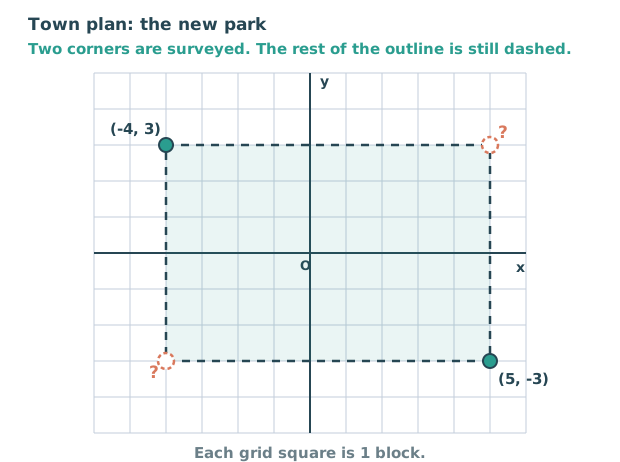
Designing the Town Square: a rectangular park will have an area of 240,000 square feet. Two vertices are already marked on the planning grid, 3 units apart, and each grid unit represents 100 feet.
✍️ Connection Reasoning
Where do the other two vertices go — and how do the known coordinates, the scale, and the area work together to tell you?
The park's width is ___ feet. Using the area formula, its length is ___ feet, which is ___ units on the map — so the new vertices sit that many units below the known ones.
Turn & Talk — Connect
The Town Square park's two known vertices are 3 units apart, and each unit represents 100 feet, so the width is 300 feet. The park's area must be 240,000 square feet. How do you use that to find how many units below the known vertices the missing vertices go?
👂 Listen For
A strong answer chains all three steps correctly — width from units × scale, length from area ÷ width, then units from length ÷ scale — and gets 8 units. A weak answer skips the scale conversion and leaves the answer in feet.
Extend: Explain why dividing by 100 (the scale) is necessary at the end, instead of just using the 800 feet directly as the number of units to move on the grid.
Summarize: Represent Polygons on the Coordinate Plane
Polygons on the Coordinate Plane. 1. Plot all given vertices and connect them in order to form the polygon. 2. Find side lengths by counting grid units or using coordinate distance formulas. 3. Perimeter = Sum of all side lengths; Area = Use standard polygon formulas
In your own words:
CLOSURE & REFLECT
⏱ ~8 min
Today I learned that ___ because ___.
One thing I am still not sure about is ___.
A rectangle has vertices (-1, 4), (5, 4), (5, 1), (-1, 1). What is its perimeter?
Bonus Exit Check
The length is 800 feet and each unit represents 100 feet. How many units long is the park on the map?
✍️ Show Your Work
Explain why your answer is correct using today's vocabulary.
Reflection & Self-Assessment
Continue Learning
Launch the Full Interactive Activity
Students continue practice in the HTML lesson engine with auto-check, hints, and differentiation.
Family Connection
Share tonight's family homework and discuss one vocabulary word at home.
Open Family Homework ↗Teacher Notes
⏱️ Pacing Guide
- Launch & vocab: 12 min
- I Do / We Do / You Do: 15 min
- Explore & practice: 15 min
- Connect & closure: 8 min
Total: ~45 min
🎯 Listen For · Common Errors
• A strong answer explains that the SHARED coordinate tells you the direction of the side, and the DIFFERING coordinate is what you subtract. A weak answer just says 'subtract the numbers' without identifying which pair.
• Listen for students checking BOTH coordinates for a match, not just glancing at the numbers. A strong answer states clearly that neither the x's nor the y's match for the slanted pair.
• A strong answer chains all three steps correctly — width from units × scale, length from area ÷ width, then units from length ÷ scale — and gets 8 units. A weak answer skips the scale conversion and leaves the answer in feet.
• Listen for the full chain — two side lengths from coordinate subtraction, then the perimeter formula — not just a final number pulled without showing the vertex pairs used.
Common mistake: Subtracting coordinates without the absolute value — from y = 3 down to y = −3.75 the distance is 3 + 3.75 = 6.75 units, not 3.75 − 3 = 0.75. Distances that cross zero are the whole reason the absolute value is there.
Answer Key (Teacher Appendix)
Hide this slide during presentation or move to the end of your copy.
✓ Practice 1: 300 feet — 3 units × 100 feet per unit = 300 feet.
✓ Practice 2: 800 feet — Length = area ÷ width = 240,000 ÷ 300 = 800 feet.
✓ Practice 3: 8 units — 800 ÷ 100 = 8 units on the map.
✓ Practice 4: (2, -4) and (5, -4) — 8 units below y = 4 is y = 4 − 8 = −4, keeping each x the same: (2, −4) and (5, −4).
✓ Exit ticket: 18 units — Width |5 − (−1)| = 6, height |4 − 1| = 3. Perimeter = 2(6) + 2(3) = 18 units.