Understand Equations and Their Solutions
I can write an equation for a real situation and check whether a given value is a solution by substituting it.
How to Use This Deck
Click Present or press F11 for fullscreen. Use arrow keys to advance.
Blue boxes show exactly what to say, ask, and how long to spend.
Text boxes, polls, and drag-sort save automatically in the browser.
Press N or click 📝 in the toolbar for pacing tips and answers.
Launch the full HTML activity for independent practice.
File → Print or the print button for handout copies.
🎯 Content Objective / Objetivo de contenido
I can write an equation for a real situation and check whether a given value is a solution by substituting it.
Today's Flow
Total pacing: ~45 min · Progress bar at top tracks your place
LAUNCH
⏱ ~10 min
⏱️ 3 MIN · THINK-PAIR-SHARE
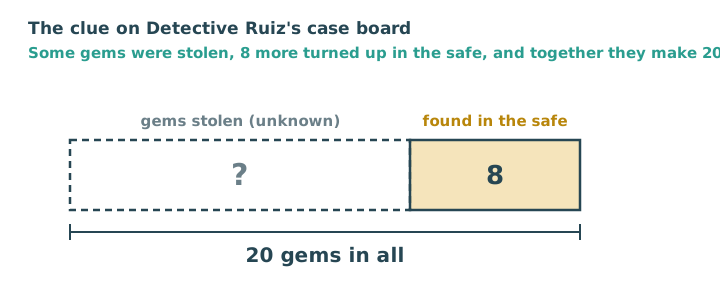
Detective Ruiz's clue says 'a number of stolen gems plus 8 more equals 20 total.' How would you turn this clue into an equation, and what does each part stand for?
Check for Understanding #1
Teacher: If >30% thumbs down, re-teach with a fresh example before moving on.
Case File: Translate the Clues
Detective Ruiz received a tip: 'A number of stolen gems plus 8 more equals 20 total gems.' She needs to write an equation to represent this clue before she can solve the case. How would you write this situation as an equation?
Concept Launch
💡 How do I turn a word clue into an equation?
An equation is a math sentence with an equal sign (=). To write one, I pick a letter (a variable) for the unknown number and match the words to math symbols.
Equations & Solutions. Formula: Left Expression = Right Expression. 1. An equation is a mathematical sentence stating two expressions are equal. 2. A solution is a value for the variable that makes the equation true. 3. Check: Substitute the value into the equation and verify that both sides balance
Check for Understanding #2
Teacher: If >30% thumbs down, re-teach with a fresh example before moving on.
Your turn — test a solution
VOCABULARY
⏱ ~8 min
| Term / Término | Meaning / Significado | Example / Ejemplo | Visual |
|---|---|---|---|
| Write Equations Escribir ecuaciones |
Represent a relationship with expressions joined by an equal sign. Representar una relación con expresiones unidas por un signo igual. |
A $5 fee plus $3 per game for g games: 5 + 3g = total. | |
| Equation Ecuación |
A math sentence with an equal sign showing both sides are the same. Una oración matemática con un signo igual que muestra que ambos lados son iguales. |
n + 8 = 20 means 'some number plus 8 equals 20' | |
| Variable Variable |
A letter that stands for a number that is unknown or can change. Una letra que representa un número desconocido o que puede cambiar. |
In n + 3 = 10, the letter n stands for the unknown number (n = 7) | |
| Equal sign Signo igual |
The = sign, showing both sides are the same. El signo =, que muestra que ambos lados son iguales. |
7 + 3 = 10 — both sides equal 10 | |
| Expression Expresión |
A math phrase with numbers and letters, but no equal sign. Una frase matemática con números y letras, pero sin signo igual. |
2x + 5 is an expression; it becomes an equation when you write 2x + 5 = 15 | |
| Constant Constante |
A fixed number in an expression or equation that does not change. Un número fijo en una expresión o ecuación que no cambia. |
In x + 7 = 12, the numbers 7 and 12 are constants; only x can change. |
Which Word Fits?
Two expressions joined by an ___ ___ make an equation.
Use It In a Sentence
Check for Understanding #3
Teacher: If >30% thumbs down, re-teach with a fresh example before moving on.
Turn & Talk — Launch
Detective Ruiz's clue says 'a number of stolen gems plus 8 more equals 20 total.' How would you turn this clue into an equation, and what does each part stand for?
👂 Listen For
Students choose a variable (such as n) for the unknown gems, build n + 8 = 20, and connect 'plus 8 more' to + 8 and 'equals 20 total' to = 20.
Extend: Why does the equation n + 8 = 20 represent the clue better than the expression n + 8 alone? Justify using the role of the equal sign.
EXPLORE & PRACTICE
⏱ ~18 min
Visual Modeling Workspace
Use the drawing tray below to annotate the visual model. Teacher: say "Click to reveal" on key steps.
Explore Activity
Use the balance scale to see how this word problem becomes an equation. Drag the correct expression to each side of the scale to make it balance.
✍️ Explore Discourse
How did you decide what expression to put on each side of the balance?
Whiteboard Moment
Show your work clearly. Be ready to explain your thinking to a partner.
Turn & Talk — Explore
On the balance scale you put n + 8 on one side and 20 on the other. How did you decide what belongs on each side of the equal sign?
👂 Listen For
Students place the expression n + 8 on one side and the total 20 on the other, explaining the equal sign means both sides have the same value.
Extend: Compare 'twice a number equals 20' with 'a number plus 8 equals 20.' How would the equations differ, and why?
Practice Check A
A detective found some fingerprints on Monday and 14 more on Tuesday, for a total of 30. Which equation represents this?
✍️ Show Your Work
Explain why your answer is correct using today's vocabulary.
Practice Check B
Which equation represents: 'A number plus 12 equals 30'?
✍️ Show Your Work
Explain why your answer is correct using today's vocabulary.
Ratio Table Builder
Fill the ratio table. Each row must be equivalent.
| Factor | A | B |
|---|---|---|
| ×1 | ||
| ×2 | ||
| ×3 |
✍️ Justify Your Thinking
Drag each clue phrase into the operation a detective should write.
A classmate turned in the work below. One step has a mistake. Read every step, find it, name it, and fix it.
Choose ONE option to show what you know — then do it in the workspace below.
Use evidence from today's lesson to complete each frame.
Today's key idea is: "Equations & Solutions. Formula: Left Expression = Right Expression. 1. An equation is a mathematical sentence stating two expressions are equal. 2. A solution is a value for the variable that makes the equation true. 3. Check: Substitute the value into the equation and verify that both sides balance" — and it works because ___.
Because Write Equations means ___, but a tricky part is ___, so I have to ___.
A common mistake with Write Equations is ___. It happens because ___, and the fix is ___.
I can prove my answer is correct by ___, using Equation to check my work.
✍️ TWR · WRITE 3 SENTENCES · 7 MIN
Equations & Solutions. Formula: Left Expression = Right Expression. 1. An equation is a mathematical sentence stating two expressions are equal. 2. A solution is a value for the variable that makes the equation true. 3. Check: Substitute the value into the equation and verify that both sides balance because ___
Equations & Solutions. Formula: Left Expression = Right Expression. 1. An equation is a mathematical sentence stating two expressions are equal. 2. A solution is a value for the variable that makes the equation true. 3. Check: Substitute the value into the equation and verify that both sides balance but ___
Equations & Solutions. Formula: Left Expression = Right Expression. 1. An equation is a mathematical sentence stating two expressions are equal. 2. A solution is a value for the variable that makes the equation true. 3. Check: Substitute the value into the equation and verify that both sides balance so ___
🌱 TWR · GROW THE KERNEL · 6 MIN
Answer these to add detail
Sentence starters (tap to use)
Student Workspace
Use the balance scale to see how this word problem becomes an equation. Drag the correct expression to each side of the scale to make it balance.
| Column A | Column B |
|---|---|
✏️ Sketch Your Strategy
Differentiation Paths
Step-by-step with a worked model and sentence frames.
Which equation represents: 'A number plus 12 equals 30'?
Core practice aligned to the standard.
Extension with error analysis or multi-step reasoning.
Partner Activity
Work with your partner on the practice problems at your differentiation path level. Explain each step using math vocabulary.
Check for Understanding #4
Teacher: If >30% thumbs down, re-teach with a fresh example before moving on.
Real-World Connection
🌍 Math in the Wild
A detective is tracking stolen paintings. She knows that the number of paintings recovered plus 14 paintings still missing equals the 37 total stolen. The equation p + 14 = 37 represents this situation.
✍️ Connection Reasoning
How many paintings has the detective recovered? How did writing an equation help you understand the situation?
The detective recovered ___ paintings because p + 14 = 37 means p = 37 − ___ = ___.
Turn & Talk — Connect
When would writing an equation help you solve a real problem instead of just guessing?
👂 Listen For
Students explain that an equation captures the relationship clearly, lets you use a variable for the unknown, and can be solved instead of guessing.
Extend: Critique: 'Any sentence with numbers is an equation.' Use the words expression and equal sign to explain why this is wrong.
Summarize: Understand Equations and Their Solutions
Equations & Solutions. Formula: Left Expression = Right Expression. 1. An equation is a mathematical sentence stating two expressions are equal. 2. A solution is a value for the variable that makes the equation true. 3. Check: Substitute the value into the equation and verify that both sides balance
In your own words:
CLOSURE & REFLECT
⏱ ~8 min
Today I learned that ___ because ___.
One thing I am still not sure about is ___.
Which value is the solution of n + 5 = 9, and how do you know?
Bonus Exit Check
Which equation represents: 'Seven less than a number is 18'?
✍️ Show Your Work
Explain why your answer is correct using today's vocabulary.
Reflection & Self-Assessment
Continue Learning
Launch the Full Interactive Activity
Students continue practice in the HTML lesson engine with auto-check, hints, and differentiation.
Family Connection
Share tonight's family homework and discuss one vocabulary word at home.
Open Family Homework ↗Teacher Notes
⏱️ Pacing Guide
- Launch & vocab: 12 min
- I Do / We Do / You Do: 15 min
- Explore & practice: 15 min
- Connect & closure: 8 min
Total: ~45 min
🎯 Listen For · Common Errors
• Students choose a variable (such as n) for the unknown gems, build n + 8 = 20, and connect 'plus 8 more' to + 8 and 'equals 20 total' to = 20.
• Students place the expression n + 8 on one side and the total 20 on the other, explaining the equal sign means both sides have the same value.
• Students explain that an equation captures the relationship clearly, lets you use a variable for the unknown, and can be solved instead of guessing.
• Listen for students naming a specific strategy tied to 6.AT.8 — not just "I multiplied." They should connect steps to the key idea.
Common mistake: A common mistake in Write Equations is writing subtraction and division clues in the wrong order — putting the number from the clue first instead of the variable first. For 'a number decreased by 8 equals 5,' students often write 8 − n = 5 instead of the correct n − 8 = 5; for 'a number divided by 4 equals 6,' they write 4 ÷ n (or 4n) instead of n / 4 = 6. Always start with the variable, then attach the operation in the order the words describe it, and check by substituting your answer back in.
Answer Key (Teacher Appendix)
Hide this slide during presentation or move to the end of your copy.
✓ Practice 1: f + 14 = 30 — The detective's Monday fingerprints (f) plus 14 more equals 30: f + 14 = 30.
✓ Practice 2: n + 12 = 30 — 'Plus' means addition, so the equation is n + 12 = 30.
✓ Practice 3: n − 7 = 18 — 'Seven less than a number' means start with the number and subtract 7: n − 7 = 18.
✓ Practice 4: 3n = 21 — 'Three times' means multiply by 3, so the equation is 3n = 21.
✓ Exit ticket: n = 4, because 4 + 5 = 9 is true — Substitute each value and check. Replacing n with 4 gives 4 + 5 = 9, a true statement, so 4 is the solution.