Touch and changeToca y cambia
Move, type, tap, or drag in the model. Watch what changes.Mueve, escribe, toca o arrastra en el modelo. Observa qué cambia.
Unit 9 · 6.AT.11
Explore Relationships Between Two Variables · Lesson 9-1
English: Use the pictures and short steps. Ask questions; let your student do the thinking. Español: Usen los dibujos y los pasos cortos. Hagan preguntas; dejen que su estudiante piense.
Tonight we look at two quantities that change together and decide which one is the independent variable and which is the dependent variable.
Esta noche observamos dos cantidades que cambian juntas y decidimos cuál es la variable independiente y cuál la dependiente.
Follow the picture pathSigan la ruta visual
Real example: a student puts plant trays in different spots and measures how tall the plants grow.
Ejemplo real: una estudiante pone bandejas de plantas en distintos lugares y mide cuánto crecen las plantas.
She CHOSE how many hours of sunlight each tray got, so sunlight is the independent variable.
Ella ELIGIÓ cuántas horas de sol recibía cada bandeja, así que el sol es la variable independiente.
She did not choose the plant height — it responded.
Ella no eligió la altura de las plantas: la altura respondió.
Height is the dependent variable.
La altura es la variable dependiente.
Say it as a sentence: "Plant height depends on hours of sunlight." The word "depends" points to the dependent variable.
Dilo como oración: "La altura de la planta depende de las horas de sol".
La palabra "depende" señala la variable dependiente.
Listen for "depends on" (depende de) — whatever comes before it is the dependent variable.
Escucha "depende de": lo que va antes es la variable dependiente.
Ask "Which one did someone get to choose?" That is always the independent variable.
Pregunta "¿Cuál pudo elegir alguien?" Esa es siempre la variable independiente.
Both quantities change. Being the one that changes is not what makes a variable independent.
Las dos cantidades cambian. Cambiar no es lo que hace independiente a una variable.
Use the same interactive model from the lesson. Change it, notice the pattern, and explain what the model shows.Usa el mismo modelo interactivo de la lección. Cámbialo, observa el patrón y explica lo que muestra.
Move, type, tap, or drag in the model. Watch what changes.Mueve, escribe, toca o arrastra en el modelo. Observa qué cambia.
Record one equation, value, or relationship you can see.Escribe una ecuación, un valor o una relación que puedas ver.
I notice ___ changes when ___ changes. This shows ___.Noto que ___ cambia cuando ___ cambia. Esto muestra ___.
Independent & Dependent Variables. 1. Independent Variable (x): The input / cause that is chosen or changes freely. 2. Dependent Variable (y): The output / effect that depends on the independent variable. 3. Sentence check: 'The (dependent) depends on the (independent)'
A quick, no-timer review game for tonight's lesson — sort, match, and choose. A wrong answer just gives a hint and lets your student try again. Un juego de repaso sin reloj para la lección de hoy — clasificar, emparejar y elegir. Si se equivocan, reciben una pista y pueden intentar de nuevo.
↗ Play full screen ↗ Jugar en pantalla completa
Tap a card to flip. Use these words when you talk about the math together. Toquen una tarjeta para voltearla. Usen estas palabras cuando hablen de la matemática juntos.
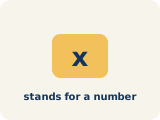
variable independiente
The quantity that is subject to choice. It does not depend on the other quantity.
La cantidad que se elige. No depende de la otra cantidad.
📌 Miguel picks the number of MONTHS — nothing else decides it for him.
variable dependiente
The quantity that changes in response to the independent variable.
La cantidad que cambia en respuesta a la variable independiente.
📌 Total cost = $24.95 × months — the cost RESPONDS to the months.
depende de
One quantity depends on another when changing the first causes the second to change.
Una cantidad depende de otra cuando cambiar la primera hace cambiar la segunda.
📌 “Total cost depends on the number of months.” Responder first, chooser last.
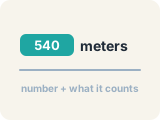
cantidad
Something that can be counted or measured.
Algo que se puede contar o medir.
📌 24.95 dollars per month, 12 months — each is a number with a meaning.
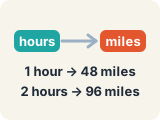
relación
How two quantities change together.
Cómo dos cantidades cambian juntas.
📌 1 month → $24.95, 2 months → $49.90: the two quantities move together.
You decide how many hours to work, and your pay changes as a result.
Ustedes deciden cuántas horas trabajar, y su pago cambia como resultado.
Work side by side. You ask questions; your student does the thinking. Trabajen juntos. Tú haces preguntas; tu estudiante piensa.
Which quantity did you choose?
¿Cuál cantidad eligieron?
Which quantity responded?
¿Cuál cantidad respondió?
Say the whole relationship in one sentence.
Digan toda la relación en una oración.
Do these together. Start at ★ and climb to ★★★ when ready. Háganlos juntos. Empiecen en ★ y suban a ★★★ cuando estén listos.
Akela chooses how many hours of sunlight each tray gets. Which is the INDEPENDENT variable?
A. Hours of sunlight
In Akela's experiment, which is the DEPENDENT variable?
A. Plant height
A gym charges $24.95 per month. Which pair correctly names the variables?
A. Independent: months; Dependent: total cost
Claire jogs 30 minutes and burns 123 Calories. At the same rate, how many Calories would a 90-minute jog burn?
A. 369
Two quantities are related. Which statement is ALWAYS true?
A. The independent variable is subject to choice
⏱️ Plan on about 15–20 minutes for the 6 problems below. The extra practice at the bottom is optional. ⏱️ Calculen unos 15–20 minutos para los 6 problemas de abajo. La práctica extra al final es opcional.
A few problems to practice together. Each one has a step-by-step guide, a picture to draw on, and a space to show your work. Use Check This Problem for instant feedback — no need to finish everything at once. Unos problemas para practicar juntos. Cada uno tiene una guía paso a paso, un dibujo para trabajar y un espacio para mostrar el trabajo. Usen Revisar esta pregunta para retroalimentación al instante — no tienen que terminar todo de una vez.
Easier problems to practice the idea. Do these first together. Problemas más fáciles para practicar la idea. Hagan estos primero juntos.
Which question would you ask to find the DEPENDENT variable?¿Cuál pregunta harías para hallar la variable DEPENDIENTE?
👪 Read the question together, then let your student pick an answer before you discuss why.👪 Lean la pregunta juntos; dejen que su estudiante elija antes de hablar del porqué.
Sort each quantity: independent or dependent?Clasifica cada cantidad: ¿independiente o dependiente?
👪 On a phone, use Move to. On a computer, drag cards or tap a card then tap a column.👪 En el teléfono usen Mover a. En la computadora arrastren o toquen tarjeta y columna.
💡 Use the sentence check: 'The ___ depends on the ___.' The first blank is dependent.Usa la oración de comprobación: 'El/La ___ depende de el/la ___.' El primer espacio es la dependiente.
💡 The independent variable is the one a person chooses or controls directly.La variable independiente es la que una persona elige o controla directamente.
Claire decides to walk instead of jog for the same 30 minutes. What happens to the two variables?Claire decide caminar en vez de trotar durante los mismos 30 minutos. ¿Qué pasa con las dos variables?
👪 Read the question together, then let your student pick an answer before you discuss why.👪 Lean la pregunta juntos; dejen que su estudiante elija antes de hablar del porqué.
Try these once the warm-up feels easy. It's okay to use the steps and pictures. Intenten estos cuando el calentamiento sea fácil. Está bien usar los pasos y los dibujos.
Give an example where the SAME quantity can be independent in one problem and dependent in another.Da un ejemplo donde la MISMA cantidad pueda ser independiente en un problema y dependiente en otro.
👪 Read the question together, then let your student pick an answer before you discuss why.👪 Lean la pregunta juntos; dejen que su estudiante elija antes de hablar del porqué.
Two quantities are related. Which statement is ALWAYS true?Dos cantidades están relacionadas. ¿Cuál enunciado es SIEMPRE verdadero?
👪 Read the question together, then let your student pick an answer before you discuss why.👪 Lean la pregunta juntos; dejen que su estudiante elija antes de hablar del porqué.
Which relationship is NOT a case of one quantity depending on the other?¿Cuál relación NO es un caso de una cantidad que depende de la otra?
👪 Read the question together, then let your student pick an answer before you discuss why.👪 Lean la pregunta juntos; dejen que su estudiante elija antes de hablar del porqué.
Optional. Only if your student wants more — these are bonus problems. Opcional. Solo si tu estudiante quiere más — son problemas adicionales.
Akela chooses how many hours of sunlight each tray gets. Which is the INDEPENDENT variable?Akela escoge cuántas horas de luz solar recibe cada bandeja. ¿Cuál es la variable INDEPENDIENTE?
👪 Read the question together, then let your student pick an answer before you discuss why.👪 Lean la pregunta juntos; dejen que su estudiante elija antes de hablar del porqué.
A gym charges $24.95 per month. Which pair correctly names the variables?Un gimnasio cobra $24.95 al mes. ¿Cuál par nombra correctamente las variables?
👪 Read the question together, then let your student pick an answer before you discuss why.👪 Lean la pregunta juntos; dejen que su estudiante elija antes de hablar del porqué.
If Claire runs exactly 3 miles and records how long it takes, which is the independent variable now?Si Claire corre exactamente 3 millas y registra cuánto tiempo tarda, ¿cuál es ahora la variable independiente?
👪 Read the question together, then let your student pick an answer before you discuss why.👪 Lean la pregunta juntos; dejen que su estudiante elija antes de hablar del porqué.
Which sentence is written in the correct order?¿Cuál oración está escrita en el orden correcto?
👪 Read the question together, then let your student pick an answer before you discuss why.👪 Lean la pregunta juntos; dejen que su estudiante elija antes de hablar del porqué.
You buy tickets at $45 each. Which quantity depends on the other?Compras boletos a $45 cada uno. ¿Cuál cantidad depende de la otra?
👪 Read the question together, then let your student pick an answer before you discuss why.👪 Lean la pregunta juntos; dejen que su estudiante elija antes de hablar del porqué.
Which of these pairs is NOT a dependent relationship?¿Cuál de estos pares NO es una relación de dependencia?
👪 Read the question together, then let your student pick an answer before you discuss why.👪 Lean la pregunta juntos; dejen que su estudiante elija antes de hablar del porqué.
In Akela's experiment, which is the DEPENDENT variable?En el experimento de Akela, ¿cuál es la variable DEPENDIENTE?
👪 Read the question together, then let your student pick an answer before you discuss why.👪 Lean la pregunta juntos; dejen que su estudiante elija antes de hablar del porqué.
Claire burned 123 Calories on a 30-minute jog. Which quantity is subject to choice?Claire quemó 123 calorías en un trote de 30 minutos. ¿Cuál cantidad es la que se escoge?
👪 Read the question together, then let your student pick an answer before you discuss why.👪 Lean la pregunta juntos; dejen que su estudiante elija antes de hablar del porqué.
A digital scratch pad to draw models, line up decimals, and show your work. It opens in a new tab so you keep your place on this homework. Una pizarra digital para dibujar modelos, alinear decimales y mostrar el trabajo. Se abre en una pestaña nueva para no perder tu lugar en esta tarea.
🧮 Open the Math Workbench ↗ 🧮 Abrir la Pizarra de matemáticas ↗
Which one did someone get to decide?
¿Cuál pudo decidir alguien?
Which one changed because of the other?
¿Cuál cambió a causa de la otra?
Can you say it with the words "depends on"?
¿Puedes decirlo con las palabras "depende de"?
The first one mentioned is always independent.
La primera que se menciona siempre es independiente.
It does not matter which is which.
No importa cuál es cuál.
The bigger number is the dependent variable.
El número más grande es la variable dependiente.
These links go to specific videos and lessons about tonight's topic — not general math pages. Estos enlaces van a videos y lecciones específicas sobre el tema de hoy — no páginas generales.
Reinforce tonight's topic with a quick family game. You ask; your student decides! Refuercen el tema de hoy con un juego rápido en familia. ¡Ustedes preguntan; su estudiante decide!
🎮 Play together! Substitute the value, then follow order of operations. 🎮 ¡Jueguen juntos! Sustituyan el valor, luego sigan el orden de operaciones.
High five! Whether every answer was perfect or not, you showed up for your student tonight. That matters.
¡Chócalas! No importa si cada respuesta fue perfecta — estuviste con tu estudiante esta noche. Eso importa.
Answers save automatically on this device. Tap Check This Problem anytime. Las respuestas se guardan solas en este dispositivo. Toquen Revisar esta pregunta cuando quieran.
Signed on:Firmado el:
Note to teacher / Nota para el maestro:
This certifies that the homework for was completed and reviewed collaboratively.
Parent/Guardian Signature
Date