Touch and changeToca y cambia
Move, type, tap, or drag in the model. Watch what changes.Mueve, escribe, toca o arrastra en el modelo. Observa qué cambia.
Unit 5 · Solve Area, Surface Area, and Volume ProblemsUnidad 5 · Resolver problemas de área, área total y volumen
TicketBoleto
A class packs a time capsule box. It is 2 feet long, 1.5 feet wide and 1 foot tall. The class wants to know how much fits inside. How many cubic feet is the capsule?Una clase prepara una caja para una cápsula del tiempo. Mide 2 pies de largo, 1.5 pies de ancho y 1 pie de alto. La clase quiere saber cuánto cabe adentro. ¿Cuántos pies cúbicos mide la cápsula?
Five short steps, about 15–20 minutes: watch the idea, try one together, solve 10 in three levels, check, celebrate.Cinco pasos cortos, unos 15–20 minutos: miren la idea, prueben uno juntos, resuelvan 10 en tres niveles, revisen y celebren.
Optional. No grades, no account. Your place is saved on this device.Opcional. Sin calificaciones ni cuenta. Su avance se guarda en este dispositivo.
Tonight's ideaLa idea de hoy Find the volume of a box, even when an edge is a fraction or a decimal.Hallar el volumen de una caja, incluso cuando una medida es una fracción o un decimal.
💡 Draw fraction bars, tape diagrams, equations, or line up decimals together!💡 ¡Dibujen barras de fracciones, modelos o alineen decimales juntos!
Step 1 of 5Paso 1 de 5
Read the goal and look at the picture. Then go through the example one step at a time.Lean la meta y miren el dibujo. Luego sigan el ejemplo un paso a la vez.
Find the volume of a box, even when an edge is a fraction or a decimal.
Hallar el volumen de una caja, incluso cuando una medida es una fracción o un decimal.
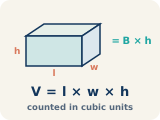
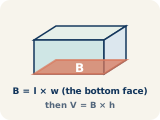
In class we usedEn clase usamos base area times heightárea de la base por la altura.
Why it worksPor qué funciona 1.5 and 3/2 name the same length, so 2 × 3/2 also makes 3. A decimal or fraction edge is still a number, and the steps do not change.1.5 y 3/2 nombran la misma longitud, así que 2 × 3/2 también da 3. Una arista decimal o fraccionaria sigue siendo un número, y los pasos no cambian.
The example:El ejemplo: My capsule is 2 ft long, 1.5 ft wide, and 1 ft tall. I write V = length × width × height.Mi cápsula mide 2 pies de largo, 1.5 pies de ancho y 1 pie de alto. Escribo V = largo × ancho × alto.
Your case:Su caso: Tonight we find the volume of a box even when one edge is a fraction or a decimal, like 1.5. The rule does not change: multiply length × width × height.Esta noche encontramos el volumen de una caja aunque una arista sea una fracción o un decimal, como 1.5. La regla no cambia: multiplica largo × ancho × altura.
Tap a clue to read what it means.Toquen una pista para leer qué significa.
Look at the picture and the story. Say it out loud, or type a few words. There is no wrong answer here.Mira el dibujo y la historia. Dilo en voz alta o escribe unas palabras. Aquí no hay respuestas incorrectas.
Just for you. It stays on this device. We ask again at the end.Solo para ti. Se queda en este dispositivo. Preguntamos otra vez al final.
A box is 6 in. long, 3 in. wide and 2 in. tall. What is its volume?Una caja mide 6 pulg. de largo, 3 de ancho y 2 de alto. ¿Cuál es su volumen?
Not yet. Try another look.Todavía no. Intenta otra mirada.
Multiply the three edges: 6 × 3 × 2 = 36 cubic inches.Multiplica las tres medidas: 6 × 3 × 2 = 36 pulgadas cúbicas.
A regular hexagon splits into 6 triangles of 4 square units each. What is its area?Un hexágono regular se divide en 6 triángulos de 4 unidades cuadradas cada uno. ¿Cuál es su área?
Not yet. Try another look.Todavía no. Intenta otra mirada.
Repeat the triangle's area 6 times: 6 × 4 = 24.Repite el área del triángulo 6 veces: 6 × 4 = 24.
Step 2 of 5Paso 2 de 5
Do this one side by side. Use the model, and ask for a hint whenever you want one.Háganlo lado a lado. Usen el modelo y pidan una pista cuando quieran.
Try this one togetherPrueben este juntos
Find the volume of a capsule design that is 4 ft long, 2 ft wide, and 0.5 ft tall (half a foot).Encuentren el volumen de un diseño de cápsula que mide 4 ft de largo, 2 ft de ancho y 0.5 ft de alto (medio pie).
Write the rule and put in the numbers. Start by multiplying the first two — what do you get?Escriban la regla y pongan los números. Empiecen multiplicando los dos primeros — ¿qué obtienen?
Volume = 4 × 2 × 0.5. First 4 × 2 = 8.Volumen = 4 × 2 × 0.5. Primero 4 × 2 = 8.
Remind your student that 0.5 means half.Recuerden a su estudiante que 0.5 significa la mitad.
Now multiply by 0.5 — that means take half. What is the volume?Ahora multipliquen por 0.5 — eso significa tomar la mitad. ¿Cuál es el volumen?
Half of 8 is 4: 8 × 0.5 = 4. The volume is 4 cubic feet.La mitad de 8 es 4: 8 × 0.5 = 4. El volumen es 4 pies cúbicos.
If half is confusing, fold a paper in two to show "half."Si la mitad confunde, doblen un papel en dos para mostrar "la mitad".
Check together: the decimal edge just made the answer a little smaller. The rule stayed the same.Revisen juntos: la arista decimal solo hizo la respuesta un poco más pequeña. La regla siguió igual.
A smaller height means a smaller volume.Una altura más pequeña da un volumen más pequeño.
Talking about why the answer makes sense matters more than speed.Hablar de por qué la respuesta tiene sentido importa más que la rapidez.
Edges can be fractions. Count the small cubes in each layer.Las aristas pueden ser fracciones. Cuenta los cubitos de cada capa.
Change one value. Watch what changes in the picture and answer.Cambia un valor. Mira qué cambia en el dibujo y la respuesta. Say: “When ___ changes, ___ changes.”Di: “Cuando ___ cambia, ___ cambia.”
Before you go on: say one thing the model showed you.Antes de seguir: digan una cosa que les mostró el modelo.
Change the prism's three edges. Count the cubes in one layer, then all layers.Cambia las tres aristas del prisma. Cuenta los cubos de una capa y luego de todas.
Move, type, tap, or drag in the model. Watch what changes.Mueve, escribe, toca o arrastra en el modelo. Observa qué cambia.
Record one equation, value, or relationship you can see.Escribe una ecuación, un valor o una relación que puedas ver.
I notice ___ changes when ___ changes. This shows ___.Noto que ___ cambia cuando ___ cambia. Esto muestra ___.
Ask: "Where do you see the numbers from tonight's math in this model?"Pregunta: "¿Dónde ves los números de la tarea de hoy en este modelo?"
Find the volume of a box, even when an edge is a fraction or a decimal.
Hallar el volumen de una caja, incluso cuando una medida es una fracción o un decimal.
A fraction or decimal edge is still just a number. You multiply the three edges the same way you always do.
Una arista con fracción o decimal sigue siendo solo un número. Multiplicas las tres aristas igual que siempre.
Find the edges: 2 ft long, 1.5 ft wide, and 1 ft tall.
Halla las aristas: la cápsula mide 2 pies de largo, 1.5 pies de ancho y 1 pie de alto.
Use volume = length × width × height.
Usa volumen = largo × ancho × altura.
Put in the numbers: volume = 2 × 1.5 × 1.
Pon los números: volumen = 2 × 1.5 × 1.
Find the base area: 2 × 1.5 = 3 square feet.
Halla el área de la base: 2 × 1.5 = 3 pies cuadrados.
(Two groups of 1.5 make 3.)
(Dos grupos de 1.5 dan 3.)
Multiply by the height: 3 × 1 = 3.
Multiplica por la altura: 3 × 1 = 3.
The volume is 3 cubic feet (ft³). The decimal did not change the steps.
El volumen es 3 pies cúbicos (pies³). El decimal no cambió los pasos.
Listen for "dimensiones" — it means how long, how wide, and how tall the box is.
Escuchen la palabra "dimensiones" — significa qué tan largo, ancho y alto es la caja.
Listen for "área de la base" — you can also find volume by multiplying the base area times the height.
Escuchen "área de la base" — también pueden hallar el volumen multiplicando el área de la base por la altura.
Let your student try first. Ask "Does the fraction change what we do?" The answer is no.
Dejen que su estudiante intente primero. Pregunten "¿La fracción cambia lo que hacemos?" La respuesta es no.
Step 3 of 5Paso 3 de 5
One at a time. Work on your own; a grown-up can watch.Uno a la vez. Trabaja solo; un adulto puede observar.
10 problems. Hints are always okay. 10 problemas. Las pistas siempre están bien.
+0 bonusextraArea of a rectangle multiplies its two sides.
El área de un rectángulo multiplica sus dos lados.
The base is the bottom face. Which two edges form it?
La base es la cara de abajo. ¿Cuáles dos aristas la forman?
12: the base area is 4 × 3 = 12.
12: el área de la base es 4 × 3 = 12.
A box has a length of 4 and a width of 3. What is its base area?Una caja tiene largo 4 y ancho 3. ¿Cuál es su área de base?
Answer key for families — compare, then talk about why.Clave de respuestas para la familia — comparen y hablen del porqué.
Not tried yet? Close this and give it one try first. A wrong first try still helps.¿Todavía no lo intentaron? Ciérrenla y hagan un intento primero. Un primer intento equivocado también ayuda.
Why:Por qué: 12: the base area is 4 × 3 = 12.12: el área de la base es 4 × 3 = 12.
Find the base area first.
Halla primero el área de la base.
Is 1.5 a number you can multiply with, or must you round it?
¿1.5 es un número con el que puedes multiplicar o debes redondearlo?
12 cubic ft: the base area is 4 × 2 = 8, and 8 × 1.5 = 12.
12 pies cúbicos: el área de la base es 4 × 2 = 8 y 8 × 1.5 = 12.
A box is 4 ft long, 2 ft wide and 1.5 ft tall. What is its volume?Una caja mide 4 pies de largo, 2 de ancho y 1.5 de alto. ¿Cuál es su volumen?
Answer key for families — compare, then talk about why.Clave de respuestas para la familia — comparen y hablen del porqué.
Not tried yet? Close this and give it one try first. A wrong first try still helps.¿Todavía no lo intentaron? Ciérrenla y hagan un intento primero. Un primer intento equivocado también ayuda.
Why:Por qué: 12 cubic ft: the base area is 4 × 2 = 8, and 8 × 1.5 = 12.12 pies cúbicos: el área de la base es 4 × 2 = 8 y 8 × 1.5 = 12.
Rounding 1.5 down to 1, or up to 2, before multiplying. The volume must use the exact edge.
Redondear 1.5 a 1, o a 2, antes de multiplicar. El volumen debe usar la arista exacta.
Base area = ___ × ___ = ___. Volume = ___ × ___ = ___ cubic units.
Área de la base = ___ × ___ = ___. Volumen = ___ × ___ = ___ unidades cúbicas.
Multiply all three exact edges. 3 × 2.5 = 7.5. Then 7.5 × 2 = 15 cubic feet.
Multiplica las tres medidas exactas. 3 × 2.5 = 7.5. Luego 7.5 × 2 = 15 pies cúbicos.
A storage bin is 3 feet long, 2.5 feet wide and 2 feet tall. What is its volume?Un contenedor mide 3 pies de largo, 2.5 pies de ancho y 2 pies de alto. ¿Cuál es su volumen?
Answer key for families — compare, then talk about why.Clave de respuestas para la familia — comparen y hablen del porqué.
Not tried yet? Close this and give it one try first. A wrong first try still helps.¿Todavía no lo intentaron? Ciérrenla y hagan un intento primero. Un primer intento equivocado también ayuda.
Why:Por qué: Multiply all three exact edges. 3 × 2.5 = 7.5. Then 7.5 × 2 = 15 cubic feet.Multiplica las tres medidas exactas. 3 × 2.5 = 7.5. Luego 7.5 × 2 = 15 pies cúbicos.
Volume = base area × height.
Volumen = área de la base × altura.
The base area is one layer of cubes. How many layers are there?
El área de la base es una capa de cubos. ¿Cuántas capas hay?
30 cm³: 10 × 3 = 30.
30 cm³: 10 × 3 = 30.
A box has a base area of 10 cm² and a height of 3 cm. What is its volume?Una caja tiene un área de base de 10 cm² y una altura de 3 cm. ¿Cuál es su volumen?
Answer key for families — compare, then talk about why.Clave de respuestas para la familia — comparen y hablen del porqué.
Not tried yet? Close this and give it one try first. A wrong first try still helps.¿Todavía no lo intentaron? Ciérrenla y hagan un intento primero. Un primer intento equivocado también ayuda.
Why:Por qué: 30 cm³: 10 × 3 = 30.
What is the base area, and what happens to it when the height is 1/2?
¿Cuánto mide el área de la base, y qué pasa con ella si la altura es 1/2?
What does multiplying by 1/2 do to a number?
¿Qué hace multiplicar por 1/2 a un número?
12 in³: the base area is 6 × 4 = 24, and 24 × 1/2 = 12.
12 pulg³: el área de la base es 6 × 4 = 24 y 24 × 1/2 = 12.
A box is 6 in. long, 4 in. wide and 1/2 in. tall. What is its volume?Una caja mide 6 pulg. de largo, 4 de ancho y 1/2 de alto. ¿Cuál es su volumen?
Answer key for families — compare, then talk about why.Clave de respuestas para la familia — comparen y hablen del porqué.
Not tried yet? Close this and give it one try first. A wrong first try still helps.¿Todavía no lo intentaron? Ciérrenla y hagan un intento primero. Un primer intento equivocado también ayuda.
Why:Por qué: 12 in³: the base area is 6 × 4 = 24, and 24 × 1/2 = 12.12 pulg³: el área de la base es 6 × 4 = 24 y 24 × 1/2 = 12.
Think of 12 × 2 and then half of 12.
Piensa en 12 × 2 y luego la mitad de 12.
Base area times height gives volume. Should 2.5 be rounded?
Área de la base por altura da el volumen. ¿Debe redondearse 2.5?
30 m³: 12 × 2.5 = 30.
30 m³: 12 × 2.5 = 30.
A box has a base area of 12 m² and a height of 2.5 m. What is its volume?Una caja tiene un área de base de 12 m² y una altura de 2.5 m. ¿Cuál es su volumen?
Answer key for families — compare, then talk about why.Clave de respuestas para la familia — comparen y hablen del porqué.
Not tried yet? Close this and give it one try first. A wrong first try still helps.¿Todavía no lo intentaron? Ciérrenla y hagan un intento primero. Un primer intento equivocado también ayuda.
Why:Por qué: 30 m³: 12 × 2.5 = 30.
Which two edges make the base, and what is its area?
¿Qué dos aristas forman la base, y cuánto mide su área?
Which edge is not a whole number?
¿Cuál arista no es un número entero?
3 cubic ft: the base area is 2 × 1 = 2, and 2 × 1.5 = 3.
3 pies cúbicos: el área de la base es 2 × 1 = 2 y 2 × 1.5 = 3.
A fish tank is 2 ft long, 1 ft wide and 1.5 ft tall. What is its volume?Una pecera mide 2 pies de largo, 1 de ancho y 1.5 de alto. ¿Cuál es su volumen?
Answer key for families — compare, then talk about why.Clave de respuestas para la familia — comparen y hablen del porqué.
Not tried yet? Close this and give it one try first. A wrong first try still helps.¿Todavía no lo intentaron? Ciérrenla y hagan un intento primero. Un primer intento equivocado también ayuda.
Why:Por qué: 3 cubic ft: the base area is 2 × 1 = 2, and 2 × 1.5 = 3.3 pies cúbicos: el área de la base es 2 × 1 = 2 y 2 × 1.5 = 3.
Easier problems to practice the idea. Do these first together. Problemas más fáciles para practicar la idea. Hagan estos primero juntos.
Use V = length × width × height: multiply two of the dimensions first, then multiply by the third.
Usa V = largo × ancho × alto: multiplica primero dos de las dimensiones y luego multiplica por la tercera.
Volume measures the space inside a solid, and it is always labeled in cubic units.
El volumen mide el espacio dentro de un cuerpo y siempre se escribe en unidades cúbicas.
V = length × width × height = 6 × 4 × 3 = 72 cubic in. Volume uses cubic units.
V = largo × ancho × alto = 6 × 4 × 3 = 72 pulgadas cúbicas. El volumen usa unidades cúbicas.
A time-capsule box measures 6 in long, 4 in wide, and 3 in tall. What is its volume?Una caja para una cápsula del tiempo mide 6 in de largo, 4 in de ancho y 3 in de alto. ¿Cuál es su volumen?
Answer key for families — compare, then talk about why.Clave de respuestas para la familia — comparen y hablen del porqué.
Not tried yet? Close this and give it one try first. A wrong first try still helps.¿Todavía no lo intentaron? Ciérrenla y hagan un intento primero. Un primer intento equivocado también ayuda.
Why:Por qué: V = length × width × height = 6 × 4 × 3 = 72 cubic in. Volume uses cubic units.V = largo × ancho × alto = 6 × 4 × 3 = 72 pulgadas cúbicas. El volumen usa unidades cúbicas.
Multiply the two whole-number edges first, then multiply that product by the fractional height.
Multiplica primero las dos aristas enteras y después multiplica ese producto por la altura fraccionaria.
A fractional edge length works exactly like a whole-number one — the formula V = l × w × h does not change.
Una arista fraccionaria funciona igual que una entera: la fórmula V = l × w × h no cambia.
V = 4 × 3 × 1.5 = 12 × 1.5 = 18 cubic in. A fractional edge does not change the steps.
V = 4 × 3 × 1.5 = 12 × 1.5 = 18 pulgadas cúbicas. Una arista fraccionaria no cambia los pasos.
A keepsake box is 4 in long, 3 in wide, and 1½ in tall. What is its volume?Una caja de recuerdos mide 4 in de largo, 3 in de ancho y 1½ in de alto. ¿Cuál es su volumen?
Answer key for families — compare, then talk about why.Clave de respuestas para la familia — comparen y hablen del porqué.
Not tried yet? Close this and give it one try first. A wrong first try still helps.¿Todavía no lo intentaron? Ciérrenla y hagan un intento primero. Un primer intento equivocado también ayuda.
Why:Por qué: V = 4 × 3 × 1.5 = 12 × 1.5 = 18 cubic in. A fractional edge does not change the steps.V = 4 × 3 × 1.5 = 12 × 1.5 = 18 pulgadas cúbicas. Una arista fraccionaria no cambia los pasos.
Compute each volume with V = l × w × h, then subtract the smaller total from the larger.
Calcula cada volumen con V = l × a × h y luego resta el total menor del mayor.
This asks two things: which box holds more AND by how many cubic inches — so find both volumes first.
Esto pregunta dos cosas: cuál caja guarda más Y por cuántas pulgadas cúbicas, así que halla primero ambos volúmenes.
Box A: 10 × 5 × 4 = 200 in³. Box B: 8 × 6 × 5 = 240 in³. Box B is bigger by 40 in³.
Caja A: 10 × 5 × 4 = 200 in³. Caja B: 8 × 6 × 5 = 240 in³. La caja B es mayor por 40 in³.
Two boxes: Box A is 10 × 5 × 4 inches. Box B is 8 × 6 × 5 inches. Which has more volume and by how much?Dos cajas: la caja A mide 10 × 5 × 4 pulgadas. La caja B mide 8 × 6 × 5 pulgadas. ¿Cuál tiene más volumen y por cuánto?
Answer key for families — compare, then talk about why.Clave de respuestas para la familia — comparen y hablen del porqué.
Not tried yet? Close this and give it one try first. A wrong first try still helps.¿Todavía no lo intentaron? Ciérrenla y hagan un intento primero. Un primer intento equivocado también ayuda.
Why:Por qué: Box A: 10 × 5 × 4 = 200 in³. Box B: 8 × 6 × 5 = 240 in³. Box B is bigger by 40 in³.Caja A: 10 × 5 × 4 = 200 in³. Caja B: 8 × 6 × 5 = 240 in³. La caja B es mayor por 40 in³.
Try these once the warm-up feels easy. It's okay to use the steps and pictures. Intenten estos cuando el calentamiento sea fácil. Está bien usar los pasos y los dibujos.
Multiply all three edges: V = 1/2 × 3 × 4. Multiplying by 1/2 is the same as dividing by 2.
Multiplica las tres aristas: V = 1/2 × 3 × 4. Multiplicar por 1/2 es lo mismo que dividir entre 2.
One edge is a fraction: 1/2 m. The other edges are 3 m and 4 m. The formula works the same with fractions.
Una arista es una fracción: 1/2 m. Las otras aristas son 3 m y 4 m. La fórmula funciona igual con fracciones.
V = 1/2 × 3 × 4 = 6 m³.
V = 1/2 × 3 × 4 = 6 m³.
What is the volume of a prism with edge lengths 1/2 m, 3 m, and 4 m?¿Cuál es el volumen de un prisma con longitudes de arista de 1/2 m, 3 m y 4 m?
Answer key for families — compare, then talk about why.Clave de respuestas para la familia — comparen y hablen del porqué.
Not tried yet? Close this and give it one try first. A wrong first try still helps.¿Todavía no lo intentaron? Ciérrenla y hagan un intento primero. Un primer intento equivocado también ayuda.
Why:Por qué: V = 1/2 × 3 × 4 = 6 m³.
Find the volume of each box separately with V = l × w × h, then compare the two numbers.
Halla el volumen de cada caja por separado con V = l × w × h y luego compara los dos números.
How much a box holds is its volume, not its height or its widest side.
Lo que cabe en una caja es su volumen, no su altura ni su lado más ancho.
Box A: 5 × 5 × 2 = 50 cubic in. Box B: 4 × 4 × 3 = 48 cubic in. 50 > 48, so Box A holds more.
Caja A: 5 × 5 × 2 = 50 pulgadas cúbicas. Caja B: 4 × 4 × 3 = 48 pulgadas cúbicas. 50 > 48, así que la caja A guarda más.
Two storage boxes are ready to pack. Box A is 5 × 5 × 2 inches and Box B is 4 × 4 × 3 inches. Which box holds more?Hay dos cajas de almacenamiento listas para empacar. La caja A mide 5 × 5 × 2 pulgadas y la caja B mide 4 × 4 × 3 pulgadas. ¿Cuál caja guarda más?
Answer key for families — compare, then talk about why.Clave de respuestas para la familia — comparen y hablen del porqué.
Not tried yet? Close this and give it one try first. A wrong first try still helps.¿Todavía no lo intentaron? Ciérrenla y hagan un intento primero. Un primer intento equivocado también ayuda.
Why:Por qué: Box A: 5 × 5 × 2 = 50 cubic in. Box B: 4 × 4 × 3 = 48 cubic in. 50 > 48, so Box A holds more.Caja A: 5 × 5 × 2 = 50 pulgadas cúbicas. Caja B: 4 × 4 × 3 = 48 pulgadas cúbicas. 50 > 48, así que la caja A guarda más.
What makes your answer reasonable? Use the question to check it.
¿Por qué es razonable tu respuesta? Usa la pregunta para comprobarla.
Multiply the three dimensions for each set to find the volume.
Indica largo, ancho y alto. Cuenta una capa y luego el número de capas.
Multiply the three dimensions on each card to find its volume: 2 × 3 × 4 = 24, 5 × 2 × 2 = 20, 3 × 3 × 3 = 27, and 6 × 1 × 5 = 30 cubic in. Boxes with very different shapes can land close in volume, so multiply instead of guessing from how big the numbers look.
Multiplica las tres dimensiones de cada tarjeta para hallar su volumen: 2 × 3 × 4 = 24, 5 × 2 × 2 = 20, 3 × 3 × 3 = 27 y 6 × 1 × 5 = 30 pulgadas cúbicas. Cajas con formas muy distintas pueden quedar cerca en volumen, así que multiplica en lugar de adivinar por el tamaño de los números.
Match each box's dimensions to its correct volume.Une las dimensiones de cada caja con su volumen correcto.
Answer key for families — compare, then talk about why.Clave de respuestas para la familia — comparen y hablen del porqué.
Not tried yet? Close this and give it one try first. A wrong first try still helps.¿Todavía no lo intentaron? Ciérrenla y hagan un intento primero. Un primer intento equivocado también ayuda.
Why:Por qué: Multiply the three dimensions on each card to find its volume: 2 × 3 × 4 = 24, 5 × 2 × 2 = 20, 3 × 3 × 3 = 27, and 6 × 1 × 5 = 30 cubic in. Boxes with very different shapes can land close in volume, so multiply instead of guessing from how big the numbers look.Multiplica las tres dimensiones de cada tarjeta para hallar su volumen: 2 × 3 × 4 = 24, 5 × 2 × 2 = 20, 3 × 3 × 3 = 27 y 6 × 1 × 5 = 30 pulgadas cúbicas. Cajas con formas muy distintas pueden quedar cerca en volumen, así que multiplica en lugar de adivinar por el tamaño de los números.
Optional. Only if your student wants more — these are bonus problems. Opcional. Solo si tu estudiante quiere más — son problemas adicionales.
Match each measurement to its unit: flat surfaces get square units (²), filled space gets cubic units (³).
Une cada medida con su unidad: las superficies planas llevan unidades cuadradas (²) y el espacio lleno lleva unidades cúbicas (³).
Think dimensions: area covers a flat 2D surface, while volume fills a 3D space.
Piensa en dimensiones: el área cubre una superficie plana 2D, mientras que el volumen llena un espacio 3D.
Volume measures the space inside a 3D shape (cubic units like in³). Area measures a flat 2D surface (square units like in²).
El volumen mide el espacio dentro de una figura de tres dimensiones (unidades cúbicas como in³). El área mide una superficie plana de dos dimensiones (unidades cuadradas como in²).
How is volume different from area?¿En qué se diferencia el volumen del área?
Answer key for families — compare, then talk about why.Clave de respuestas para la familia — comparen y hablen del porqué.
Not tried yet? Close this and give it one try first. A wrong first try still helps.¿Todavía no lo intentaron? Ciérrenla y hagan un intento primero. Un primer intento equivocado también ayuda.
Why:Por qué: Volume measures the space inside a 3D shape (cubic units like in³). Area measures a flat 2D surface (square units like in²).El volumen mide el espacio dentro de una figura de tres dimensiones (unidades cúbicas como in³). El área mide una superficie plana de dos dimensiones (unidades cuadradas como in²).
Use V = l × w × h and remember the answer needs cubic units (in³), not square units.
Usa V = l × a × h y recuerda que la respuesta necesita unidades cúbicas (pulg³), no cuadradas.
Spot the three edges: l = 4 in, w = 3 in, h = 5 in. Volume fills the whole box, so all three matter.
Identifica las tres aristas: l = 4 pulg, a = 3 pulg, h = 5 pulg. El volumen llena toda la caja, así que las tres importan.
V = l × w × h = 4 × 3 × 5 = 60 cubic inches.
V = l × w × h = 4 × 3 × 5 = 60 pulgadas cúbicas.
What is the volume of a rectangular prism with l = 4 in, w = 3 in, h = 5 in?¿Cuál es el volumen de un prisma rectangular con l = 4 in, w = 3 in, h = 5 in?
Answer key for families — compare, then talk about why.Clave de respuestas para la familia — comparen y hablen del porqué.
Not tried yet? Close this and give it one try first. A wrong first try still helps.¿Todavía no lo intentaron? Ciérrenla y hagan un intento primero. Un primer intento equivocado también ayuda.
Why:Por qué: V = l × w × h = 4 × 3 × 5 = 60 cubic inches.V = l × w × h = 4 × 3 × 5 = 60 pulgadas cúbicas.
For every row use V = l × w × h: multiply the first two numbers, then multiply by the third.
Para cada fila usa V = l × a × h: multiplica los dos primeros números y luego multiplica por el tercero.
Each row lists a length, width, and height. The blank Volume cell needs a number with cubic units.
Cada fila indica un largo, un ancho y una altura. La celda vacía de Volumen necesita un número con unidades cúbicas.
Volume counts the unit cubes that fill a prism, and V = length × width × height finds that count: 8 × 5 × 2 = 80 in³, 4 × 4 × 4 = 64 cm³, and 10 × 3 × 6 = 180 ft³. Because three lengths are multiplied, the units come out cubic.
El volumen cuenta los cubos unitarios que llenan un prisma, y V = largo × ancho × altura encuentra esa cantidad: 8 × 5 × 2 = 80 in³, 4 × 4 × 4 = 64 cm³ y 10 × 3 × 6 = 180 ft³. Como se multiplican tres longitudes, las unidades quedan cúbicas.
Find the volume of each rectangular prism.Encuentra el volumen de cada prisma rectangular.
| LengthLongitud | WidthAncho | HeightAltura | VolumeVolumen |
|---|---|---|---|
| 8 in8 pulgadas | 5 in5 pulgadas | 2 in2 pulgadas |
|
| 4 cm | 4 cm | 4 cm |
|
| 10 ft10 pies | 3 ft3 pies | 6 ft6 pies |
|
Answer key for families — compare, then talk about why.Clave de respuestas para la familia — comparen y hablen del porqué.
Not tried yet? Close this and give it one try first. A wrong first try still helps.¿Todavía no lo intentaron? Ciérrenla y hagan un intento primero. Un primer intento equivocado también ayuda.
Why:Por qué: Volume counts the unit cubes that fill a prism, and V = length × width × height finds that count: 8 × 5 × 2 = 80 in³, 4 × 4 × 4 = 64 cm³, and 10 × 3 × 6 = 180 ft³. Because three lengths are multiplied, the units come out cubic.El volumen cuenta los cubos unitarios que llenan un prisma, y V = largo × ancho × altura encuentra esa cantidad: 8 × 5 × 2 = 80 in³, 4 × 4 × 4 = 64 cm³ y 10 × 3 × 6 = 180 ft³. Como se multiplican tres longitudes, las unidades quedan cúbicas.
Use V = edge × edge × edge — multiply 5 by itself three times, not 5 × 3.
Usa V = arista × arista × arista: multiplica 5 por sí mismo tres veces, no 5 × 3.
A cube's edges are all equal, so its length, width, and height are each 5 cm.
Las aristas de un cubo son todas iguales, así que su largo, ancho y altura son 5 cm cada uno.
A cube's volume is edge³ = 5 × 5 × 5 = 125 cm³.
El volumen de un cubo es arista³ = 5 × 5 × 5 = 125 cm³.
A cube has an edge length of 5 cm. What is its volume?Un cubo tiene una longitud de arista de 5 cm. ¿Cuál es su volumen?
Answer key for families — compare, then talk about why.Clave de respuestas para la familia — comparen y hablen del porqué.
Not tried yet? Close this and give it one try first. A wrong first try still helps.¿Todavía no lo intentaron? Ciérrenla y hagan un intento primero. Un primer intento equivocado también ayuda.
Why:Por qué: A cube's volume is edge³ = 5 × 5 × 5 = 125 cm³.El volumen de un cubo es arista³ = 5 × 5 × 5 = 125 cm³.
Ignore how long or tall each box looks — compare only the volume numbers, smallest to largest.
Ignora qué tan larga o alta se ve cada caja: compara solo los números de volumen, de menor a mayor.
Each card gives a box's three measurements. Multiply all three to get its volume, then sort by that total.
Cada tarjeta muestra su volumen después del signo igual, como 2 × 2 × 5 = 20. Clasifica por esos totales.
Each card already shows its product, so ordering them is just comparing totals: 20, then 60, then 64, then 84, then 90. A box with one long edge is not automatically bigger — 10 × 2 × 3 = 60 holds less than the cube 4 × 4 × 4 = 64.
Cada tarjeta ya muestra su producto, así que ordenarlas es solo comparar totales: 20, luego 60, luego 64, luego 84 y luego 90. Una caja con un lado largo no es automáticamente más grande: 10 × 2 × 3 = 60 guarda menos que el cubo 4 × 4 × 4 = 64.
Sort these boxes from SMALLEST volume to LARGEST volume.
Answer key for families — compare, then talk about why.Clave de respuestas para la familia — comparen y hablen del porqué.
Not tried yet? Close this and give it one try first. A wrong first try still helps.¿Todavía no lo intentaron? Ciérrenla y hagan un intento primero. Un primer intento equivocado también ayuda.
Why:Por qué: Each card already shows its product, so ordering them is just comparing totals: 20, then 60, then 64, then 84, then 90. A box with one long edge is not automatically bigger — 10 × 2 × 3 = 60 holds less than the cube 4 × 4 × 4 = 64.Cada tarjeta ya muestra su producto, así que ordenarlas es solo comparar totales: 20, luego 60, luego 64, luego 84 y luego 90. Una caja con un lado largo no es automáticamente más grande: 10 × 2 × 3 = 60 guarda menos que el cubo 4 × 4 × 4 = 64.
What makes your answer reasonable? Use the question to check it.
¿Por qué es razonable tu respuesta? Usa la pregunta para comprobarla.
Think about the order of steps in solving a volume problem.
Indica largo, ancho y alto. Cuenta una capa y luego el número de capas.
Each card shows its own volume, so you only compare that number to 60. 4 × 4 × 2 = 32, 5 × 3 × 3 = 45, and 3 × 3 × 5 = 45 all fall below 60, while 7 × 4 × 3 = 84, 8 × 2 × 5 = 80, and 6 × 4 × 4 = 96 all rise above it.
Cada tarjeta muestra su propio volumen, así que solo comparas ese número con 60. 4 × 4 × 2 = 32, 5 × 3 × 3 = 45 y 3 × 3 × 5 = 45 quedan por debajo de 60, mientras que 7 × 4 × 3 = 84, 8 × 2 × 5 = 80 y 6 × 4 × 4 = 96 quedan por encima.
Sort each box by whether it holds MORE or LESS than the 60-cubic-inch time capsule.
Answer key for families — compare, then talk about why.Clave de respuestas para la familia — comparen y hablen del porqué.
Not tried yet? Close this and give it one try first. A wrong first try still helps.¿Todavía no lo intentaron? Ciérrenla y hagan un intento primero. Un primer intento equivocado también ayuda.
Why:Por qué: Each card shows its own volume, so you only compare that number to 60. 4 × 4 × 2 = 32, 5 × 3 × 3 = 45, and 3 × 3 × 5 = 45 all fall below 60, while 7 × 4 × 3 = 84, 8 × 2 × 5 = 80, and 6 × 4 × 4 = 96 all rise above it.Cada tarjeta muestra su propio volumen, así que solo comparas ese número con 60. 4 × 4 × 2 = 32, 5 × 3 × 3 = 45 y 3 × 3 × 5 = 45 quedan por debajo de 60, mientras que 7 × 4 × 3 = 84, 8 × 2 × 5 = 80 y 6 × 4 × 4 = 96 quedan por encima.
Use V = l × w × h with all three numbers: 2.5 × 2 × 3. Keep the half — don't round it away.
Usa V = largo × ancho × alto con los tres números: 2.5 × 2 × 3. Conserva la mitad — no la redondees.
One dimension is a mixed number: 2 1/2 ft. Rewrite it as 2.5 before multiplying.
Una dimensión es un número mixto: 2 1/2 pies. Reescríbela como 2.5 antes de multiplicar.
V = 2.5 × 2 × 3 = 15 ft³.
V = 2.5 × 2 × 3 = 15 ft³.
A fish tank measures 2 1/2 ft by 2 ft by 3 ft. What is its volume?Una pecera mide 2 1/2 ft por 2 ft por 3 ft. ¿Cuál es su volumen?
Answer key for families — compare, then talk about why.Clave de respuestas para la familia — comparen y hablen del porqué.
Not tried yet? Close this and give it one try first. A wrong first try still helps.¿Todavía no lo intentaron? Ciérrenla y hagan un intento primero. Un primer intento equivocado también ayuda.
Why:Por qué: V = 2.5 × 2 × 3 = 15 ft³.
Compute the true volume with V = l × w × h, then put statements that don't match first (FALSE) and matches last (TRUE).
¿Por qué es razonable tu respuesta? Usa la pregunta para comprobarla.
The pool is 12 ft × 8 ft × 5 ft. Test each statement against the real volume before sorting.
Indica largo, ancho y alto. Cuenta una capa y luego el número de capas.
The pool's real volume is 12 × 8 × 5 = 480 ft³, so the claim of 96 ft³ (that is only 12 × 8) and the claim of 400 ft³ are both false. The two true cards come last: the setup V = 12 × 8 × 5 followed by the result, 480 ft³.
El volumen real de la piscina es 12 × 8 × 5 = 480 ft³, así que la afirmación de 96 ft³ (eso es solo 12 × 8) y la de 400 ft³ son falsas. Las dos tarjetas verdaderas van al final: el planteamiento V = 12 × 8 × 5 y luego el resultado, 480 ft³.
A pool is 12 ft × 8 ft × 5 ft. Sort the statements from FALSE to TRUE.
Answer key for families — compare, then talk about why.Clave de respuestas para la familia — comparen y hablen del porqué.
Not tried yet? Close this and give it one try first. A wrong first try still helps.¿Todavía no lo intentaron? Ciérrenla y hagan un intento primero. Un primer intento equivocado también ayuda.
Why:Por qué: The pool's real volume is 12 × 8 × 5 = 480 ft³, so the claim of 96 ft³ (that is only 12 × 8) and the claim of 400 ft³ are both false. The two true cards come last: the setup V = 12 × 8 × 5 followed by the result, 480 ft³.El volumen real de la piscina es 12 × 8 × 5 = 480 ft³, así que la afirmación de 96 ft³ (eso es solo 12 × 8) y la de 400 ft³ son falsas. Las dos tarjetas verdaderas van al final: el planteamiento V = 12 × 8 × 5 y luego el resultado, 480 ft³.
Step 4 of 5Paso 4 de 5
See what each answer shows. Fix one, then try a fresh one.Vean qué muestra cada respuesta. Corrijan una y prueben una nueva.
Finish Your Turn first. Then this page shows what each answer tells us.Primero terminen Tu turno. Luego esta página muestra qué nos dice cada respuesta.
Step 5 of 5Paso 5 de 5
Celebrate what you did, see what it showed, then take one next step or stop here.Celebren lo que hicieron, vean lo que mostró y den un siguiente paso o paren aquí.
Saved only on this device. Your teacher has not received it.Se guarda solo en este dispositivo. Su maestro o maestra no lo ha recibido.
The last stepEl último paso
Compare it with how you felt at the start.Compáralo con cómo te sentías al empezar.
Weekends never break it. Saved only on this device.Los fines de semana no la interrumpen. Se guarda solo en este dispositivo.
Name one strategy that helped, or one question to ask next time. You can stop here; no adult signature is needed.
Di una estrategia que te ayudó o una pregunta para la próxima vez. Puedes terminar aquí; no necesitas la firma de un adulto.
Answers save automatically on this device. Tap Check This Problem anytime. Las respuestas se guardan solas en este dispositivo. Toquen Revisar esta pregunta cuando quieran.
These extras are not required. Photos, recordings and reflections stay on this device. To send anything to Mr. Neft, use ClassDojo.Estos extras no son obligatorios. Las fotos, grabaciones y reflexiones quedan en este dispositivo. Para enviar algo al Sr. Neft, usa ClassDojo.
Saved on:Guardado el:
🔥 1-Night StreakRacha de 1 noche
Question draft (not sent):Borrador de pregunta (no enviado):
Family reflection:Reflexión familiar:
Student Work Photo:Foto del trabajo:
Student Voice Memo:Nota de voz del estudiante:
A personal record of practice for . Saved on this device; not submitted to the teacher.
Practice partner (optional)
Date
Ask at the table
What is the base area, and what do you multiply it by to get the volume?
Try it together
Pretend a box is 3 units long, 2 units wide and 1.5 units tall. Find the base area first, then multiply it by the height. Write the answer in cubic units and do not round 1.5.
To start talking
Base area = ___ × ___ = ___. Volume = ___ × ___ = ___ cubic units.
Pregunten en la mesa
¿Cuál es el área de la base y por cuánto la multiplican para obtener el volumen?
Prueben juntos
Imaginen una caja de 3 unidades de largo, 2 unidades de ancho y 1.5 unidades de alto. Hallen primero el área de la base y luego multiplíquenla por la altura. Escriban la respuesta en unidades cúbicas y no redondeen 1.5.
Para empezar a hablar
Área de la base = ___ × ___ = ___. Volumen = ___ × ___ = ___ unidades cúbicas.
What is the base area, and what do you multiply it by to get the volume?¿Cuál es el área de la base y por cuánto la multiplican para obtener el volumen?
Start your answer like this:Empiecen su respuesta así: Base area = ___ × ___ = ___. Volume = ___ × ___ = ___ cubic units.Área de la base = ___ × ___ = ___. Volumen = ___ × ___ = ___ unidades cúbicas.
A strong answer sounds like:Una respuesta sólida suena así: In class we keep the decimal and use V = B × h. The floor is 2 × 1.5 = 3 square feet, and the capsule is 1 foot tall, so 3 × 1 = 3 cubic feet.En clase dejamos el decimal y usamos V = B × h. El piso mide 2 × 1.5 = 3 pies cuadrados y la cápsula mide 1 pie de alto, así que 3 × 1 = 3 pies cúbicos.
No grown-up nearby? Say your answer out loud to yourself, then write one sentence that proves it. Either language is fine.¿No hay un adulto cerca? Di tu respuesta en voz alta y escribe una oración que la pruebe. Sirve cualquiera de los dos idiomas.
Rounding 1.5 down to 1, or up to 2, before multiplying. The volume must use the exact edge. Redondear 1.5 a 1, o a 2, antes de multiplicar. El volumen debe usar la arista exacta.
Grown-up: you will say one wrong answer, on purpose. Student: you are the math coach. Fix it, and explain why. Nothing is timed, and nobody has to know the answer first. Adulto: van a decir una respuesta equivocada, a propósito. Estudiante: tú eres el entrenador de matemáticas. Corrígela y explica por qué. Nada tiene cronómetro y nadie necesita saber la respuesta primero.
Round 1 of 3Ronda 1 de 3
The problem:El problema: A regular hexagon splits into 6 identical triangles, each with an area of 8 square cm. What is the area of the hexagon?Un hexágono regular se divide en 6 triángulos idénticos, cada uno con un área de 8 centímetros cuadrados. ¿Cuál es el área del hexágono?
🎭 Grown-up says (out loud, with confidence):🎭 El adulto dice (en voz alta, con seguridad):
“I'm pretty sure the answer is 14 square cm.”“Estoy casi seguro de que la respuesta es 14 centímetros cuadrados.”
Your job: fix the answer. Which one is right?Tu trabajo: corregir la respuesta. ¿Cuál es la correcta?
🎉 You fixed it!¡Lo corregiste! 6 × 8 = 48 square cm.6 × 8 = 48 centímetros cuadrados.
Why this slip is easy to make:Por qué es fácil cometer este error: This adds 6 and 8 instead of multiplying — six triangles of 8 square cm each means multiplying.Esto suma 6 y 8 en vez de multiplicarlos — seis triángulos de 8 centímetros cuadrados cada uno se multiplican.
Question to ask next time:Pregunta para la próxima vez: What is happening to the amount in this story: are we joining amounts, or making equal groups?¿Qué le pasa a la cantidad en esta historia: juntamos cantidades o hacemos grupos iguales?
Round 2 of 3Ronda 2 de 3
The problem:El problema: A regular octagon has an area of 96 square inches and splits into 8 identical triangles. What is the area of one triangle?Un octágono regular tiene un área de 96 pulgadas cuadradas y se divide en 8 triángulos idénticos. ¿Cuál es el área de un triángulo?
🎭 Grown-up says (out loud, with confidence):🎭 El adulto dice (en voz alta, con seguridad):
“I'm pretty sure the answer is 768 square inches.”“Estoy casi seguro de que la respuesta es 768 pulgadas cuadradas.”
Your job: fix the answer. Which one is right?Tu trabajo: corregir la respuesta. ¿Cuál es la correcta?
🎉 You fixed it!¡Lo corregiste! 96 ÷ 8 = 12 square inches per triangle.96 ÷ 8 = 12 pulgadas cuadradas por triángulo.
Why this slip is easy to make:Por qué es fácil cometer este error: This multiplies 96 by 8 instead of dividing — splitting the total area among 8 triangles means dividing.Esto multiplica 96 por 8 en vez de dividir — repartir el área total entre 8 triángulos significa dividir.
Question to ask next time:Pregunta para la próxima vez: Before we compute, should the answer be bigger or smaller than the number we started with?Antes de calcular, ¿la respuesta debe ser mayor o menor que el número con el que empezamos?
Round 3 of 3Ronda 3 de 3
The problem:El problema: A garden planter box has l = 8 ft, w = 3 ft, h = 2 ft. What is the volume?Una jardinera tiene l = 8 pies, a = 3 pies, h = 2 pies. ¿Cuál es el volumen?
🎭 Grown-up says (out loud, with confidence):🎭 El adulto dice (en voz alta, con seguridad):
“I'm pretty sure the answer is 13 ft³.”“Estoy casi seguro de que la respuesta es 13 pies³.”
Your job: fix the answer. Which one is right?Tu trabajo: corregir la respuesta. ¿Cuál es la correcta?
🎉 You fixed it!¡Lo corregiste! V = 8 × 3 × 2 = 48 cubic feet. Remember: volume uses cubic units (ft³).V = 8 × 3 × 2 = 48 pies cúbicos. Recuerda: el volumen usa unidades cúbicas (pies³).
Why this slip is easy to make:Por qué es fácil cometer este error: Are you adding the dimensions? Volume multiplies all edges: length × width × height.¿Estás sumando las dimensiones? El volumen multiplica todas las aristas: largo × ancho × altura.
Question to ask next time:Pregunta para la próxima vez: Picture one layer of unit cubes first. How many layers are there?Imagina primero una capa de cubos unitarios. ¿Cuántas capas hay?
Quick practice shows round 1. Choose Learn & practice for every round.La práctica breve muestra la ronda 1. Elijan Aprender y practicar para ver todas las rondas.
Garden planters and fish tanks often have measurements like 1.5 feet. Soil and water are bought by volume, so the exact decimal edge matters. Las macetas de jardín y las peceras suelen tener medidas como 1.5 pies. La tierra y el agua se compran por volumen, así que importa la arista decimal exacta.
Try it at homePruébenlo en casa
Pretend a box is 3 units long, 2 units wide and 1.5 units tall. Find the base area first, then multiply it by the height. Write the answer in cubic units and do not round 1.5.Imaginen una caja de 3 unidades de largo, 2 unidades de ancho y 1.5 unidades de alto. Hallen primero el área de la base y luego multiplíquenla por la altura. Escriban la respuesta en unidades cúbicas y no redondeen 1.5.
Tonight's mystery challengeEl reto misterioso de hoy
Two storage boxes are ready to pack. Box A is 5 × 5 × 2 inches and Box B is 4 × 4 × 3 inches. Which box holds more?Hay dos cajas de almacenamiento listas para empacar. La caja A mide 5 × 5 × 2 pulgadas y la caja B mide 4 × 4 × 3 pulgadas. ¿Cuál caja guarda más?
Locked. Finish 10 problems and it opens. Bloqueado. Termina 10 problemas y se abre.
1. Tap a card to flip it. 2. Play the quiz. 3. Match the words. 1. Toca una tarjeta para voltearla. 2. Haz la prueba. 3. Empareja las palabras.
Volumen de prismas rectangulares
Volumen de prismas rectangulares
Length times width times height.
ES Largo por ancho por alto.

Volumen
Volumen
How much space is inside a solid shape.
ES Cuánto espacio hay dentro de un cuerpo sólido.

Prisma rectangular
Prisma rectangular
A box shape with six flat sides.
ES Una figura en forma de caja con seis lados planos.

Unidades cúbicas
Unidades cúbicas
A cube with sides 1 unit long. It measures volume.
ES Un cubo de 1 unidad por lado. Sirve para medir volumen.

Dimensiones
Dimensiones
How long, how wide, and how tall something is.
ES Qué tan largo, ancho y alto es algo.
Área de la base
Área de la base
The space covered by the bottom of a solid.
ES El espacio que cubre el fondo de un sólido.
Which word fits?¿Qué palabra encaja?
🎉 Quiz done!¡Prueba terminada!
First-try stars:Estrellas al primer intento:
Tap a word on the left, then tap its matching definition on the right! ¡Toca una palabra a la izquierda y su significado a la derecha!
Pick a game and play as a team. Nothing here is timed, and every game can be replayed as many times as you like. Escojan un juego y jueguen en equipo. Nada aquí tiene cronómetro, y pueden repetir cada juego cuantas veces quieran.
Try the recommended mission. Student: explain; partner: ask one question, then switch. Paper drawings work for every object. Prueba la misión recomendada. Estudiante: explica; acompañante: haz una pregunta, luego cambien. Puedes dibujar los objetos en papel.
One mission is enough. You can also work solo and explain in writing.Una misión es suficiente. También puedes trabajar a solas y explicar por escrito.
Pretend a box is 3 units long, 2 units wide and 1.5 units tall. Find the base area first, then multiply it by the height. Write the answer in cubic units and do not round 1.5.
Imaginen una caja de 3 unidades de largo, 2 unidades de ancho y 1.5 unidades de alto. Hallen primero el área de la base y luego multiplíquenla por la altura. Escriban la respuesta en unidades cúbicas y no redondeen 1.5.
Show a labeled drawing, table, or equation. Your partner asks one question; working alone, write your explanation.
Muestra un dibujo con etiquetas, una tabla o una ecuación. Tu acompañante hace una pregunta; a solas, escribe tu explicación.
Choose ONE game. Quick Quiz practices this lesson; the other games review related skills. Play together or solo, without a timer. Elige UN juego. Reto rápido practica esta lección; los demás repasan temas relacionados. Juega acompañado o a solas, sin cronómetro.
Build a chain. The left side of each domino is the match for the problem on the end of the chain. Tap the domino that fits next. Armen una cadena. El lado izquierdo de cada ficha es la pareja del problema al final de la cadena. Toquen la ficha que encaja.
A student and a grown-up share one chain. Take turns placing, and switch coach and player each time. There is no winner and no timer.Un estudiante y un adulto comparten una cadena. Colocan fichas por turnos y cambian de entrenador y jugador cada vez. No hay ganador ni cronómetro.
🎉 Chain complete! The last problem links back to the first domino: a perfect loop.¡Cadena completa! El último problema conecta con la primera ficha: un círculo perfecto.
Take turns — student answers one, then a family member answers the next. Watch for the trick statements! Por turnos: el estudiante responde una y luego un familiar responde la siguiente. ¡Cuidado con las trampas!
Tap a card, then tap the bin it belongs in. Talk it through before you tap! Toquen una tarjeta y luego el cesto al que pertenece. ¡Conversen antes de tocar!
Everyone votes and says WHY. Then tap to see what the math says — sometimes it is a tie! Todos votan y dicen POR QUÉ. Luego toquen para ver qué dicen las matemáticas: ¡a veces es empate!
🔎 What the math saysLo que dicen las matemáticas
Reinforce tonight's topic with a quick family game. You ask; your student decides! Refuercen el tema de hoy con un juego rápido en familia. ¡Ustedes preguntan; su estudiante decide!
🎮 Play together! Imagine filling the prism with unit cubes layer by layer. 🎮 ¡Jueguen juntos! Imaginen llenar el prisma con cubos unidad capa por capa.
The bigger review game for tonight's lesson — sort, match and choose. A wrong answer gives a hint and lets your student try again. No timer. El juego de repaso más grande para la lección de hoy — clasificar, emparejar y elegir. Si se equivocan, reciben una pista y lo intentan otra vez. Sin cronómetro.
Use this as a photobooth for the work itself: point the camera at tonight's notebook page, the scratchpad or the whiteboard and take the picture — or pose holding it up. Choose a frame, add stickers, then download it, print it, or add it to your optional reflection. The photo is never uploaded; it stays on this device. Úsenla como cabina de fotos del trabajo: apunten la cámara a la página del cuaderno, al borrador o a la pizarra y tomen la foto, o posen sosteniéndola. Elijan un marco, agreguen calcomanías y luego descárguenla, imprímanla o agréguenla a la reflexión opcional. La foto nunca se sube a internet; se queda en este dispositivo.
Camera Ready!¡Cámara lista!
Tap “Start Camera” to photograph tonight’s work, or use “Upload Work” below. The photo stays on this device.Toca “Iniciar Cámara” para fotografiar el trabajo de hoy, o usa “Subir Foto”. La foto se queda en este dispositivo.
Holding your open notebook or paper up next to your smile makes the best shot! You can also snap a photo of just your written work. ¡Sostener el cuaderno abierto junto a su sonrisa crea la mejor foto! También pueden tomar la foto solo de su trabajo escrito.
What are the three dimensions of the box?
¿Cuáles son las tres dimensiones de la caja?
Does a fraction or decimal change the rule? No — we still multiply.
¿Una fracción o decimal cambia la regla? No — igual multiplicamos.
What does 0.5 (or one half) mean here?
¿Qué significa 0.5 (o un medio) aquí?
Just skip the fraction edge.
Solo ignora la arista con fracción.
Add the edges instead of multiplying them.
Suma las aristas en lugar de multiplicarlas.
A decimal edge makes the volume bigger.
Una arista decimal hace el volumen más grande.
These links go to specific videos about tonight's topic — not general math pages. Estos enlaces van a videos específicos sobre el tema de hoy — no a páginas generales.
Family Math Studio
Lesson 5.106.GR.2
Volume of Rectangular Prisms
Find the volume of a box, even when an edge is a fraction or a decimal.
NameDate
Tonight's spark
A class packs a time capsule box. It is 2 feet long, 1.5 feet wide and 1 foot tall. The class wants to know how much fits inside. How many cubic feet is the capsule?
Guess first: is it more than 4 cubic feet, or less?
Try it
Work it out on paper. Write one answer on each line.
A box has a length of 4 and a width of 3. What is its base area?
My answer
A box has a base area of 10 cm² and a height of 3 cm. What is its volume?
My answer
A box is 4 ft long, 2 ft wide and 1.5 ft tall. What is its volume?
My answer
A box is 6 in. long, 4 in. wide and 1/2 in. tall. What is its volume?
My answer
A box has a base area of 12 m² and a height of 2.5 m. What is its volume?
My answer
A fish tank is 2 ft long, 1 ft wide and 1.5 ft tall. What is its volume?
My answer
Talk about it
What is the base area, and what do you multiply it by to get the volume?
Home mission
Find a shoebox or a snack box. Measure each edge to the nearest half unit, like 7.5. Multiply the three edges out loud. Does a half change the steps?
If we get stuck, ask
Family Math Studio
Lección 5.106.GR.2
Volumen de prismas rectangulares
Hallar el volumen de una caja, incluso cuando una medida es una fracción o un decimal.
NombreFecha
La chispa de hoy
Una clase prepara una caja para una cápsula del tiempo. Mide 2 pies de largo, 1.5 pies de ancho y 1 pie de alto. La clase quiere saber cuánto cabe adentro. ¿Cuántos pies cúbicos mide la cápsula?
Primero adivina: ¿son más de 4 pies cúbicos o menos?
Inténtalo
Resuélvelo en papel. Escribe una respuesta en cada línea.
Una caja tiene largo 4 y ancho 3. ¿Cuál es su área de base?
Mi respuesta
Una caja tiene un área de base de 10 cm² y una altura de 3 cm. ¿Cuál es su volumen?
Mi respuesta
Una caja mide 4 pies de largo, 2 de ancho y 1.5 de alto. ¿Cuál es su volumen?
Mi respuesta
Una caja mide 6 pulg. de largo, 4 de ancho y 1/2 de alto. ¿Cuál es su volumen?
Mi respuesta
Una caja tiene un área de base de 12 m² y una altura de 2.5 m. ¿Cuál es su volumen?
Mi respuesta
Una pecera mide 2 pies de largo, 1 de ancho y 1.5 de alto. ¿Cuál es su volumen?
Mi respuesta
Conversen
¿Cuál es el área de la base y por cuánto la multiplican para obtener el volumen?
Misión en casa
Busquen una caja de zapatos o de botanas. Midan cada arista a la media unidad más cercana, como 7.5. Multipliquen las tres medidas en voz alta. ¿Una mitad cambia los pasos?
Si se atoran, pregunten