Touch and changeToca y cambia
Move, type, tap, or drag in the model. Watch what changes.Mueve, escribe, toca o arrastra en el modelo. Observa qué cambia.
Unit 8 · Equations and InequalitiesUnidad 8 · Ecuaciones y desigualdades
TicketBoleto
An escape-game clue card says: some stolen gems plus 8 more equals 20 gems. How many gems were stolen at first?La tarjeta de pista de un juego de escape dice: algunas gemas robadas más 8 más son 20 gemas. ¿Cuántas gemas robaron al principio?
Five short steps, about 15–20 minutes: watch the idea, try one together, solve 10 in three levels, check, celebrate.Cinco pasos cortos, unos 15–20 minutos: miren la idea, prueben uno juntos, resuelvan 10 en tres niveles, revisen y celebren.
Optional. No grades, no account. Your place is saved on this device.Opcional. Sin calificaciones ni cuenta. Su avance se guarda en este dispositivo.
Tonight's ideaLa idea de hoy Write an equation for a situation and check whether a value is a solution.Escribir una ecuación para una situación y comprobar si un valor es una solución.
💡 Draw fraction bars, tape diagrams, equations, or line up decimals together!💡 ¡Dibujen barras de fracciones, modelos o alineen decimales juntos!
Step 1 of 5Paso 1 de 5
Read the goal and look at the picture. Then go through the example one step at a time.Lean la meta y miren el dibujo. Luego sigan el ejemplo un paso a la vez.
Write an equation for a situation and check whether a value is a solution.
Escribir una ecuación para una situación y comprobar si un valor es una solución.
In class we usedEn clase usamos match the words to symbolsconvierte las palabras en símbolos.
Why it worksPor qué funciona The letter n does the same job as the blank box: it holds the place of the unknown number. Putting 12 in either one makes the sentence true.La letra n hace el mismo trabajo que la caja vacía: ocupa el lugar del número desconocido. Poner 12 en cualquiera de las dos hace verdadera la oración.
The example:El ejemplo: Clue: 'A number of stolen gems plus 8 more equals 20 total.'Pista: «Una cantidad de gemas robadas más 8 más es igual a 20 en total.»
Your case:Su caso: Tonight we turn a word clue into an equation, and we check whether a value is a solution by substituting it.Esta noche convertimos una pista en una ecuación y comprobamos si un valor es solución sustituyéndolo.
Tap a clue to read what it means.Toquen una pista para leer qué significa.
Look at the picture and the story. Say it out loud, or type a few words. There is no wrong answer here.Mira el dibujo y la historia. Dilo en voz alta o escribe unas palabras. Aquí no hay respuestas incorrectas.
Just for you. It stays on this device. We ask again at the end.Solo para ti. Se queda en este dispositivo. Preguntamos otra vez al final.
What is 5x + 2x?¿Cuánto es 5x + 2x?
Not yet. Try another look.Todavía no. Intenta otra mirada.
These are like terms. Add the numbers in front: 5 + 2 = 7, so 7x.Son términos semejantes. Suma los números del frente: 5 + 2 = 7, así que 7x.
A point at (4, 6) is reflected over the y-axis. What is the x-coordinate of its twin?Un punto en (4, 6) se refleja sobre el eje y. ¿Cuál es la coordenada x de su gemelo?
Not yet. Try another look.Todavía no. Intenta otra mirada.
Over the y-axis, the x changes sign: 4 becomes −4. The y stays 6.Sobre el eje y, cambia el signo de la x: 4 se vuelve −4. La y se queda en 6.
Step 2 of 5Paso 2 de 5
Do this one side by side. Use the model, and ask for a hint whenever you want one.Háganlo lado a lado. Usen el modelo y pidan una pista cuando quieran.
Try this one togetherPrueben este juntos
Detective Ruiz finds a new clue: 'A number plus 5 equals 9.' Write it as an equation together.La detective Ruiz encuentra una nueva pista: 'Un número más 5 es igual a 9.' Escríbanla juntos como ecuación.
Pick a letter for the unknown number. What letter could stand for it?Elijan una letra para el número desconocido. ¿Qué letra podría representarlo?
Any letter works. Let n be the unknown number.Cualquier letra sirve. Que n sea el número desconocido.
Write the letter n on the paper before anything else.Escriban la letra n en el papel antes que nada.
Match the words to symbols. What does 'plus 5' become, and what does 'equals 9' become? Write the equation.Hagan que las palabras coincidan con símbolos. ¿En qué se convierte 'más 5', y en qué 'es igual a 9'? Escriban la ecuación.
'Plus 5' is + 5 and 'equals 9' is = 9, so the equation is n + 5 = 9.'Más 5' es + 5 y 'es igual a 9' es = 9, así que la ecuación es n + 5 = 9.
Read the clue out loud and write each part as you say it.Lean la pista en voz alta y escriban cada parte mientras la dicen.
Check together: does the equation n + 5 = 9 say the same thing as the clue?Revisen juntos: ¿la ecuación n + 5 = 9 dice lo mismo que la pista?
Read it back as words: 'a number plus 5 equals 9.' It matches.Léanla de nuevo como palabras: 'un número más 5 es igual a 9.' Coincide.
Understanding what each symbol means matters more than speed.Entender qué significa cada símbolo importa más que la rapidez.
Try a value for x. Does the balance tip left, tip right, or stay level?Prueba un valor para x. ¿La balanza se inclina a la izquierda, a la derecha o queda nivelada?
Change one value. Watch what changes in the picture and answer.Cambia un valor. Mira qué cambia en el dibujo y la respuesta. Say: “When ___ changes, ___ changes.”Di: “Cuando ___ cambia, ___ cambia.”
Before you go on: say one thing the model showed you.Antes de seguir: digan una cosa que les mostró el modelo.
Change the equation. Keep both sides equal as you solve for the unknown.Cambia la ecuación. Mantén iguales los dos lados mientras hallas la incógnita.
Move, type, tap, or drag in the model. Watch what changes.Mueve, escribe, toca o arrastra en el modelo. Observa qué cambia.
Record one equation, value, or relationship you can see.Escribe una ecuación, un valor o una relación que puedas ver.
I notice ___ changes when ___ changes. This shows ___.Noto que ___ cambia cuando ___ cambia. Esto muestra ___.
Ask: "Where do you see the numbers from tonight's math in this model?"Pregunta: "¿Dónde ves los números de la tarea de hoy en este modelo?"
Write an equation for a situation and check whether a value is a solution.
Escribir una ecuación para una situación y comprobar si un valor es una solución.
Pick a letter for the unknown number, then match the words to math symbols around an equal sign.
Elige una letra para el número desconocido y luego haz que las palabras coincidan con símbolos matemáticos alrededor de un signo igual.
Read the clue: "A number of stolen gems plus 8 more equals 20 total."
Lee la pista: «Una cantidad de gemas robadas más 8 más es igual a 20 en total».
Pick a letter for the unknown.
Elige una letra para la incógnita.
Let n stand for the number of stolen gems.
Sea n la cantidad de gemas robadas.
Match words to symbols: "plus 8 more" means + 8, and "equals 20 total" means = 20.
Cambia las palabras por símbolos: «más 8 más» significa + 8, y «es igual a 20 en total» significa = 20.
Write the equation: n + 8 = 20.
Escribe la ecuación: n + 8 = 20.
Test n = 12: 12 + 8 = 20 is true, so 12 is the solution.
Prueba n = 12: 12 + 8 = 20 es verdadero, así que 12 es la solución.
Listen for "variable" (variable) — it just means the letter that stands for the unknown number.
Escuchen la palabra "variable" — solo significa la letra que representa el número desconocido.
Listen for "equation" (ecuación) — a math sentence that needs an equal sign, not just numbers.
Escuchen la palabra "ecuación" — una oración matemática que necesita un signo igual, no solo números.
Let your student try first. Ask "What number are we trying to find?" before helping.
Dejen que su estudiante intente primero. Pregunten "¿Qué número estamos tratando de encontrar?" antes de ayudar.
To test a guess, substitute it and ask: is the statement TRUE? n = 3 in n + 5 = 9 gives 8 = 9, which is false.
Para probar una suposición, sustitúyanla y pregunten: ¿la afirmación es VERDADERA? n = 3 en n + 5 = 9 da 8 = 9, que es falso.
Step 3 of 5Paso 3 de 5
One at a time. Work on your own; a grown-up can watch.Uno a la vez. Trabaja solo; un adulto puede observar.
10 problems. Hints are always okay. 10 problemas. Las pistas siempre están bien.
+0 bonusextraLook for a sentence that says two sides are equal.
Busca una oración que diga que dos lados son iguales.
What symbol must an equation have?
¿Qué símbolo debe tener una ecuación?
x + 5 = 12 is an equation because it has an equal sign between two sides.
x + 5 = 12 es una ecuación porque tiene un signo igual entre dos lados.
Which of these is an equation?¿Cuál de estas es una ecuación?
Answer key for families — compare, then talk about why.Clave de respuestas para la familia — comparen y hablen del porqué.
Not tried yet? Close this and give it one try first. A wrong first try still helps.¿Todavía no lo intentaron? Ciérrenla y hagan un intento primero. Un primer intento equivocado también ayuda.
Why:Por qué: x + 5 = 12 is an equation because it has an equal sign between two sides.x + 5 = 12 es una ecuación porque tiene un signo igual entre dos lados.
Substitute a choice and add 3.
Sustituye una opción y suma 3.
What do you get when you put each choice in place of x?
¿Qué obtienes al poner cada opción en lugar de x?
The solution is 6 because 6 + 3 = 9.
La solución es 6 porque 6 + 3 = 9.
Which value is the solution of x + 3 = 9?¿Qué valor es la solución de x + 3 = 9?
Answer key for families — compare, then talk about why.Clave de respuestas para la familia — comparen y hablen del porqué.
Not tried yet? Close this and give it one try first. A wrong first try still helps.¿Todavía no lo intentaron? Ciérrenla y hagan un intento primero. Un primer intento equivocado también ayuda.
Why:Por qué: The solution is 6 because 6 + 3 = 9.La solución es 6 porque 6 + 3 = 9.
You add the two numbers you see, so h = 4 + 9 = 13.
Suman los dos números que ven, así que h = 4 + 9 = 13.
The letter ___ stands for ___. When I substitute ___, both sides equal ___.
La letra ___ representa ___. Cuando sustituyo ___, los dos lados son iguales a ___.
Substitute each guess. b = 16: 16 + 9 = 25, true. b = 34: 34 + 9 = 43, false. b = 25: 25 + 9 = 34, false.
Sustituye cada estimación. b = 16: 16 + 9 = 25, verdadero. b = 34: 34 + 9 = 43, falso. b = 25: 25 + 9 = 34, falso.
A shelf holds some books, and 9 more are on a cart. Together that is 25 books. Which value of b makes b + 9 = 25 true?Un estante tiene algunos libros, y 9 más están en un carrito. Juntos son 25 libros. ¿Cuál valor de b hace verdadera b + 9 = 25?
Answer key for families — compare, then talk about why.Clave de respuestas para la familia — comparen y hablen del porqué.
Not tried yet? Close this and give it one try first. A wrong first try still helps.¿Todavía no lo intentaron? Ciérrenla y hagan un intento primero. Un primer intento equivocado también ayuda.
Why:Por qué: Substitute each guess. b = 16: 16 + 9 = 25, true. b = 34: 34 + 9 = 43, false. b = 25: 25 + 9 = 34, false.Sustituye cada estimación. b = 16: 16 + 9 = 25, verdadero. b = 34: 34 + 9 = 43, falso. b = 25: 25 + 9 = 34, falso.
A variable is a letter.
Una variable es una letra.
Which part could stand for different numbers?
¿Qué parte podría representar diferentes números?
n is the variable because it is a letter standing for an unknown number.
n es la variable porque es una letra que representa un número desconocido.
In the equation n + 4 = 9, which part is the variable?En la ecuación n + 4 = 9, ¿qué parte es la variable?
Answer key for families — compare, then talk about why.Clave de respuestas para la familia — comparen y hablen del porqué.
Not tried yet? Close this and give it one try first. A wrong first try still helps.¿Todavía no lo intentaron? Ciérrenla y hagan un intento primero. Un primer intento equivocado también ayuda.
Why:Por qué: n is the variable because it is a letter standing for an unknown number.n es la variable porque es una letra que representa un número desconocido.
He starts with 12 and gives some away.
Empieza con 12 y regala algunas.
Does the number of stickers go up or down?
¿La cantidad de calcomanías sube o baja?
12 − s = 7 matches because he starts with 12 and takes away s.
12 − s = 7 corresponde porque empieza con 12 y quita s.
Sam had 12 stickers and gave away s stickers. He has 7 left. Which equation matches?Sam tenía 12 calcomanías y regaló s calcomanías. Le quedan 7. ¿Qué ecuación corresponde?
Answer key for families — compare, then talk about why.Clave de respuestas para la familia — comparen y hablen del porqué.
Not tried yet? Close this and give it one try first. A wrong first try still helps.¿Todavía no lo intentaron? Ciérrenla y hagan un intento primero. Un primer intento equivocado también ayuda.
Why:Por qué: 12 − s = 7 matches because he starts with 12 and takes away s.12 − s = 7 corresponde porque empieza con 12 y quita s.
Replace y with 4 and compute the left side.
Reemplaza y con 4 y calcula el lado izquierdo.
What does 3y mean?
¿Qué significa 3y?
Yes, because 3 × 4 = 12, so both sides are equal.
Sí, porque 3 × 4 = 12, así que los dos lados son iguales.
Is y = 4 a solution of 3y = 12?¿Es y = 4 una solución de 3y = 12?
Answer key for families — compare, then talk about why.Clave de respuestas para la familia — comparen y hablen del porqué.
Not tried yet? Close this and give it one try first. A wrong first try still helps.¿Todavía no lo intentaron? Ciérrenla y hagan un intento primero. Un primer intento equivocado también ayuda.
Why:Por qué: Yes, because 3 × 4 = 12, so both sides are equal.Sí, porque 3 × 4 = 12, así que los dos lados son iguales.
Each notebook costs the same, so repeat $3.
Cada cuaderno cuesta lo mismo, así que repite $3.
Is the $3 paid once or for each notebook?
¿Los $3 se pagan una vez o por cada cuaderno?
3n = 15 shows 3 dollars for each of n notebooks.
3n = 15 muestra 3 dólares por cada uno de n cuadernos.
Each notebook costs $3. n notebooks cost $15. Which equation shows this?Cada cuaderno cuesta $3. n cuadernos cuestan $15. ¿Qué ecuación lo muestra?
Answer key for families — compare, then talk about why.Clave de respuestas para la familia — comparen y hablen del porqué.
Not tried yet? Close this and give it one try first. A wrong first try still helps.¿Todavía no lo intentaron? Ciérrenla y hagan un intento primero. Un primer intento equivocado también ayuda.
Why:Por qué: 3n = 15 shows 3 dollars for each of n notebooks.3n = 15 muestra 3 dólares por cada uno de n cuadernos.
Easier problems to practice the idea. Do these first together. Problemas más fáciles para practicar la idea. Hagan estos primero juntos.
Ask two questions for each row: What number don't we know? (that's n) What happened to it? (5 removed, or 48 photos split equally).
Hazte dos preguntas en cada fila: ¿qué número no conocemos? (ese es n) ¿Qué le pasó? (se quitaron 5, o se repartieron 48 fotos en partes iguales).
Row 1: the box starts with an unknown number of files — that unknown starting amount is exactly what n stands for.
Fila 1: la caja empieza con un número desconocido de archivos; esa cantidad inicial desconocida es exactamente lo que representa n.
In row 1 the unknown is how many files the box started with, and removing 5 leaves 13, so n − 5 = 13. In row 2 the 48 photos are known and the unknown is how many folders they were split into, so n stands for the number of folders and the equation is 48 / n = 6.
En la fila 1 lo desconocido es cuántos archivos había al principio en la caja, y al quitar 5 quedan 13, así que n − 5 = 13. En la fila 2 las 48 fotos son conocidas y lo desconocido es en cuántas carpetas se repartieron, así que n representa el número de carpetas y la ecuación es 48 / n = 6.
For each situation, identify what the variable represents and write the equation.Para cada situación, identifica qué representa la variable y escribe la ecuación.
| SituationSituación | Variable RepresentsLa variable representa | EquationEcuación |
|---|---|---|
| A box holds some files. After removing 5, there are 13 left.Una caja contiene varios archivos. Después de sacar 5, quedan 13. |
|
|
| A detective split 48 photos equally into folders. Each folder has 6 photos.Un detective repartió 48 fotos por igual en carpetas. Cada carpeta tiene 6 fotos. |
|
|
Answer key for families — compare, then talk about why.Clave de respuestas para la familia — comparen y hablen del porqué.
Not tried yet? Close this and give it one try first. A wrong first try still helps.¿Todavía no lo intentaron? Ciérrenla y hagan un intento primero. Un primer intento equivocado también ayuda.
Why:Por qué: In row 1 the unknown is how many files the box started with, and removing 5 leaves 13, so n − 5 = 13. In row 2 the 48 photos are known and the unknown is how many folders they were split into, so n stands for the number of folders and the equation is 48 / n = 6.En la fila 1 lo desconocido es cuántos archivos había al principio en la caja, y al quitar 5 quedan 13, así que n − 5 = 13. En la fila 2 las 48 fotos son conocidas y lo desconocido es en cuántas carpetas se repartieron, así que n representa el número de carpetas y la ecuación es 48 / n = 6.
Work out the left side.
Resuelve el lado izquierdo.
Replace n with 3.
Reemplaza n por 3.
Substitute the value and check whether the statement is true: 3 + 5 = 8, and 8 ≠ 9, so 3 is not a solution.
Sustituye el valor y revisa si el enunciado es verdadero: 3 + 5 = 8, y 8 ≠ 9, así que 3 no es una solución.
Is n = 3 a solution of n + 5 = 9?¿n = 3 es una solución de n + 5 = 9?
Answer key for families — compare, then talk about why.Clave de respuestas para la familia — comparen y hablen del porqué.
Not tried yet? Close this and give it one try first. A wrong first try still helps.¿Todavía no lo intentaron? Ciérrenla y hagan un intento primero. Un primer intento equivocado también ayuda.
Why:Por qué: Substitute the value and check whether the statement is true: 3 + 5 = 8, and 8 ≠ 9, so 3 is not a solution.Sustituye el valor y revisa si el enunciado es verdadero: 3 + 5 = 8, y 8 ≠ 9, así que 3 no es una solución.
'More than' and 'sum' both mean addition. 'Less than' and 'fewer' both mean subtraction.
'Más que' y 'suma' significan ambas adición. 'Menos que' y 'menos' significan ambas sustracción.
Read each phrase and think: does it mean combining, taking away, making groups, or sharing equally?
Lee cada frase y piensa: ¿significa combinar, quitar, formar grupos o repartir en partes iguales?
Each phrase names one operation by describing what happens to the amount: 'more than', 'increased by', and 'sum of' all combine, while 'less than', 'decreased by', and 'fewer than' all take away. 'Times', 'product of', and 'twice' build equal groups, and 'divided by', 'split equally', and 'quotient of' break an amount into equal shares.
Cada frase nombra una operación al describir lo que le pasa a la cantidad: 'more than', 'increased by' y 'sum of' combinan, mientras que 'less than', 'decreased by' y 'fewer than' quitan. 'Times', 'product of' y 'twice' forman grupos iguales, y 'divided by', 'split equally' y 'quotient of' reparten una cantidad en partes iguales.
Sort each phrase into the correct operation.Clasifica cada frase en la operación correcta.
💡 Read each phrase and think: does it mean combining, taking away, making groups, or sharing equally?Lee cada frase y piensa: ¿significa combinar, quitar, formar grupos o repartir en partes iguales?
💡 'More than' and 'sum' both mean addition. 'Less than' and 'fewer' both mean subtraction.'Más que' y 'suma' significan ambas adición. 'Menos que' y 'menos' significan ambas sustracción.
Answer key for families — compare, then talk about why.Clave de respuestas para la familia — comparen y hablen del porqué.
Not tried yet? Close this and give it one try first. A wrong first try still helps.¿Todavía no lo intentaron? Ciérrenla y hagan un intento primero. Un primer intento equivocado también ayuda.
Why:Por qué: Each phrase names one operation by describing what happens to the amount: 'more than', 'increased by', and 'sum of' all combine, while 'less than', 'decreased by', and 'fewer than' all take away. 'Times', 'product of', and 'twice' build equal groups, and 'divided by', 'split equally', and 'quotient of' break an amount into equal shares.Cada frase nombra una operación al describir lo que le pasa a la cantidad: 'more than', 'increased by' y 'sum of' combinan, mientras que 'less than', 'decreased by' y 'fewer than' quitan. 'Times', 'product of' y 'twice' forman grupos iguales, y 'divided by', 'split equally' y 'quotient of' reparten una cantidad en partes iguales.
Try these once the warm-up feels easy. It's okay to use the steps and pictures. Intenten estos cuando el calentamiento sea fácil. Está bien usar los pasos y los dibujos.
Pick a context — n stickers shared by 5 friends, n dollars split 5 ways. Say clearly what n counts, then check your value by multiplying 9 × 5.
Escoge un contexto: n calcomanías repartidas entre 5 amigos, n dólares divididos en 5. Di claramente qué cuenta n y comprueba tu valor multiplicando 9 × 5.
n / 5 = 9 says: some amount n is split into 5 equal shares, and each share is 9. Think of things that get shared equally.
n / 5 = 9 dice: una cantidad n se reparte en 5 partes iguales y cada parte es 9. Piensa en cosas que se reparten por igual.
The equation n / 5 = 9 describes one amount being shared into 5 equal groups with 9 in each group, so a matching story could be n stickers split evenly among 5 friends with each friend getting 9. Since 5 groups of 9 rebuild the whole, n = 9 × 5 = 45, and 45 ÷ 5 = 9 checks the story.
La ecuación n / 5 = 9 describe una cantidad que se reparte en 5 grupos iguales con 9 en cada grupo, así que una historia que encaja podría ser n calcomanías repartidas entre 5 amigos y cada uno recibe 9. Como 5 grupos de 9 reconstruyen el total, n = 9 × 5 = 45, y 45 ÷ 5 = 9 comprueba la historia.
Write a real-world situation that can be modeled by the equation n / 5 = 9. Explain what n represents and verify your equation makes sense.Escribe una situación de la vida real que se pueda modelar con la ecuación n / 5 = 9. Explica qué representa n y comprueba que tu ecuación tiene sentido.
Answer key for families — compare, then talk about why.Clave de respuestas para la familia — comparen y hablen del porqué.
Not tried yet? Close this and give it one try first. A wrong first try still helps.¿Todavía no lo intentaron? Ciérrenla y hagan un intento primero. Un primer intento equivocado también ayuda.
Why:Por qué: The equation n / 5 = 9 describes one amount being shared into 5 equal groups with 9 in each group, so a matching story could be n stickers split evenly among 5 friends with each friend getting 9. Since 5 groups of 9 rebuild the whole, n = 9 × 5 = 45, and 45 ÷ 5 = 9 checks the story.La ecuación n / 5 = 9 describe una cantidad que se reparte en 5 grupos iguales con 9 en cada grupo, así que una historia que encaja podría ser n calcomanías repartidas entre 5 amigos y cada uno recibe 9. Como 5 grupos de 9 reconstruyen el total, n = 9 × 5 = 45, y 45 ÷ 5 = 9 comprueba la historia.
For each row, name the operation the equation uses (× or −), then test whether each situation's story truly uses that same operation.
Para cada fila, nombra la operación que usa la ecuación (× o −) y luego prueba si la historia de cada situación realmente usa esa misma operación.
Row 1: 5n = 35 means 5 EQUAL groups of n. Ask which situation really has equal groups and which one just adds more.
Fila 1: 5n = 35 significa 5 grupos IGUALES de n. Pregunta cuál situación de verdad tiene grupos iguales y cuál solo agrega más.
5n = 35 needs 5 equal groups, which the five identical bags provide; '5 more clues than 35' only adds, so it would be 35 + 5, not multiplication. In the same way n − 8 = 12 needs 8 taken away from an unknown start, which giving away 8 does; collecting 8 and then 12 more is addition, so it does not fit the equation.
5n = 35 necesita 5 grupos iguales, que es justo lo que dan las cinco bolsas idénticas; '5 pistas más que 35' solo suma, así que sería 35 + 5 y no una multiplicación. De la misma forma, n − 8 = 12 necesita que se quiten 8 de un inicio desconocido, que es lo que hace regalar 8; juntar 8 y luego 12 más es una suma, así que no encaja con la ecuación.
For each equation, explain why one situation matches and the other does not.Para cada ecuación, explica por qué una situación corresponde y la otra no.
| EquationEcuación | Situation That MATCHESSituación que SÍ corresponde | Situation That Does NOT MatchSituación que NO corresponde |
|---|---|---|
| 5n = 35 |
|
|
| n − 8 = 12 |
|
|
Answer key for families — compare, then talk about why.Clave de respuestas para la familia — comparen y hablen del porqué.
Not tried yet? Close this and give it one try first. A wrong first try still helps.¿Todavía no lo intentaron? Ciérrenla y hagan un intento primero. Un primer intento equivocado también ayuda.
Why:Por qué: 5n = 35 needs 5 equal groups, which the five identical bags provide; '5 more clues than 35' only adds, so it would be 35 + 5, not multiplication. In the same way n − 8 = 12 needs 8 taken away from an unknown start, which giving away 8 does; collecting 8 and then 12 more is addition, so it does not fit the equation.5n = 35 necesita 5 grupos iguales, que es justo lo que dan las cinco bolsas idénticas; '5 pistas más que 35' solo suma, así que sería 35 + 5 y no una multiplicación. De la misma forma, n − 8 = 12 necesita que se quiten 8 de un inicio desconocido, que es lo que hace regalar 8; juntar 8 y luego 12 más es una suma, así que no encaja con la ecuación.
What makes your answer reasonable? Use the question to check it.
¿Por qué es razonable tu respuesta? Usa la pregunta para comprobarla.
Sort by the key operation or concept each item shows.
Nombra la incógnita. Escribe qué significa cada lado y comprueba sustituyendo.
'Increased by 7' and 'sum of clues' both grow the amount, so they are addition, while '13 fewer than' and 'decreased by 8' both shrink it, so they are subtraction. 'Triple the tips' means three equal copies, which is multiplication, and 'split equally among' shares one amount into equal groups, which is division.
'Increased by 7' y 'sum of clues' aumentan la cantidad, así que son suma, mientras que '13 fewer than' y 'decreased by 8' la reducen, así que son resta. 'Triple the tips' significa tres copias iguales, lo cual es multiplicación, y 'split equally among' reparte una cantidad en grupos iguales, lo cual es división.
Drag each clue phrase into the operation a detective should write.Arrastra cada frase de pista a la operación que debería escribir un detective.
Answer key for families — compare, then talk about why.Clave de respuestas para la familia — comparen y hablen del porqué.
Not tried yet? Close this and give it one try first. A wrong first try still helps.¿Todavía no lo intentaron? Ciérrenla y hagan un intento primero. Un primer intento equivocado también ayuda.
Why:Por qué: 'Increased by 7' and 'sum of clues' both grow the amount, so they are addition, while '13 fewer than' and 'decreased by 8' both shrink it, so they are subtraction. 'Triple the tips' means three equal copies, which is multiplication, and 'split equally among' shares one amount into equal groups, which is division.'Increased by 7' y 'sum of clues' aumentan la cantidad, así que son suma, mientras que '13 fewer than' y 'decreased by 8' la reducen, así que son resta. 'Triple the tips' significa tres copias iguales, lo cual es multiplicación, y 'split equally among' reparte una cantidad en grupos iguales, lo cual es división.
Optional. Only if your student wants more — these are bonus problems. Opcional. Solo si tu estudiante quiere más — son problemas adicionales.
Let n stand for the unknown number, then translate each phrase into symbols: 'a number' becomes n, 'plus 12' names an operation, 'equals 30' becomes = 30.
Deja que n represente el número desconocido y luego traduce cada frase a símbolos: 'un número' se vuelve n, 'más 12' nombra una operación y 'es igual a 30' se vuelve = 30.
Find the operation word in the sentence. What does 'plus' tell you to do with the number and 12?
Halla la palabra de operación en la oración. ¿Qué te dice 'más' que hagas con el número y el 12?
'Plus' means addition, so the equation is n + 12 = 30.
'Más' significa suma, así que la ecuación es n + 12 = 30.
Which equation represents: 'A number plus 12 equals 30'?¿Cuál ecuación representa: 'Un número más 12 es igual a 30'?
Answer key for families — compare, then talk about why.Clave de respuestas para la familia — comparen y hablen del porqué.
Not tried yet? Close this and give it one try first. A wrong first try still helps.¿Todavía no lo intentaron? Ciérrenla y hagan un intento primero. Un primer intento equivocado también ayuda.
Why:Por qué: 'Plus' means addition, so the equation is n + 12 = 30.'Más' significa suma, así que la ecuación es n + 12 = 30.
'Three times a number' means 3 multiplied by n, written 3n with no symbol between the 3 and the n.
'Tres veces un número' significa 3 multiplicado por n, y se escribe 3n sin ningún símbolo entre el 3 y la n.
Circle the operation word: 'times'. What operation does 'times' always signal?
Encierra la palabra de operación: 'veces'. ¿Qué operación señala siempre 'veces'?
'Three times' means multiply by 3, so the equation is 3n = 21.
'Tres veces' significa multiplicar por 3, así que la ecuación es 3n = 21.
Which equation represents: 'Three times a number equals 21'?¿Cuál ecuación representa: 'Tres veces un número es igual a 21'?
Answer key for families — compare, then talk about why.Clave de respuestas para la familia — comparen y hablen del porqué.
Not tried yet? Close this and give it one try first. A wrong first try still helps.¿Todavía no lo intentaron? Ciérrenla y hagan un intento primero. Un primer intento equivocado también ayuda.
Why:Por qué: 'Three times' means multiply by 3, so the equation is 3n = 21.'Tres veces' significa multiplicar por 3, así que la ecuación es 3n = 21.
Keep the sentence order: the number n comes first, THEN it gets divided by 4.
Conserva el orden de la oración: el número n va primero y DESPUÉS se divide entre 4.
The phrase 'divided by 4' names the operation. Which symbol shows division?
La frase 'dividido entre 4' nombra la operación. ¿Qué símbolo muestra división?
'Divided by 4' means division: n / 4 = 8.
'Dividido entre 4' significa división: n / 4 = 8.
Which equation represents: 'A number divided by 4 equals 8'?¿Cuál ecuación representa: 'Un número dividido entre 4 es igual a 8'?
Answer key for families — compare, then talk about why.Clave de respuestas para la familia — comparen y hablen del porqué.
Not tried yet? Close this and give it one try first. A wrong first try still helps.¿Todavía no lo intentaron? Ciérrenla y hagan un intento primero. Un primer intento equivocado también ayuda.
Why:Por qué: 'Divided by 4' means division: n / 4 = 8.'Dividido entre 4' significa división: n / 4 = 8.
The unknown is b, the number of evidence bags, and the clue says that amount is repeated a certain number of times.
La incógnita es b, el número de bolsas de evidencia, y la pista dice que esa cantidad se repite cierto número de veces.
Words like 'times' tell you exactly which operation belongs in the equation.
Palabras como 'veces' te dicen exactamente qué operación va en la ecuación.
'5 times the number' means 5 times b, so 5b = 35. Check: 5 × 7 = 35.
'5 veces el número' significa 5 por b, así que 5b = 35. Comprueba: 5 × 7 = 35.
The lab tech says: '5 times the number of evidence bags b equals 35.' Which equation represents this clue?El técnico del laboratorio dice: '5 veces el número de bolsas de evidencia b es igual a 35.' ¿Cuál ecuación representa esta pista?
Answer key for families — compare, then talk about why.Clave de respuestas para la familia — comparen y hablen del porqué.
Not tried yet? Close this and give it one try first. A wrong first try still helps.¿Todavía no lo intentaron? Ciérrenla y hagan un intento primero. Un primer intento equivocado también ayuda.
Why:Por qué: '5 times the number' means 5 times b, so 5b = 35. Check: 5 × 7 = 35.'5 veces el número' significa 5 por b, así que 5b = 35. Comprueba: 5 × 7 = 35.
'Less than' flips the wording: '7 less than n' means start at n and subtract 7, not start at 7 and subtract n.
'Menos que' invierte el enunciado: '7 menos que n' significa empezar en n y restar 7, no empezar en 7 y restar n.
'Seven less than a number' is tricky — the number comes FIRST, and then 7 is taken away from it.
'Siete menos que un número' es tramposo: el número va PRIMERO y luego se le quitan 7.
'Seven less than a number' means start with the number and subtract 7: n − 7 = 18.
'Siete menos que un número' significa empezar con el número y restar 7: n − 7 = 18.
Which equation represents: 'Seven less than a number is 18'?¿Cuál ecuación representa: 'Siete menos que un número es 18'?
Answer key for families — compare, then talk about why.Clave de respuestas para la familia — comparen y hablen del porqué.
Not tried yet? Close this and give it one try first. A wrong first try still helps.¿Todavía no lo intentaron? Ciérrenla y hagan un intento primero. Un primer intento equivocado también ayuda.
Why:Por qué: 'Seven less than a number' means start with the number and subtract 7: n − 7 = 18.'Siete menos que un número' significa empezar con el número y restar 7: n − 7 = 18.
'More' means the two amounts combine into one total. Combining to reach a total is addition, not multiplying or dividing.
'Más' significa que las dos cantidades se combinan en un total. Combinar para llegar a un total es suma, no multiplicación ni división.
Monday's fingerprints are the unknown f. On Tuesday she found 14 MORE, and the two days together total 30.
Las huellas del lunes son la incógnita f. El martes encontró 14 MÁS, y los dos días juntos suman 30.
The detective's Monday fingerprints (f) plus 14 more equals 30: f + 14 = 30.
Las huellas del lunes (f) más 14 más es igual a 30: f + 14 = 30.
A detective found some fingerprints on Monday and 14 more on Tuesday, for a total of 30. Which equation represents this?Un detective encontró algunas huellas dactilares el lunes y 14 más el martes, para un total de 30. ¿Cuál ecuación representa esto?
Answer key for families — compare, then talk about why.Clave de respuestas para la familia — comparen y hablen del porqué.
Not tried yet? Close this and give it one try first. A wrong first try still helps.¿Todavía no lo intentaron? Ciérrenla y hagan un intento primero. Un primer intento equivocado también ayuda.
Why:Por qué: The detective's Monday fingerprints (f) plus 14 more equals 30: f + 14 = 30.Las huellas del lunes (f) más 14 más es igual a 30: f + 14 = 30.
What makes your answer reasonable? Use the question to check it.
¿Por qué es razonable tu respuesta? Usa la pregunta para comprobarla.
Read each item carefully, then match based on what the problem is asking.
Nombra la incógnita. Escribe qué significa cada lado y comprueba sustituyendo.
Each clue names its variable and one action, which fixes the equation: adding 4 to d gives d + 4 = 17, six groups of t gives 6t = 42, losing 11 from f gives f − 11 = 20, and splitting s into 5 vans gives s / 5 = 8. Reading the action word — plus, times, losing, split — is enough to identify each match.
Cada pista nombra su variable y una acción, y eso fija la ecuación: sumar 4 a d da d + 4 = 17, seis grupos de t dan 6t = 42, perder 11 de f da f − 11 = 20, y repartir s en 5 camionetas da s / 5 = 8. Leer la palabra de acción —más, veces, perder, repartir— basta para identificar cada pareja.
Match each detective clue to the equation that cracks it.Une cada pista del detective con la ecuación que la resuelve.
Answer key for families — compare, then talk about why.Clave de respuestas para la familia — comparen y hablen del porqué.
Not tried yet? Close this and give it one try first. A wrong first try still helps.¿Todavía no lo intentaron? Ciérrenla y hagan un intento primero. Un primer intento equivocado también ayuda.
Why:Por qué: Each clue names its variable and one action, which fixes the equation: adding 4 to d gives d + 4 = 17, six groups of t gives 6t = 42, losing 11 from f gives f − 11 = 20, and splitting s into 5 vans gives s / 5 = 8. Reading the action word — plus, times, losing, split — is enough to identify each match.Cada pista nombra su variable y una acción, y eso fija la ecuación: sumar 4 a d da d + 4 = 17, seis grupos de t dan 6t = 42, perder 11 de f da f − 11 = 20, y repartir s en 5 camionetas da s / 5 = 8. Leer la palabra de acción —más, veces, perder, repartir— basta para identificar cada pareja.
Name the unknown first — c is the number of cameras you do not know yet — then translate 'plus 6 more' into an operation.
Nombra primero la incógnita: c es el número de cámaras que aún no conoces. Luego traduce 'más 6 más' a una operación.
An equation matches the words piece by piece: a starting amount, an operation, and what the total equals.
Una ecuación corresponde a las palabras parte por parte: una cantidad inicial, una operación y a cuánto es igual el total.
'Plus 6 more' means + 6 and 'equals 19' means = 19, so c + 6 = 19. Check: 13 + 6 = 19.
'Más 6 más' significa + 6 y 'es igual a 19' significa = 19, así que c + 6 = 19. Comprueba: 13 + 6 = 19.
A witness statement reads: 'A number c of security cameras plus 6 more equals 19.' Which equation matches?Una declaración de un testigo dice: 'Un número c de cámaras de seguridad más 6 más es igual a 19.' ¿Cuál ecuación corresponde?
Answer key for families — compare, then talk about why.Clave de respuestas para la familia — comparen y hablen del porqué.
Not tried yet? Close this and give it one try first. A wrong first try still helps.¿Todavía no lo intentaron? Ciérrenla y hagan un intento primero. Un primer intento equivocado también ayuda.
Why:Por qué: 'Plus 6 more' means + 6 and 'equals 19' means = 19, so c + 6 = 19. Check: 13 + 6 = 19.'Más 6 más' significa + 6 y 'es igual a 19' significa = 19, así que c + 6 = 19. Comprueba: 13 + 6 = 19.
Step 4 of 5Paso 4 de 5
See what each answer shows. Fix one, then try a fresh one.Vean qué muestra cada respuesta. Corrijan una y prueben una nueva.
Finish Your Turn first. Then this page shows what each answer tells us.Primero terminen Tu turno. Luego esta página muestra qué nos dice cada respuesta.
Step 5 of 5Paso 5 de 5
Celebrate what you did, see what it showed, then take one next step or stop here.Celebren lo que hicieron, vean lo que mostró y den un siguiente paso o paren aquí.
Saved only on this device. Your teacher has not received it.Se guarda solo en este dispositivo. Su maestro o maestra no lo ha recibido.
The last stepEl último paso
Compare it with how you felt at the start.Compáralo con cómo te sentías al empezar.
Weekends never break it. Saved only on this device.Los fines de semana no la interrumpen. Se guarda solo en este dispositivo.
Name one strategy that helped, or one question to ask next time. You can stop here; no adult signature is needed.
Di una estrategia que te ayudó o una pregunta para la próxima vez. Puedes terminar aquí; no necesitas la firma de un adulto.
Answers save automatically on this device. Tap Check This Problem anytime. Las respuestas se guardan solas en este dispositivo. Toquen Revisar esta pregunta cuando quieran.
These extras are not required. Photos, recordings and reflections stay on this device. To send anything to Mr. Neft, use ClassDojo.Estos extras no son obligatorios. Las fotos, grabaciones y reflexiones quedan en este dispositivo. Para enviar algo al Sr. Neft, usa ClassDojo.
Saved on:Guardado el:
🔥 1-Night StreakRacha de 1 noche
Question draft (not sent):Borrador de pregunta (no enviado):
Family reflection:Reflexión familiar:
Student Work Photo:Foto del trabajo:
Student Voice Memo:Nota de voz del estudiante:
A personal record of practice for . Saved on this device; not submitted to the teacher.
Practice partner (optional)
Date
Ask at the table
What does the letter stand for in your equation? Which number makes both sides equal?
Try it together
Put 9 coins or buttons in a pile. Hide some under a cup and leave 4 showing. Let h be the number hidden. Write an equation, h + 4 = 9, then pick a value for h, substitute it, and check whether both sides are equal.
To start talking
The letter ___ stands for ___. When I substitute ___, both sides equal ___.
Pregunten en la mesa
¿Qué representa la letra en su ecuación? ¿Qué número hace iguales los dos lados?
Prueben juntos
Pongan 9 monedas o botones en un montón. Esconde algunos debajo de una taza y deja 4 a la vista. Sea h la cantidad escondida. Escriban una ecuación, h + 4 = 9, luego elijan un valor para h, sustitúyanlo y comprueben si los dos lados son iguales.
Para empezar a hablar
La letra ___ representa ___. Cuando sustituyo ___, los dos lados son iguales a ___.
What does the letter stand for in your equation? Which number makes both sides equal?¿Qué representa la letra en su ecuación? ¿Qué número hace iguales los dos lados?
Start your answer like this:Empiecen su respuesta así: The letter ___ stands for ___. When I substitute ___, both sides equal ___.La letra ___ representa ___. Cuando sustituyo ___, los dos lados son iguales a ___.
A strong answer sounds like:Una respuesta sólida suena así: In class we pick a letter for the unknown and match the words to symbols. "Some gems plus 8 more equals 20" becomes n + 8 = 20.En clase elegimos una letra para la incógnita y cambiamos las palabras por símbolos. «Algunas gemas más 8 más es igual a 20» se vuelve n + 8 = 20.
No grown-up nearby? Say your answer out loud to yourself, then write one sentence that proves it. Either language is fine.¿No hay un adulto cerca? Di tu respuesta en voz alta y escribe una oración que la pruebe. Sirve cualquiera de los dos idiomas.
You add the two numbers you see, so h = 4 + 9 = 13. Suman los dos números que ven, así que h = 4 + 9 = 13.
Grown-up: you will say one wrong answer, on purpose. Student: you are the math coach. Fix it, and explain why. Nothing is timed, and nobody has to know the answer first. Adulto: van a decir una respuesta equivocada, a propósito. Estudiante: tú eres el entrenador de matemáticas. Corrígela y explica por qué. Nada tiene cronómetro y nadie necesita saber la respuesta primero.
Round 1 of 3Ronda 1 de 3
The problem:El problema: Reflect the point (4, 3) across the x-axis. What are the new coordinates?Refleja el punto (4, 3) a través del eje x. ¿Cuáles son las coordenadas nuevas?
🎭 Grown-up says (out loud, with confidence):🎭 El adulto dice (en voz alta, con seguridad):
“I'm pretty sure the answer is (3, 4).”“Estoy casi seguro de que la respuesta es (3, 4).”
Your job: fix the answer. Which one is right?Tu trabajo: corregir la respuesta. ¿Cuál es la correcta?
🎉 You fixed it!¡Lo corregiste! Reflecting across the x-axis keeps x and changes the sign of y.Reflejar a través del eje x mantiene x y cambia el signo de y.
Why this slip is easy to make:Por qué es fácil cometer este error: That swaps the x and y values instead of flipping a sign.Eso intercambia los valores de x y y en vez de invertir un signo.
Question to ask next time:Pregunta para la próxima vez: Trace the sideways move with your finger first. Which number told you how far across to go?Traza primero con el dedo el movimiento de lado. ¿Cuál número te dijo cuánto avanzar de lado?
Round 2 of 3Ronda 2 de 3
The problem:El problema: Reflect the point (−2, 5) across the y-axis.Refleja el punto (−2, 5) a través del eje y.
🎭 Grown-up says (out loud, with confidence):🎭 El adulto dice (en voz alta, con seguridad):
“I'm pretty sure the answer is (5, −2).”“Estoy casi seguro de que la respuesta es (5, −2).”
Your job: fix the answer. Which one is right?Tu trabajo: corregir la respuesta. ¿Cuál es la correcta?
🎉 You fixed it!¡Lo corregiste! Reflecting across the y-axis keeps y and changes the sign of x.Reflejar a través del eje y mantiene y y cambia el signo de x.
Why this slip is easy to make:Por qué es fácil cometer este error: That swaps the x and y values instead of flipping a sign.Eso intercambia los valores de x y y en vez de invertir un signo.
Question to ask next time:Pregunta para la próxima vez: Trace the sideways move with your finger first. Which number told you how far across to go?Traza primero con el dedo el movimiento de lado. ¿Cuál número te dijo cuánto avanzar de lado?
Round 3 of 3Ronda 3 de 3
The problem:El problema: Which value is the solution of k + 7 = 15, and how do you know?¿Qué valor es la solución de k + 7 = 15 y cómo lo sabes?
🎭 Grown-up says (out loud, with confidence):🎭 El adulto dice (en voz alta, con seguridad):
“I'm pretty sure the answer is k = 22, because 15 + 7 = 22.”“Estoy casi seguro de que la respuesta es k = 22, porque 15 + 7 = 22.”
Your job: fix the answer. Which one is right?Tu trabajo: corregir la respuesta. ¿Cuál es la correcta?
🎉 You fixed it!¡Lo corregiste! Substitute each value and check. Replacing k with 8 gives 8 + 7 = 15, a true statement, so 8 is the solution.Sustituye cada valor y comprueba. Reemplazar k con 8 da 8 + 7 = 15, que es verdadero, así que 8 es la solución.
Why this slip is easy to make:Por qué es fácil cometer este error: That adds the two numbers shown instead of finding what joins with 7 to make 15.Eso suma los dos números que se muestran en vez de hallar qué se junta con 7 para dar 15.
Question to ask next time:Pregunta para la próxima vez: What is being done to the letter? Say it, then say what undoes it.¿Qué se le está haciendo a la letra? Dilo, y luego di qué lo deshace.
Quick practice shows round 1. Choose Learn & practice for every round.La práctica breve muestra la ronda 1. Elijan Aprender y practicar para ver todas las rondas.
If you pay $20 for a $14 snack, you can write 14 + c = 20 for the change c. Substituting your answer back into the equation is how you make sure the change is right. Si pagas $20 por una merienda de $14, puedes escribir 14 + c = 20 para el cambio c. Sustituir tu respuesta en la ecuación es cómo comprobar que el cambio es correcto.
Try it at homePruébenlo en casa
Put 9 coins or buttons in a pile. Hide some under a cup and leave 4 showing. Let h be the number hidden. Write an equation, h + 4 = 9, then pick a value for h, substitute it, and check whether both sides are equal.Pongan 9 monedas o botones en un montón. Esconde algunos debajo de una taza y deja 4 a la vista. Sea h la cantidad escondida. Escriban una ecuación, h + 4 = 9, luego elijan un valor para h, sustitúyanlo y comprueben si los dos lados son iguales.
Tonight's mystery challengeEl reto misterioso de hoy
It is the last problem in Level up. It is the hardest one — and you can do it.Es el último problema de «Sube de nivel». Es el más difícil, y tú puedes resolverlo.
Locked. Finish 10 problems and it opens. Bloqueado. Termina 10 problemas y se abre.
1. Tap a card to flip it. 2. Play the quiz. 3. Match the words. 1. Toca una tarjeta para voltearla. 2. Haz la prueba. 3. Empareja las palabras.
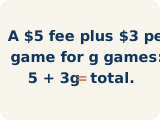
Escribir ecuaciones
Escribir ecuaciones
Use an equal sign to show two sides match.
ES Usar un signo igual para mostrar que dos lados coinciden.
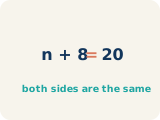
Ecuación
Ecuación
A math sentence with an equal sign.
ES Una oración matemática con un signo de igual.

Variable
Variable
A letter that stands for a number.
ES Una letra que representa un número.

Signo igual
Signo igual
The = sign. Both sides are the same.
ES El signo =. Ambos lados son iguales.

Expresión
Expresión
A math phrase. It has no equal sign.
ES Una frase matemática. No tiene signo de igual.

Constante
Constante
A number that stays the same.
ES Un número que se queda igual.
Incógnita
Incógnita
The value you want to find.
ES El valor que quieres hallar.
Solución
Solución
A value that makes the math sentence true.
ES Un valor que hace verdadera la oración matemática.

Sustituir
Sustituir
Put a number in place of a letter.
ES Poner un número en lugar de una letra.

Estimar
Estimar
An answer that is close, found without exact work.
ES Una respuesta cercana, sin hacer el cálculo exacto.
Which word fits?¿Qué palabra encaja?
🎉 Quiz done!¡Prueba terminada!
First-try stars:Estrellas al primer intento:
Tap a word on the left, then tap its matching definition on the right! ¡Toca una palabra a la izquierda y su significado a la derecha!
Pick a game and play as a team. Nothing here is timed, and every game can be replayed as many times as you like. Escojan un juego y jueguen en equipo. Nada aquí tiene cronómetro, y pueden repetir cada juego cuantas veces quieran.
Try the recommended mission. Student: explain; partner: ask one question, then switch. Paper drawings work for every object. Prueba la misión recomendada. Estudiante: explica; acompañante: haz una pregunta, luego cambien. Puedes dibujar los objetos en papel.
One mission is enough. You can also work solo and explain in writing.Una misión es suficiente. También puedes trabajar a solas y explicar por escrito.
Put 9 coins or buttons in a pile. Hide some under a cup and leave 4 showing. Let h be the number hidden. Write an equation, h + 4 = 9, then pick a value for h, substitute it, and check whether both sides are equal.
Pongan 9 monedas o botones en un montón. Esconde algunos debajo de una taza y deja 4 a la vista. Sea h la cantidad escondida. Escriban una ecuación, h + 4 = 9, luego elijan un valor para h, sustitúyanlo y comprueben si los dos lados son iguales.
Show a labeled drawing, table, or equation. Your partner asks one question; working alone, write your explanation.
Muestra un dibujo con etiquetas, una tabla o una ecuación. Tu acompañante hace una pregunta; a solas, escribe tu explicación.
Choose ONE game. Quick Quiz practices this lesson; the other games review related skills. Play together or solo, without a timer. Elige UN juego. Reto rápido practica esta lección; los demás repasan temas relacionados. Juega acompañado o a solas, sin cronómetro.
Build a chain. The left side of each domino is the match for the problem on the end of the chain. Tap the domino that fits next. Armen una cadena. El lado izquierdo de cada ficha es la pareja del problema al final de la cadena. Toquen la ficha que encaja.
A student and a grown-up share one chain. Take turns placing, and switch coach and player each time. There is no winner and no timer.Un estudiante y un adulto comparten una cadena. Colocan fichas por turnos y cambian de entrenador y jugador cada vez. No hay ganador ni cronómetro.
🎉 Chain complete! The last problem links back to the first domino: a perfect loop.¡Cadena completa! El último problema conecta con la primera ficha: un círculo perfecto.
Take turns — student answers one, then a family member answers the next. Watch for the trick statements! Por turnos: el estudiante responde una y luego un familiar responde la siguiente. ¡Cuidado con las trampas!
Tap a card, then tap the bin it belongs in. Talk it through before you tap! Toquen una tarjeta y luego el cesto al que pertenece. ¡Conversen antes de tocar!
Everyone votes and says WHY. Then tap to see what the math says — sometimes it is a tie! Todos votan y dicen POR QUÉ. Luego toquen para ver qué dicen las matemáticas: ¡a veces es empate!
🔎 What the math saysLo que dicen las matemáticas
Reinforce tonight's topic with a quick family game. You ask; your student decides! Refuercen el tema de hoy con un juego rápido en familia. ¡Ustedes preguntan; su estudiante decide!
🎮 Play together! Match words to symbols: plus → +, equals → =, unknown → letter. 🎮 ¡Jueguen juntos! Unan palabras con símbolos: más → +, es igual → =, incógnita → letra.
The bigger review game for tonight's lesson — sort, match and choose. A wrong answer gives a hint and lets your student try again. No timer. El juego de repaso más grande para la lección de hoy — clasificar, emparejar y elegir. Si se equivocan, reciben una pista y lo intentan otra vez. Sin cronómetro.
Use this as a photobooth for the work itself: point the camera at tonight's notebook page, the scratchpad or the whiteboard and take the picture — or pose holding it up. Choose a frame, add stickers, then download it, print it, or add it to your optional reflection. The photo is never uploaded; it stays on this device. Úsenla como cabina de fotos del trabajo: apunten la cámara a la página del cuaderno, al borrador o a la pizarra y tomen la foto, o posen sosteniéndola. Elijan un marco, agreguen calcomanías y luego descárguenla, imprímanla o agréguenla a la reflexión opcional. La foto nunca se sube a internet; se queda en este dispositivo.
Camera Ready!¡Cámara lista!
Tap “Start Camera” to photograph tonight’s work, or use “Upload Work” below. The photo stays on this device.Toca “Iniciar Cámara” para fotografiar el trabajo de hoy, o usa “Subir Foto”. La foto se queda en este dispositivo.
Holding your open notebook or paper up next to your smile makes the best shot! You can also snap a photo of just your written work. ¡Sostener el cuaderno abierto junto a su sonrisa crea la mejor foto! También pueden tomar la foto solo de su trabajo escrito.
What number are we trying to find? Let's pick a letter for it.
¿Qué número estamos tratando de encontrar? Elijamos una letra para él.
What does the word 'plus' tell us to write? And the word 'equals'?
¿Qué nos dice la palabra 'más' que escribamos? ¿Y la palabra 'es igual a'?
Read the clue out loud. What is each part telling us to do?
Lee la pista en voz alta. ¿Qué nos dice que hagamos cada parte?
An equation is any sentence that has numbers in it.
Una ecuación es cualquier oración que tiene números.
You don't need the equal sign.
No necesitas el signo igual.
Just guess the answer instead of writing the equation.
Solo adivina la respuesta en lugar de escribir la ecuación.
These links go to specific videos about tonight's topic — not general math pages. Estos enlaces van a videos específicos sobre el tema de hoy — no a páginas generales.
Family Math Studio
Lesson 8.16.AT.8
Understand Equations and Their Solutions
Write an equation for a situation and check whether a value is a solution.
NameDate
Tonight's spark
An escape-game clue card says: some stolen gems plus 8 more equals 20 gems. How many gems were stolen at first?
Make a guess first: is the number more than 10, or less?
Try it
Work it out on paper. Write one answer on each line.
Which of these is an equation?
My answer
In the equation n + 4 = 9, which part is the variable?
My answer
Which value is the solution of x + 3 = 9?
My answer
Sam had 12 stickers and gave away s stickers. He has 7 left. Which equation matches?
My answer
Is y = 4 a solution of 3y = 12?
My answer
Talk about it
What does the letter stand for in your equation? Which number makes both sides equal?
Home mission
Hide some coins in a cup. Put 3 more coins next to it. Say, «The cup plus 3 coins is 10 coins.» Can your student write n + 3 = 10? Then test a guess by putting it in for n.
If we get stuck, ask
Family Math Studio
Lección 8.16.AT.8
Comprender las ecuaciones y sus soluciones
Escribir una ecuación para una situación y comprobar si un valor es una solución.
NombreFecha
La chispa de hoy
La tarjeta de pista de un juego de escape dice: algunas gemas robadas más 8 más son 20 gemas. ¿Cuántas gemas robaron al principio?
Primero adivina: ¿el número es mayor que 10 o menor?
Inténtalo
Resuélvelo en papel. Escribe una respuesta en cada línea.
¿Cuál de estas es una ecuación?
Mi respuesta
En la ecuación n + 4 = 9, ¿qué parte es la variable?
Mi respuesta
¿Qué valor es la solución de x + 3 = 9?
Mi respuesta
Sam tenía 12 calcomanías y regaló s calcomanías. Le quedan 7. ¿Qué ecuación corresponde?
Mi respuesta
¿Es y = 4 una solución de 3y = 12?
Mi respuesta
Conversen
¿Qué representa la letra en su ecuación? ¿Qué número hace iguales los dos lados?
Misión en casa
Escondan algunas monedas en una taza. Pongan 3 monedas más al lado. Digan: «La taza más 3 monedas son 10 monedas». ¿Puede su estudiante escribir n + 3 = 10? Después prueben una estimación poniéndola en lugar de n.
Si se atoran, pregunten